|
|||
|
Oil, Monopoly, Imperialism (“Il petrolio, i monopoli, l’imperialismo”, Il Partito Comunista, No.357, 2013 – No.373, 2015) |
|||
|
1. Black gold rush and monopolies – 2. Oil in Russia – 3. The game spreads to Asia – 4. Concentration and monopolies – 5. Our compass: Lenin – 6. The new function of banks – 7. Finance capital – 8. Export of capital – 9. The division of the world among the great trusts – 10. The dispute between the imperial powers – 11. The place of imperialism in history – 12. The clash for Middle Eastern oil – 13. The thieves of Baghdad – 14. Trials of war between brothers – 15. Imperialism and Revolution in Russia – 16. Usury era of the Dollar – 17. A Red Line on the Middle East – 18. The dictatorship of the Seven Sisters – 19. Bees on honey – 20. Immorality or ground rent? – 21. Italy, a clay vase – 22. Mexico and Venezuela – 23. The 1929 crisis – 24. A Germany running dry – 25. Iran at the crossroads of the clash between imperialisms – 26. Japan and oil – 27. The big business of the Second War – 28. The new world order – 29. USA-USSR collaboration and containment – 30. Open door to the USA – 31. The chimera of pan-Arabism – 32. The clash for Algerian oil – 33. Overproduction and the birth of OPEC – 34. The Six Day War – 35. Gaddafi’s push – 36. The world economic crisis, 1973, the first oil shock – 37. 1979, the second shock – 38. Caspian oil – 39. In Africa – 40. In Iraq – 41. The price of crude – 42. Producers, production, consumption – 43. The reserves – 44. Only one alternative: revolution |
Today, as yesterday, a non-secondary factor in the dispute between the imperialist powers is constituted by the control of raw materials and energy sources indispensable to the functioning of the capitalist productive machine. In particular, the history of oil is full of lessons on the conflicts over the division of profits and rents, and power, between monopolies and between States.
This history can be divided into two great stages separated by the watershed of the Second World War. In the first, we witness the formation of the great oil monopolies, the relentless struggles for control of international markets, wars of colonial partition, and the search for new deposits – from Venezuela to Mexico and from ancient Persia to Indonesia.
After the Second World War, the history of oil becomes intertwined with the presence of Western imperialism in the Middle East. This area, with its cheap oil and expectations of immense profits, will become prey to all imperialisms: here, the big international oil industries, especially those based in the USA, in tow of the military interventions of the powers to which they lead, will seize the wealth of the producing countries.
The social revolts that, over the course of 2011, shook Egypt, Tunisia, Libya, and other countries subjected to the imperialist powers, brought about by the general economic crisis gripping capitalism, have found in the Middle East a fertile ground: it is here that the political, economic, and strategic interests of global finance capital are intertwined. If the shocks have so far spared countries such as Algeria and Morocco, this is due to the fact that the local bourgeoisies have either used the oil manna or resorted to massive indebtedness in order to satisfy the needs of a section of the middle class, buying themselves social peace, following the example of the bourgeoisies of the Western countries, where opportunism has, for a century and a half, been firmly rooted.
Leaving aside here the political aspects resulting from economic penetration, this struggle for the conquest of markets has become fierce following the changes in the world market since the beginning of the twentieth century and characterised by the importance acquired by the export of capital over the export of commodities, by the dominance of finance capital in the international arena and the periodic division of the world between the great States. Behind these extremely important changes, compared with the era of competitive capitalism, which Lenin will define as imperialism, one should not see a particular economic policy of aggression, but a phase of capitalism in which a monopolistic structure of society prevails.
The capitalist mode of production, born in the 16th century, at the end of feudalism, with the creation of the world market, is characterised by an intangible law: produce to produce. The necessity of accumulation drives capital to lower production costs and increase labour productivity. The initial technical division of labour, based on cooperation and manufacture, was followed by the development of machinery and a consequent change in the sources of energy used in production: until then, they were still those of the Middle Ages: water, wood, wind, animal power.
The first technical revolution took place in the middle of the 18th century, in England, with the switch to coal and the invention of the steam engine, which allowed capitalism to initiate the worldwide process of industrialisation and to develop a technique suited to its specific mode of production. As Marx writes in Capital, Watt’s genius shows itself in the fact that he presents his steam engine not as an invention for particular purposes, but as a general agent of modern industry.
At the end of the nineteenth century, two other major technical innovations, electricity, an energy easily transportable, and the internal combustion engine, would give wings to production and transport. The combustion engine and the electric motor bring about the abandonment of steam-driven engines.
Before the mass diffusion of the automobile and the domestic and productive consumption of electricity, petroleum is the only the raw material from which paraffin for lighting and heating is obtained, covering no more than 4% of world demand. Only with the First World War would its strategic importance as a source of fuel for land, naval, and aerial engines be felt. Today, with a share ten times larger, petroleum, or oil, is the world’s primary source of energy.
The story of oil in the capitalist era begins in 1859 on the banks of Oil Creek near the small town of Titusville in Pennsylvania, in the northeastern United States, when oil gushed from a well dug by the legendary Colonel Edwin L. Drake using a new drilling technique. The news spread like wildfire and brought thousands of prospectors to rush in, who saw in the black gold an alternative to whale oil or natural gas, which had become too costly for lighting. Moreover, the natives and early settlers already used it for this purpose.
Known since antiquity (Assyrians, Byzantium, etc.), but used as pitch and bitumen, crude oil was distilled for the first time. A study by Professor Silliman, a chemist at Yale University, ascertained that oil could be brought to various boiling points by fractionally distilling those carbon and hydrogen compounds: the first fraction, gasoline, would for a long time be considered a by-product; the second fraction, called paraffin, would find immediate use in lighting.
There was a race to grab land for drilling, cities, railroads, refineries, and pipelines sprang up. The Civil War, which was bloodying the United States at the time, was not only not an obstacle to the general frenzy for oil, on the contrary, it represented a stimulus for the development of business. But the new industry was subject, much more than the coal industry, to production surpluses and therefore to sudden market crashes: the price curve moved inversely to the number of wells drilled, and the ambitions of the sector’s first unscrupulous businessmen were aimed not so much at direct control of the oilfields as at that of the transport (especially rail) and sales networks.
One man, whose name has become a symbol of the animal spirit of American capitalism, the industrialist, of French-descent, John D. Rockefeller (his real name was Roquefeuille, and his father, a fervent Calvinist, was already a commercial buccaneer), was involved in the boom of the nascent oil market, the enormous economic potential of which he immediately intuited. Like many entrepreneurs of the era, Rockefeller, little more than twenty years old, had founded, together with his partner Maurice Clark, a company that operated in the Cleveland area, trading anything as long as it had a price, but especially in the meat and wheat markets. They ventured into the field of oil lamps and started a few small industries refining and distributing naphtha and paraffin along the Cleveland Railroad. Rail transport was the only way to move crude oil from the extraction sites to the large markets in the East, and the city of Cleveland was in a favourable geographical position, as well as being a very active city that had benefited greatly from the war and was now preparing to capitalise on the oil boom.
High profits from refining convinced Rockefeller to devote himself exclusively to oil. In short, he bought out his partner and embarked on an ambitious and aggressive commercial policy. In refining, several companies competed with each other, and Rockefeller aspired to the monopolistic control of the entire market. He described the context as ‘the great game’: companies were led by men who challenged each other in business as in bitter personal wars with no holds barred.
But the enthusiasm in the oil rush quickly resulted in a situation of overproduction and between 1865 and 1870 the price halved, causing economic losses to both producer-extractors and refining companies. The typical panic that follows a phase of great enthusiasm led many investors to sell at a loss. Rockefeller understood the importance of the moment, a unique opportunity to acquire competing refining industries. In 1870, using unorthodox methods of commercial warfare, a far cry from the ‘Puritan’ morality he ostentatiously claimed to follow, he unified the thousands of small Pennsylvania companies, founding the joint-stock company Standard Oil Company of New Jersey. Through the sale of shares, Rockefeller managed to obtain new liquidity and was able to buy the competing companies being sold at a loss. In early 1872, in the midst of the depression, Rockefeller had the courage to go against the trend, carrying out a series of large industrial mergers with the aim of achieving dominance in oil refining. He formed a consortium for this purpose, which took the name South Improvement Company.
It was the proximity to the railroad that provided the big break: the company secretly made deals with the railroad companies, already organised as a monopoly, to obtain freight rate reductions for the large quantities of oil to be shipped. Standard Oil quickly became the strongest refining industry in the American market, reaching to control, by the end of the 1870s, 90% of the refining capacity of the United States. At that time, almost all the oil consumed in the world was American, and of the 36 million tonnes of oil produced in American refineries, as many as 33 million tonnes came from Standard Oil’s facilities. To cross the seas, oil then travelled on sailing ships, at first in drums, then in tanks.
Standard had its own network of representatives who travelled far and wide across Europe and Asia, and its own intelligence and espionage service to discover in advance the initiatives of competing companies and governments. When necessary, markets, such as the Chinese one, were flooded with lamps at rock-bottom prices or even free of charge to induce the population to purchase lighting oil. In this way, the Company strangled its competitors.
At the beginning of the 1880s, Rockefeller had control of forty different companies which he managed through the Standard Oil Trust: the shareholders of the various companies limited themselves to granting their ‘trust’ to a board of nine members that effectively ran the holding company. In other words, it was a system whereby a ‘mother’ parent company controlled a certain number of ‘daughter’ companies through the ownership of shares. Standard held the shares in trusteeship on behalf of the small shareholders of the various companies, who merely collected the dividends. In this way it circumvented the laws that regulated free competition and no one could accuse Standard of directly owning and controlling other companies.
During this period, almost all states resorted to protectionism, an expression of international competition among capitals and of the struggle for control of the world market. The policy of free trade was set aside for agricultural products when cheaper ones appeared from overseas, then, little by little, protectionism extended also to industry. Capitalism had to defend the domestic market against the invasion of foreign commodities in order to protect the base of its monopolistic superprofits. Germany (1879), Russia (1881), Italy (1887), the USA (1890), and France (1892) resorted to protectionism. Only England, by now an exporter more of capital than of commodities, remained faithful to liberalism.
At the same time, emerging imperialisms posed as pursuing an ‘anti-monopoly’ policy, not with the aim of hindering the centralisation process initiated by national monopolies within individual states, but to oppose the penetration of foreign capital. An example is provided by the so-called US ‘Sherman Act’, a federal law of 1890 to counteract the formation of cartels, trusts, and monopolies that companies formed to avoid competition and falling sale prices. The law declared trusts and agreements tending to restrain trade and production illegal, as they were considered an ‘assault on the freedom of trade’! It was the triumph of hypocrisy: American Puritanism could not admit that free competition is in reality only a stage in the development of capitalism, a means in the hands of the strongest to eliminate the weakest! It could not confess that under capitalism monopoly is inevitable! In fact, the law placed no restrictions on companies owning shares in other companies, and this allowed a wave of mergers and an increase in concentrations. The consequence would be that the costs of this neo-mercantilist policy would be shifted onto workers, who would not be able to benefit from any price reductions.
When at the beginning of the twentieth century oil in Pennsylvania ran out, throwing the region into crisis, pioneers swarmed by the tens of thousands to the Southern States, which were soon covered with drilling towers. Important discoveries were made there in Kansas, Texas, Louisiana, but especially in California. This state, with 73 million barrels (22% of world production), will become the largest US producer. With the discovery of the new deposits, new Companies were born: in California the main one was Unocal, the only large Company that had managed to escape the deadly embrace of Standard Oil; in Texas in 1901 Gulf Oil was founded and in 1902 the Texas Company (the future Texaco), which, thanks to the support of Texan politicians, acquired many concessions and would assume a leading role in research and production.
In 1910, the Rockefeller family’s Standard Oil reigned over a vast empire: it brought 84% of US crude oil to market and refined 35,000 barrels of oil per day; it distributed 80% of domestic paraffin production; it had the monopoly on supplying lubricating oil to the railroads; it owned more than half of the tank cars travelling in America; it had a fleet of one hundred ships, almost all of them steam-powered; it owned several banks and 150,000 kilometres of pipelines.
The press began to beat the drum of aggrieved ‘free competition’ accusing the monopolies of controlling the government through bribery and exchanging favours. The anti-trust laws were dusted off with the creation of a Special Control Section, which in 1906 filed a large number of cases against Standard based on the Sherman Act. In 1911, after seven years of investigations, appeals, and postponements, the Supreme Court of Justice ruled that within six months Standard was obliged to separate itself from the other companies it controlled. Riding the emotional wave of the ruling, Congress passed a new anti-trust law.
But this time, too, the consequence was a strengthening of monopolistic enterprises. It took Rockefeller and partners just two months to parry the blow. The empire was fragmented into several companies managed by front men: the first and most important, with almost half of the total turnover, was the former Standard Oil of New Jersey, which was called Exxon, destined to become the very emblem of American oil power; the second, with 10% of the total asset value, was Standard Oil of New York (the future Mobil). To these were added Standard Oil of California (the future Socal), Standard Oil of Indiana (which would take the name Amoco), Continental Oil (which would be called Conoco), Standard Oil of Ohio, etc. In the end, the new companies, although they had autonomous boards of directors, maintained their respective markets and trademarks; indeed, the fragmentation of the old holding company prompted the individual companies to modernise their management and become more aggressive in the markets.
Rockefeller boosted his policy of global expansion and aimed first and foremost at South America (Mexico, Venezuela) using all lawful and unlawful means against private landowners and governments to get his hands on lands smelling of oil. John D. Rockefeller would live happily to the age of 98, master of an empire branched out into all sectors, from banking to politics, a proud symbol of the fortune built by an obscure accountant, and of which the imposing Rockefeller Center in Manhattan, New York represents the visible power and the vivid lesson of how free competition leads to... monopoly!
The development of electricity dealt a fatal blow to the lighting oil market. But if one market closed, another opened. By 1907, Rockefeller’s empire had been saved by the burgeoning empire of the industrialist Henry Ford, from whose factories the first mass-produced automobiles were beginning to emerge: Standard Oil turned to petrol, or gasoline. The first cars were intended not for the city but for large-scale agricultural production as a replacement for animal traction (farm machinery was still powered by teams of even 40-50 horses!) and the furrows of the fields were plowed by the first petrol tractors bearing the Ford brand.
Just as electricity would prove perfect for lighting, so too would oil find its outlet in the automotive sector, whose boom was phenomenal: in the USA, registrations rose from 8,000 in 1900 to 900,000 in 1910. The same development occurred in the most advanced countries of Europe: in 1914, 700,000 motor vehicles would be circulating in France. The advent of the internal combustion engine made petrol the main product of refinery production, together with diesel, which was beginning to find use in boilers, trucks, trains, and ships. At the dawn of the 20th century, with the worldwide development of industry and capitalism, the race for the new energy source, which would prove to be not only much cheaper than coal but also more efficient and better suited to the needs of modern industry, would soon turn into an merciless race among the major imperialisms.
In Russia, oil refining had started as early as 1820 in Baku, in Russian Azerbaijan, where the existence of wells was known since at least the 17th century, but the industry was primitive, the wells dug by hand and production low. Intensive exploitation of the fields did not begin until the 1870s, when the Russian government opened the door to private initiative. The concessions auctioned off by the Tsar initially ended up in the hands of wealthy Tatar and Armenian businessmen, who quickly became rich and squandered their profits on palaces and banquets. The working conditions of the Tatar and Georgian workers, whether serfs or free labourers (one of Stalin’s uncles was among them), were appalling: treated like beasts, prey to alcohol, they were savagely repressed by the Cossacks every time they tried to rebel against their miserable conditions.
From 1873 onwards, the first impulse to Russian oil industry was given by the Nobels, Swedes who had emigrated to St. Petersburg and boasted connections with tsarism. They owned huge concessions and numerous refineries connected to the railway by pipelines: oil was transported across Russia to Riga, on the Baltic, and from there to Sweden. Also operating in Baku were the Rothschild brothers, French bankers and major exporters of capital to Russia. In 1886 they had purchased oilfields and founded the Caspian and Black Sea Petroleum Company for the distribution of Russian kerosene. In 1893, their capital was used to finance the construction of a railway connecting Baku to the port of Batum on the Black Sea. Batum was then one of the most important ports in the world (here the young communist Stalin and other Bolshevik leaders would cut their teeth). Crude oil, by means of tankers, was transported from Batum to the port of Trieste, where the Rothschilds owned a refinery. The Nobels also joined the operation in exchange for shares in their company being sold to the Rothschilds. By 1888, the Nobel and Rothschild companies, which constituted a true Russian oil front, had an output equal to 80% of that of the American giant Standard Oil. Soon, Russia would begin exporting its oil to Europe, putting American dominance at risk.
Growing world production would always require new outlet markets, and would force the new oil giants into a permanent economic war. And Europe would very soon become too narrow a hunting ground. In 1891, the Rothschilds, in order to circumvent Rockefeller’s overwhelming power, teamed up with the English merchants Sam and Marcus Samuel who practised import-export in Asia and were specialised in the trade of exotic products and shells (Shell) which were used to cover small boxes, then very fashionable in Victorian England. In Asia, the two Samuel brothers had warehouses at strategic points and an established trading network.
Having become general agent of Bnito, the Rothschild oil consortium in Russia, Marcus began transporting Russian oil destined for Asia with his cargo ships. With a very aggressive commercial policy, the Samuels secretly set about the construction of a fleet of nine oil tankers to meet the requirements of the British Suez Canal officials: in 1892 the first tanker named after a seashell, the Murex, sailed through the canal to the Far East. The new route shortened the course enormously and increased the competitive advantage over Standard.
The success of the project exposed Standard’s backwardness in the transport system to Asia, with oil still travelling in barrels. But the price war unleashed by Rockefeller across the entire world, if it caused the bankruptcy of hundreds of small producers, did not manage to dent the Samuel’s control over Russian oil, strong in tankers and a proven network of trading strongholds. On the contrary, they expanded their empire: in 1897, after obtaining a concession in Borneo, they founded the Shell Transport and Trading Company. At the beginning of the twentieth century, after the new Texan oilfield of Spindletop had become known in London, Marcus even landed in America. Shell, on the one hand, wanted to free itself from dependence on Russian oil, on the other, to get its hands on Texan crude, which, though poor for lighting, was suitable for producing naphtha for ships. Samuel signed a contract with Gulf whereby he committed himself for the duration of twenty years to take at a fixed price 100,000 tonnes of oil per year, half of the entire production.
Marcus Samuel was not the first to have set his eyes on Indonesia. Another, smaller, company founded in Rotterdam in 1885 by August Kessler, the Royal Dutch, had discovered oil deposits on the island of Sumatra in Dutch Indonesia and had built there a pipeline and a refinery to sell oil under the Crow Oil brand name to Asian markets. The Company was under the protective wing of the King of the Netherlands himself, William III, who had granted the use of the title ‘Royal’ in the company name and forbade the docking of the Samuels’ ships in the ports of the Dutch Indies.
This company, which controlled the world’s third largest oil hub, attracted the interest of Standard Oil, which badly needed a source of oil closer to the Asian market. But the American proposal to quadruple the capital of Royal Dutch, on the condition of holding its additional shares and therefore control, was not accepted by the Dutch executives, evidently not unaware of the methods used by Rockefeller to seize rival companies. At this point, Rockefeller’s men, increasingly determined to neutralise the troublesome intruder, attempted an agreement with Marcus Samuel. But the latter preferred to reach an agreement with Royal Dutch, in order to put an end to his ruinous trade war with this company on the Asian markets as well.
But he had miscalculated, because in the end the game was played on the terms of Henry Deterding, a young and brilliant accountant from Singapore chosen by Kessler as an expert on the world of oil and who in 1900, at only twenty-nine years of age, had been appointed director of the Dutch Company, and who was to go down in history as the architect of Shell’s ruin. Deterding had the audacity and decisiveness that Sir Marcus Samuel now lacked, who, having become an oil baronet and mayor of London, was now at the peak of his career, distracted from business by worldly engagements and the life of a country gentleman. Deterding, on the other hand, controlling reserves of enormous value in the East Indies, was able to pay dividends of 50% against just the 5% paid by Shell. Moreover, he had succeeded in combining the other major producers into a consortium, in a new concentration led by his Company, true to Kessler’s motto: cooperation makes strength.
What is more, the Spindletop field dried up and Gulf could not honour the contract, therefore Sir Marcus found himself facing a dangerous shortage of oil supply and had to convert the Shell tankers into cargo ships for livestock. When in 1907 the two companies merged, giving rise to the Royal Dutch-Shell holding company, with Deterding becoming managing director, the shares of the subsidiaries went 60% to Royal Dutch and 40% to Marcus’s old Shell. The operation would make Shell the main competitor of the American Standard Oil and, for a quarter of a century, would make Deterding the most powerful oilman in the world, who, from his office in the City of London, exercised his undisputed authority over all the Company’s affairs.
In 1911, in response to Standard, which had created its own subsidiary in Holland in order to obtain concessions in Sumatra, Royal Dutch-Shell carried the war into the very heart of America. The objective was to undermine the competitive advantage the Americans enjoyed, who, thanks to the high prices (and high profits) charged in the United States, could afford to sell at reduced prices in Europe, practising that form of active protectionism known as dumping. The Anglo-Dutch Company first landed on the West Coast by inserting itself into California’s production, then moved inland to exploit the oil boom in Oklahoma. The emblem of Shell – the ‘yellow peril’, as it was called – began to invade the streets of America.
On the other hand, Shell had always been forced to look for oil abroad: it owned oilfields in Egypt, in the Urals region, in Mexico, in Venezuela. Shell was to become the leading producer of the oil industry in Romania thanks to the deposits discovered in the Carpathians, supplanting the German imperialism of Deutsche Bank. Deterding’s project to form the first multinational oil company together with Deutsche Bank and the Rothschild family was torpedoed by Rockefeller through a fierce press campaign and the usual price war. In light of subsequent events, Deterding’s decision not to depend too much on Russian oil would prove far-sighted, not only because the Baku oil industry would continue to decline up to the First World War (also as a result of the 1905 revolution, which had put nearly two thirds of the oil installations out of operation), but above all because the nationalisation of the installations decreed by the Bolsheviks in 1918 would cause Shell to lose a large portion of its supplies.
At the turn of the century, most oil production came from three regions: the United States, Russia, and Indonesia. Strangely enough, the Middle East, where naphtha was known since the earliest antiquity, would only come to oil very late, long after the United States and Russia, but even after Romania and Mexico. In exchange, the area would become the favoured battlefield of the imperialisms. After the discovery of large Iraqi deposits in the 1920s and of Saudi and Kuwaiti deposits in the 1930s, the history of oil and the struggles between oil companies would no longer be distinguishable from the global history for world domination.
In 1916, taking into account tsarist censorship, Lenin wrote the seminal essay Imperialism, the Highest Stage of Capitalism. This book, a constant beacon of reference, shows us how to avoid the dangerous rocks of Kautskyism, democratism, and petty-bourgeois pacifism, which, today as then, attempt to conceal the depth of capitalism’s contradictions and the inevitability of the revolutionary crisis that arises from them.
Monopoly capital does not eliminate the competitive struggle between the great powers, which unfolds in a Sisyphean labour made up of diplomatic manoeuvres, economic and financial blackmail, and finally local and global wars. Marx states:
‘Conceptually, competition is nothing other than the inner nature of capital, its essential character, appearing in and realised as the reciprocal interaction of many capitals with one another, the inner tendency as external necessity (...) A universal capital, one without alien capitals confronting it, with which it exchanges (...) is therefore a non-thing’ (Grundrisse).
If the economic roots of the phenomenon ‘imperialism’ are not clarified, if its political and social importance is not assessed, neither today’s crisis nor the causes of war and the future social revolution can be understood.
Lenin describes the process that inevitably evolves from free competition towards monopoly. He precisely explains how free competition, which today is so wrongly invoked by reformists and petty bourgeois from all sides against the ‘criminal’ power of monopolies, represents the sure road that leads to monopoly and is the most suitable instrument for strengthening already existing monopolies. The process of concentration and centralisation of production and capital is not a pathology but a necessity immanent to the capitalist mode of production, and it finds its raison d’être in its normal functioning, which requires economies of scale and an increase in the minimum size of investment.
Marx had already observed in Capital that
‘A drop in the rate of profit is attended by a rise in the minimum capital required by an individual capitalist for the productive employment of labour (...) Concentration increases simultaneously, because beyond certain limits a large capital with a small rate of profit accumulates faster than a small capital with a large rate of profit’.
Dialectically, monopoly creates the bases of communist society because it represents enormous progress in the socialisation of production and technical innovation. The development of the productive force of social labour is the historical task of capital, which precisely through this development unwittingly creates the material conditions for a higher form of production. But, under the capitalist system, social production is increasingly countered by private appropriation based on capital, wage labour, and exchange value.
These property relations are desperately defended by hosts of parasites in order to keep working humanity under their intolerable yoke. The destruction of these relations is the historical mission of the proletariat.
Lenin writes in Imperialism:
‘The enormous growth of industry and the remarkably rapid concentration of production in ever-larger enterprises are one of the most characteristic features of capitalism (...)
‘Monopolist capitalist associations, cartels, syndicates and trusts first divided the home market among themselves and obtained more or less complete possession of the industry of their own country. But under capitalism the home market is inevitably bound up with the foreign market. Capitalism long ago created a world market. As the export of capital increased, and as the foreign and colonial connections and “spheres of influence” of the big monopolist associations expanded in all ways, things “naturally” gravitated towards an international agreement among these associations, and towards the formation of international cartels (...)
‘Thus, the principal stages in the history of monopolies are the following: (1) 1860-70, the highest stage, the apex of development of free competition; monopoly is in the barely discernible, embryonic stage. (2) After the crisis of 1873, a lengthy period of development of cartels; but they are still the exception. They are not yet durable. They are still a transitory phenomenon. (3) The boom at the end of the nineteenth century and the crisis of 1900-03. Cartels become one of the foundations of the whole of economic life. Capitalism has been transformed into imperialism. Cartels come to an agreement on the terms of sale, dates of payment, etc. They divide the markets among themselves. They fix the quantity of goods to be produced. They fix prices. They divide the profits among the various enterprises, etc. ‘The number of cartels in Germany was estimated at about 250 in 1896 and at 385 in 1905, with about 12,000 firms participating. But it is generally recognised that these figures are underestimations. From the statistics of German industry for 1907 we quoted above, it is evident that even these 12,000 very big enterprises probably consume more than half the steam and electric power used in the country. In the United States of America, the number of trusts in 1900 was estimated at 185 and in 1907, 250. American statistics divide all industrial enterprises into those belonging to individuals, to private firms or to corporations. The latter in 1904 comprised 23.6 per cent, and in 1909, 25.9 per cent, i.e., more than one-fourth of the total industrial enterprises in the country. These employed in 1904, 70.6 per cent, and in 1909, 75.6 per cent, i.e., more than three-fourths of the total wage-earners. Their output at these two dates was valued at $10,900,000,000 and $16,300,000,000, i.e., 73.7 per cent and 79.0 per cent of the total, respectively. ‘At times cartels and trusts concentrate in their hands seven- or eight-tenths of the total output of a given branch of industry. The Rhine-Westphalian Coal Syndicate, at its foundation in 1893, concentrated 86.7 per cent of the total coal output of the area, and in 1910 it already concentrated 95.4 per cent. The monopoly so created assures enormous profits, and leads to the formation of technical production units of formidable magnitude. ‘The famous Standard Oil Company in the United States was founded in 1900: “It has an authorised capital of $150,000,000. It issued $100,000,000 common and $106,000,000 preferred stock. From 1900 to 1907 the following dividends were paid on the latter: 48, 48, 45, 44, 36, 40, 40, 40 per cent in the respective years, i.e., in all, $367,000,000. From 1882 to 1907, out of total net profits amounting to $889,000,000, $606,000,000 were distributed in dividends, and the rest went to reserve capital”. “In 1907 the various works of the United States Steel Corporation employed no less than 210,180 people”.
‘Competition becomes transformed into monopoly. The result is immense progress in the socialisation of production. In particular, the process of technical invention and improvement becomes socialised. This is something quite different from the old free competition between manufacturers, scattered and out of touch with one another, and producing for an unknown market. Concentration has reached the point at which it is possible to make an approximate estimate of all sources of raw materials (for example, the iron ore deposits) of a country and even, as we shall see, of several countries, or of the whole world. Not only are such estimates made, but these sources are captured by gigantic monopolist associations. An approximate estimate of the capacity of markets is also made, and the associations “divide” them up amongst themselves by agreement. Skilled labour is monopolised, the best engineers are engaged; the means of transport are captured – railways in America, shipping companies in Europe and America. Capitalism in its imperialist stage leads directly to the most comprehensive socialisation of production; it, so to speak, drags the capitalists, against their will and consciousness, into some sort of a new social order, a transitional one from complete free competition to complete socialisation. ‘Production becomes social, but appropriation remains private. The social means of production remain the private property of a few. The general framework of formally recognised free competition remains, and the yoke of a few monopolists on the rest of the population becomes a hundred times heavier, more burdensome and intolerable (...)
‘It is instructive to glance at least at the list of the methods the monopolist associations resort to in the present-day, the latest, the civilised struggle for “organisation”: (1) stopping supplies of raw materials (...) (“one of the most important methods of compelling adherence to the cartel”); (2) stopping the supply of labour by means of “alliances” (i.e., of agreements between the capitalists and the trade unions by which the latter permit their members to work only in cartelised enterprises); (3) stopping deliveries; (4) closing trade outlets; (5) agreements with the buyers, by which the latter undertake to trade only with the cartels; (6) systematic price cutting (to ruin “outside” firms, i.e., those which refuse to submit to the monopolists. Millions are spent in order to sell goods for a certain time below their cost price; there were instances when the price of petrol was thus reduced from 40 to 22 marks, i.e., almost by half!); (7) stopping credits; (8) boycott. Here we no longer have competition between small and large, between technically developed and backward enterprises. We see here the monopolists throttling those who do not submit to them, to their yoke, to their dictation’.
Lenin then addresses the new role assumed by banks after the great concentration processes as well as the importance that the raising of capital holds for industrial monopolies. At the basis of the production process there is the need for initial capital, and it becomes an economic necessity to a get hold of a large capital. An essential instrument in this field are joint-stock companies. But the hunger for capital for the purposes of accumulation cannot be satisfied by recourse to this instrument alone: it is necessary to have control over the masses of floating capital not stably invested as well as over the savings that are formed among consumers. Hence the need for those particular institutions called banks. The bank must concentrate monetary wealth on the market and transform the surplus value circulating in the form of money back into capital. The centralisation of money-capital is closely linked to the concentration process of industrial capital.
In the imperialist phase, even more than in the competitive phase, capital becomes indifferent to what is produced. The goal of those who hold the ‘controlling stake’ is to obtain the maximum profit, not necessarily by investing in the main productive enterprise if a greater profit can be obtained by moving investments to other sectors. The bank ceases to be a mere credit intermediary, an apparatus of intermediation in the circulation of commodities, in order to become a creator of credit and money, dominating productive life and the industrial world itself. Banks become the operational centres where the most significant investments and the most unscrupulous speculations are made, aimed at the circulation of capital and its accumulation based on the growth of agricultural and industrial production worldwide.
The fusion of productive capital and bank capital has been imposed, i.e. that particular type of capital known as finance capital has prevailed, overcoming the antithesis between the two fractions of capital into a higher unity. Not only because each bank is closely linked to certain monopolistic sectors, not only because the domination of enterprises is exercised through financial institutions (Investment Trusts, Holding Companies, etc.), but because it determines a specific direction in all fields of production and society.
In the early years of the twentieth century, the model of the so-called ‘mixed bank’ triumphed, especially in Germany, which, in addition to the functions of collecting savings and providing short-term commercial credit, carried out the function of long-term credit to industry and acted as an investment bank by taking equity stakes in companies. In this way, banks did not limit themselves to financing companies, but sat on the boards of directors and directed their management. In the United States too, the result was essentially the same: bankers took the lead in purchasing shares and thereby achieved a predominant position in the structure of companies. To give an idea, just consider the fact that the Morgan bank controlled one third of American railroads, at a time when railroads held 60% of all shares on the New York Stock Exchange, 70% of the steel sector, and the three main insurance companies. In 1907, when the Federal Reserve did not yet exist, Morgan saved Wall Street from collapse by performing central bank functions.
The mixed-bank model would endure until the 1929 crisis and the ensuing Glass-Steagall Act of 1933, a law which would separate commercial banks from industrial investment banks; but it would return to dominance at the end of the last century, when the regulatory constraints erected against the mixed bank would fall: in 1999 the Glass-Steagall Act was officially repealed.
Let Lenin speak:
‘[T]he concentration of capital and the growth of bank turnover are radically changing the significance of the banks. Scattered capitalists are transformed into a single collective capitalist. When carrying the current accounts of a few capitalists, a bank, as it were, transacts a purely technical and exclusively auxiliary operation. When, however, this operation grows to enormous dimensions we find that a handful of monopolists subordinate to their will all the operations, both commercial and industrial, of the whole of capitalist society; for they are enabled by means of their banking connections, their current accounts and other financial operations – first, to ascertain exactly the financial position of the various capitalists, then to control them, to influence them by restricting or enlarging, facilitating or hindering credits, and finally to entirely determine their fate, determine their income, deprive them of capital, or permit them to increase their capital rapidly and to enormous dimensions, etc. (...)
‘Among the few banks which remain at the head of all capitalist economy as a result of the process of concentration, there is naturally to be observed an increasingly marked tendency towards monopolist agreements, towards a bank trust. In America, not nine, but two very big banks, those of the multimillionaires Rockefeller and Morgan, control a capital of eleven thousand million marks’.
Lenin continues:
‘As regards the close connection between the banks and industry, it is precisely in this sphere that the new role of the banks is, perhaps, most strikingly felt. When a bank discounts a bill for a firm, opens a current account for it, etc., these operations, taken separately, do not in the least diminish its independence, and the bank plays no other part than that of a modest middleman. But when such operations are multiplied and become an established practice, when the bank “collects” in its own hands enormous amounts of capital, when the running of a current account for a given firm enables the bank – and this is what happens – to obtain fuller and more detailed information about the economic position of its client, the result is that the industrial capitalist becomes more completely dependent on the bank. ‘At the same time a personal link-up, so to speak, is established between the banks and the biggest industrial and commercial enterprises, the merging of one with another through the acquisition of shares, through the appointment of bank directors to the Supervisory Boards (or Boards of Directors) of industrial and commercial enterprises, and vice versa’.
There is a clear link between the process of concentration and centralisation of capital, namely, the formation of monopolies, and their growing dependence on the world of finance. Financial resources exceeding those available within the firm for accumulation are provided by the international capital market, on the condition that profits commensurate with the capital invested result from industrial policies. It is easy to see how, in this way, control of business plans and strategies shifts from corporate decision-makers to the famous ‘markets’. Lenin states that imperialism is the domination of finance capital over all other forms of capital:
‘It is characteristic of capitalism in general that the ownership of capital is separated from the application of capital to production, that money capital is separated from industrial or productive capital, and that the rentier who lives entirely on income obtained from money capital, is separated from the entrepreneur and from all who are directly concerned in the management of capital. Imperialism, or the domination of finance capital, is that highest stage of capitalism in which this separation reaches vast proportions. The supremacy of finance capital over all other forms of capital means the predominance of the rentier and of the financial oligarchy; it means that a small number of financially “powerful” states stand out among all the rest. ‘The extent to which this process is going on may be judged from the statistics on emissions, i.e., the issue of all kinds of securities (...) From these figures we at once see standing out in sharp relief four of the richest capitalist countries, each of which holds securities to amounts ranging approximately from 100,000 to 150,000 million francs. Of these four countries, two, Britain and France, are the oldest capitalist countries, and, as we shall see, possess the most colonies; the other two, the United States and Germany, are capitalist countries leading in the rapidity of development and the degree of extension of capitalist monopolies in industry. Together, these four countries own 479,000 million francs, that is, nearly 80 per cent of the world’s finance capital. In one way or another, nearly the whole of the rest of the world is more or less the debtor to and tributary of these international banker countries, these four “pillars” of world finance capital’.
Lenin explains how, at the beginning of the 20th century, the export of capital reached spectacular peaks, especially in the three main countries: England, which in 1910 allocated half of its capital to American industrial enterprises and the other half to its overseas colonies; France, whose state loans were directed mainly to Russia: a typical case of usurer’s capitalism; Germany which, being poor in colonies, divided its capital equally between America and Europe.
In the preceding era of competitive capitalism, every enterprise was driven to produce as cheaply as possible and sell as many commodities as possible, that is, to expand the market because the export of commodities had absolute economic pre-eminence; given the low organic composition of capital, profit rates did not differ much.
But competition leads to an increase in the organic composition, a decrease in the rate of profit, and an increase in the gap between profits in different countries, i.e. between capitalistically advanced and backward countries. In the former, at a certain point, the rate of profit decreases to the point of making investment fall and causing stagnation. The struggle for competition intensifies, and for each capital it becomes a matter of life and death to expand markets at the expense of others, either as an outlet for production or as a source of raw materials.
The monopolistic bourgeoisie, having at its disposal a plethora of capital seeking new fields of investment, is no longer hungry for new capital, it is hungry for superprofits. It no longer has the monopoly of productivity which assures to it the ‘peaceful’ conquest of world markets, but must reckon with competitors who produce under identical if not higher conditions of productivity: the struggle for world domination by the major capitalist countries begins. But dominating means investing capital, taking possession of mines and exploiting them, creating banks, stimulating the birth of new industries. This is driven both by the difference in the rate of profit, higher in backward countries, which have low wages and low organic composition, and also for reasons of domination. The export of capital acquires a central role and occurs in various forms: loans made by private individuals or public bodies, direct supply of capital goods with deferred payment, transfer of entire enterprises or parts of them with the granting of patents, participation in local enterprises, etc.
The necessity of the export of capital is determined by the fact that in some countries with a capitalism more than mature, valorisation encounters even greater difficulties. Uninvested capital thus procures for itself a series of outflow channels: abroad, through the export of capital, at home, through stock market speculation. International financial flows become an ever larger multiple of commercial flows: in 1998, daily financial transactions were around two trillion dollars, of which only a hundredth related to commodity trade.
Back to Lenin:
‘Typical of the old capitalism, when free competition held undivided sway, was the export of commodities. Typical of the latest stage of capitalism, when monopolies rule, is the export of capital (...) On the threshold of the twentieth century we see the formation of a new type of monopoly: firstly, monopolist associations of capitalists in all capitalistically developed countries; secondly, the monopolist position of a few very rich countries, in which the accumulation of capital has reached gigantic proportions. An enormous “surplus of capital” has arisen in the advanced countries (...)
‘As long as capitalism remains what it is, surplus capital will be utilised not for the purpose of raising the standard of living of the masses in a given country, for this would mean a decline in profits for the capitalists, but for the purpose of increasing profits by exporting capital abroad to the backward countries. In these backward countries profits are usually high, for capital is scarce, the price of land is relatively low, wages are low, raw materials are cheap. The export of capital is made possible by a number of backward countries having already been drawn into world capitalist intercourse; main railways have either been or are being built in those countries, elementary conditions for industrial development have been created, etc. The need to export capital arises from the fact that in a few countries capitalism has become “overripe” and (owing to the backward state of agriculture and the poverty of the masses) capital cannot find a field for “profitable” investment’.
Evidently, these exports of capital abroad always take place to the benefit of the lender:
‘In these international transactions the creditor nearly always manages to secure some extra benefit: a favourable clause in a commercial treaty, a coating station, a contract to construct a harbour, a fat concession, or an order for guns (...) The most usual thing is to stipulate that part of the loan granted shall be spent on purchases in the creditor country, particularly on orders for war materials, or for ships, etc.’.
The German Deutsche Bank, in return for the loans granted to Turkey, obtained the exclusive right to build the Berlin-Baghdad railway line, as well as important oil concessions. And Lenin concludes:
‘The capital-exporting countries have divided the world among themselves in the figurative sense of the term. But finance capital has led to the actual division of the world’.
The division of the world by a few big trusts had its prototype, at the beginning of the 20th century, in the electrical industry, where the process of concentration was so rapid that it soon led to the formation of two enormous consortia, one American and the other German. Lenin writes:
‘The electrical industry is highly typical of the latest technical achievements and is most typical of capitalism at the end of the nineteenth and the beginning of the twentieth centuries. This industry has developed most in the two leaders of the new capitalist countries, the United States and Germany. In Germany, the crisis of 1900 gave a particularly strong impetus to its concentration. During the crisis, the banks, which by that time had become fairly well merged with industry, enormously accelerated and intensified the ruin of relatively small firms and their absorption by the large ones. “The banks”, writes Jeidels, “refused a helping hand to the very firms in greatest need of capital, and brought on first a frenzied boom and then the hopeless failure of the companies which had not been connected with them closely enough” (...) But of course the division of the world between two powerful trusts does not exclude the possibility of a new division, as soon as the ratio of forces changes as a result of inequality in development, wars, crackdowns, etc. ‘An instructive example of an attempt at such a redivision, of the struggle for redivision, is provided by the oil industry. “The world oil market”, wrote Jeidels in 1905, “is even today still divided between two great financial groups – Rockefeller’s American Standard Oil Co., and Rothschild and Nobel, the controlling interests of the Russian oilfields in Baku. The two groups are closely connected. But for several years five enemies have been threatening their monopoly”: (1) the exhaustion of the American oilfields; (2) the competition of the firm of Mantashev of Baku; (3) the Austrian oilfields; (4) the Rumanian oilfields; (5) the overseas oilfields, particularly in the Dutch colonies (the extremely rich firms, Samuel and Shell, also connected with British capital). The three last groups are connected with the big German banks, headed by the huge Deutsche Bank. These banks independently and systematically developed the oil industry in Rumania, for example, in order to have a foothold of their “own”. In 1907, the foreign capital invested in the Rumanian oil industry was estimated at 185 million francs, of which 74 million was German capital. ‘A struggle began for the “division of the world”, as, in fact, it is called in economic literature. On the one hand, the Rockefeller “oil trust” wanted to lay its hands on everything; it formed a “daughter company” right in Holland, and bought up oilfields in the Dutch Indies, in order to strike at its principal enemy, the Anglo-Dutch Shell trust. On the other hand, the Deutsche Bank and the other German banks aimed at “retaining” Romania “for themselves” and at uniting her with Russia against Rockefeller. The latter possessed far more capital and an excellent system of oil transportation and distribution. The struggle had to end, and did end in 1907, with the utter defeat of the Deutsche Bank, which was confronted with the alternative: either to liquidate its “oil interests” and lose millions, or submit. It chose to submit, and concluded a very disadvantageous agreement with the “oil trust”. The Deutsche Bank agreed “not to attempt anything which might injure American interests”. Provision was made, however, for the annulment of the agreement in the event of Germany establishing a state oil monopoly. ‘Then the “comedy of oil” began. One of the German finance kings, von Gwinner, a director of the Deutsche Bank, through his private secretary, Stauss, launched a campaign for a state oil monopoly. The gigantic machine of the huge German bank and all its wide “connections” were set in motion. The press bubbled over with “patriotic” indignation against the “yoke” of the American trust, and, on March 15, 1911, the Reichstag, by an almost unanimous vote, adopted a motion asking the government to introduce a bill for the establishment of an oil monopoly. The government seized upon this “popular” idea, and the game of the Deutsche Bank, which hoped to cheat its American counterpart and improve its business by a state monopoly, appeared to have been won. The German oil magnates already saw visions of enormous profits, which would not be less than those of the Russian sugar refiners (...) But, firstly, the big German banks quarrelled among themselves over the division of the spoils. The Disconto-Gesellschaft exposed the covetous aims of the Deutsche Bank; secondly, the government took fright at the prospect of a struggle with Rockefeller, for it was very doubtful whether Germany could be sure of obtaining oil from other sources (the Romanian output was small); thirdly, just at that time the 1913 credits of a thousand million marks were voted for Germany’s war preparations. The oil monopoly project was postponed. The Rockefeller “oil trust” came out of the struggle, for the time being, victorious. ‘The Berlin review, Die Bank, wrote in this connection that Germany could fight the oil trust only by establishing an electricity monopoly and by converting water-power into cheap electricity. “But”, the author added, “the electricity monopoly will come when the producers need it, that is to say, when the next great crash in the electrical industry is imminent, and when the gigantic, expensive power stations now being put up at great cost everywhere by private electrical concerns, which are already obtaining certain franchises from towns, from states, etc., can no longer work at a profit. Water-power will then have to be used. But it will be impossible to convert it into cheap electricity at state expense; it will also have to be handed over to a ‘private monopoly controlled by the state’, because private industry has already concluded a number of contracts and has stipulated for heavy compensation (...) So it was with the nitrate monopoly, so it is with the oil monopoly, so it will be with the electric power monopoly. It is time our state socialists, who allow themselves to be blinded by a beautiful principle, understood, at last, that in Germany the monopolies have never pursued the aim, nor have they had the result, of benefiting the consumer, or even of handing over to the state part of the promoter’s profits; they have served only to facilitate, at the expense of the state, the recovery of private industries which were on the verge of bankruptcy”. ‘Such are the valuable admissions which the German bourgeois economists are forced to make. We see plainly here how private and state monopolies are interwoven in the epoch of finance capital; how both are but separate links in the imperialist struggle between the big monopolists for the division of the world (...) The epoch of the latest stage of capitalism shows us that certain relations between capitalist associations grow up, based on the economic division of the world; while parallel to and in connection with it, certain relations grow up between political alliances, between states, on the basis of the territorial division of the world, of the struggle for colonies, of the “struggle for spheres of influence”’.
But the division of the world among the capitalist monopolies, above all the financial monopolies, is closely linked to the antagonisms among the powers. The central motive of the foreign policy of capitalist countries, from the 1880s onwards, is the conquest of foreign territories, closing them off from foreign competition, as markets for finished products, sources of raw materials, and cheap labour, or fields for capital investment to be exported. Lenin continues:
‘For Great Britain, the period of the enormous expansion of colonial conquests was that between 1860 and 1880, and it was also very considerable in the last twenty years of the nineteenth century. For France and Germany this period falls precisely in these twenty years. We saw above that the development of pre-monopoly capitalism, of capitalism in which free competition was predominant, reached its limit in the 1860s and 1870s. We now see that it is precisely after that period that the tremendous “boom” in colonial conquests begins, and that the struggle for the territorial division of the world becomes extraordinarily sharp. It is beyond doubt, therefore, that capitalism’s transition to the stage of monopoly capitalism, to finance capital, is connected with the intensification of the struggle for the partitioning of the world (...)
‘We clearly see from these figures how “complete” was the partition of the world at the turn of the twentieth century. After 1876 colonial possessions increased to enormous dimensions, by more than fifty per cent, from 40,000,000 to 65,000,000 square kilometres for the six biggest powers; the increase amounts to 25,000,000 square kilometres, fifty per cent more than the area of the metropolitan countries (16,500,000 square kilometres). In 1876 three powers had no colonies, and a fourth, France, had scarcely any. By 1914 these four powers had acquired colonies with an area of 14,100,000 square kilometres, i.e., about half as much again as the area of Europe, with a population of nearly 100,000,000 (...)
‘The principal feature of the latest stage of capitalism is the domination of monopolist associations of big employers. These monopolies are most firmly established when all the sources of raw materials are captured by one group, and we have seen with what zeal the international capitalist associations exert every effort to deprive their rivals of all opportunity of competing, to buy up, for example, ironfields, oilfields, etc. Colonial possession alone gives the monopolies complete guarantee against all contingencies in the struggle against competitors, including the case of the adversary wanting to be protected by a law establishing a state monopoly. The more capitalism is developed, the more strongly the shortage of raw materials is felt, the more intense the competition and the hunt for sources of raw materials throughout the whole world, the more desperate the struggle for the acquisition of colonies (...)
‘Finance capital is interested not only in the already discovered sources of raw materials but also in potential sources, because present-day technical development is extremely rapid, and land which is useless today may be improved tomorrow if new methods are devised (to this end a big bank can equip a special expedition of engineers, agricultural experts, etc.), and if large amounts of capital are invested. This also applies to prospecting for minerals, to new methods of processing up and utilising raw materials, etc., etc. Hence, the inevitable striving of finance capital to enlarge its spheres of influence and even its actual territory. ‘In the same way that the trusts capitalise their property at two or three times its value, taking into account its “potential” (and not actual) profits and the further results of monopoly, so finance capital in general strives to seize the largest possible amount of land of all kinds in all places, and by every means, taking into account potential sources of raw materials and fearing to be left behind in the fierce struggle for the last remnants of independent territory, or for the repartition of those territories that have been already divided’.
Lenin recalls the essential features of monopoly and imperialism, emphasising how this, while being parasitic and putrescent, nevertheless implements a very high degree of socialisation of production:
‘Firstly, monopoly arose out of the concentration of production at a very high stage. This refers to the monopolist capitalist associations, cartels, syndicates, and trusts (...) At the beginning of the twentieth century, monopolies had acquired complete supremacy in the advanced countries, and although the first steps towards the formation of the cartels were taken by countries enjoying the protection of high tariffs (Germany, America), Great Britain, with her system of free trade, revealed the same basic phenomenon, only a little later, namely, the birth of monopoly out of the concentration of production. ‘Secondly, monopolies have stimulated the seizure of the most important sources of raw materials, especially for the basic and most highly cartelised industries in capitalist society: the coal and iron industries. The monopoly of the most important sources of raw materials has enormously increased the power of big capital, and has sharpened the antagonism between cartelised and non-cartelised industry. ‘Thirdly, monopoly has sprung from the banks. The banks have developed from modest middleman enterprises into the monopolists of finance capital. Some three to five of the biggest banks in each of the foremost capitalist countries have achieved the “personal link-up” between industrial and bank capital, and have concentrated in their hands the control of thousands upon thousands of millions which form the greater part of the capital and income of entire countries. A financial oligarchy, which throws a close network of dependence relationships over all the economic and political institutions of present-day bourgeois society without exception – such is the most striking manifestation of this monopoly. ‘Fourthly, monopoly has grown out of colonial policy. To the numerous “old” motives of colonial policy, finance capital has added the struggle for the sources of raw materials, for the export of capital, for spheres of influence, i.e., for spheres for profitable deals, concessions, monopoly profits and so on, economic territory in general. When the colonies of the European powers, for instance, comprised only one-tenth of the territory of Africa (as was the case in 1876), colonial policy was able to develop – by methods other than those of monopoly – by the “free grabbing” of territories, so to speak. But when nine-tenths of Africa had been seized (by 1900), when the whole world had been divided up, there was inevitably ushered in the era of monopoly possession of colonies and, consequently, of particularly intense struggle for the division and the redivision of the world. ‘The extent to which monopoly capital has intensified all the contradictions of capitalism is generally known. It is sufficient to mention the high cost of living and the tyranny of the cartels. This intensification of contradictions constitutes the most powerful driving force of the transitional period of history, which began from the time of the final victory of world finance capital. Monopolies, oligarchy, the striving for domination and not for freedom, the exploitation of an increasing number of small or weak nations by a handful of the richest or most powerful nations – all these have given birth to those distinctive characteristics of imperialism which compel us to define it as parasitic or decaying capitalism (...)
‘It would be a mistake to believe that this tendency to decay precludes the rapid growth of capitalism. It does not. In the epoch of imperialism, certain branches of industry, certain strata of the bourgeoisie and certain countries betray, to a greater or lesser degree, now one and now another of these tendencies. On the whole, capitalism is growing far more rapidly than before; but this growth is not only becoming more and more uneven in general, its unevenness also manifests itself, in particular, in the decay of the countries which are richest in capital (Britain) (...)
‘When a big enterprise assumes gigantic proportions, and, on the basis of an exact computation of mass data, organises according to plan the supply of primary raw materials to the extent of two-thirds, or three-fourths, of all that is necessary for tens of millions of people; when the raw materials are transported in a systematic and organised manner to the most suitable places of production, sometimes situated hundreds or thousands of miles from each other; when a single centre directs all the consecutive stages of processing the material right up to the manufacture of numerous varieties of finished articles; when these products are distributed according to a single plan among tens and hundreds of millions of consumers (the marketing of oil in America and Germany by the American oil trust) – then it becomes evident that we have socialisation of production, and not mere “interlocking”, that private economic and private property relations constitute a shell which no longer fits its contents, a shell which must inevitably decay if its removal is artificially delayed, a shell which may remain in a state of decay for a fairly long period (if, at the worst, the cure of the opportunist abscess is protracted), but which will inevitably be removed’.
Imperialism is linked to opportunism because:
‘The receipt of high monopoly profits by the capitalists in one of the numerous branches of industry, in one of the numerous countries, etc., makes it economically possible for them to bribe certain sections of the workers (...) and win them to the side of the bourgeoisie of a given industry or given nation against all the others’.
The interlude of the Second World War will represent a bath of youth for capitalism by momentarily bringing back the organic composition of capital. But accumulation then resumed hellishly up until the general crisis of overproduction in 1973, which has not yet found its resolution: in Europe, in North America, in Russia, in China, bourgeois society today is a putrescent corpse.
With the viaticum of Lenin’s extraordinary text, we now resume the history of oil, or rather, of modern monopolies.
According to Lenin, on the eve of First World War, the great emerging powers were the United States and Germany. In Europe, Germany found itself suffocated by the old English and French capitalisms, and this made a war for a new division of the world inevitable sooner or later. Let us take a closer look at things.
At the beginning of the century, the world and European oil trade was in the hands of the Shell and Standard Oil cartels. Great Britain, still the world’s leading power, lacked, unlike the United States and Russia, any oil reserves on its own territory, and was therefore forced to search for it in the most remote places.
For the British, the oil business was closely linked to diplomatic policy from the very beginning. In 1901, the initiative of the British businessman William D’Arcy, who had purchased a sixty-year oil concession from the Shah of Persia for the prospecting and exploitation of deposits in three-quarters of the country, was well suited to British needs in an anti-Russian function. In Persia, the British held strong positions, which the Russians were trying to undermine. By the new century, Russia had increased its pressure on Persia and established its own naval force in the Persian Gulf, which threatened India and the routes leading to it. Precisely to avoid premature friction with Russia, the northern territories bordering the tsarist empire had been excluded from D’Arcy’s concession.
Finally in 1908, D’Arcy’s perseverance was rewarded as oil was found and the rich Masjed-e Soleyman field, one of the most important in the country, discovered. The creation of a corporate structure to make the most of the concession became necessary: thus the Anglo-Persian Oil Company (Apoc, the future British Petroleum) was born. Lord Strathcona, coming from the Foreign Office, was appointed its chairman and D’Arcy its managing director.
In 1912, Churchill, then Lord of the Admiralty, decided to modernise the war fleet and equip the ships of the Royal Navy with oil-fired boilers to replace coal-fired ones in order to make them more agile, faster, and more flexible than German and American ships. The Agadir incident of the year before, when a German gunboat had entered the Moroccan port for the purpose of demonstration, was a clear message that Germany was pursuing expansionist aims and challenged British dominance of the seas. Moreover, the British fleet, at the time, depended on American oil, and this was viewed with concern by a government jealous of national independence and of its maritime policy in the world. Churchill was one of the few then to identify the close relationship between state control of oil and military power. Indeed, relying on a resource located in territories outside British influence required a clear political and military commitment.
Thus, in order to protect its own strategic interests and place the rich Middle Eastern reserves under the direct control of the navy, the British government had proposed the partial nationalisation of the newly formed Anglo-Persian, becoming its majority shareholder. The position gained by the Company would be strengthened by the work needed to exploit the fields that the British would soon embark on. In order to transport the Persian oil, the finance capital that had control of the company initiated pharaonic works for the construction of the port of Abadan, on the Persian Gulf, as well as roads in the mountainous regions of the country, which were at the time infested with bandits, and above all of a pipeline several hundred kilometres long to connect the oil wells to the port, then home to one of the largest refineries in the world. On the eve of the war, Persian oilfields churned out an annual output of 89,000 tonnes of crude oil.
In the Middle East, rivalries between powers had been going on long before the intensive exploitation of oil began. The Ottoman Empire, spanning three continents, held a strategic position in international relations, and was an indispensable ally, especially to Great Britain for its access to India.
At the end of the nineteenth century, the new fact was that even the Germans began to infiltrate the area by various means: archaeological and scientific explorations, trade missions, shipping lines, etc. Oil made its entrance in 1903, when the Kaiser obtained permission from the Sultan to build the Berlin-Baghdad railway. The Grand Vizier promised to Deutsche Bank the right to exploit the oil resources located along the line for a twenty-kilometre strip on either side of the railway.
Rivalries in the Middle East are an extension of a general and increasingly bitter naval and commercial competition between the European powers, especially after the Entente Cordiale (1904) with which the British and French had shamelessly divided hegemony over the Mediterranean. In 1908-1909 the Young Turks’ revolution would further change the situation: the news of the fall of Sultan Abdul Hamid was greeted with satisfaction in London and Paris because it seemed to prelude the complete defenestration of Germany from the region.
The British had never hidden their desire to make Constantinople an exclusively British centre of financial influence. The favourable opportunity presented itself in 1910 when, with the help of Calouste Gulbenkian, economic and financial adviser to the Turkish embassies in Paris and London, the National Bank of Turkey was founded with entirely British capital. In January 1911, the same Gulbenkian, who had in the meantime become director of the bank in London, urged the founders to launch themselves into the Ottoman oil business with the founding of the Turkish Petroleum Company Ltd., in which Sir Ernest Cassel, Britain’s ambassador to Constantinople (40% of the capital), Gulbenkian (40%) and the National Bank of Turkey (20%) participated. At the time, Gulbenkian, an Armenian of Ottoman nationality, was no stranger in the oil world. Son and grandson of major Russian oil importers, he had completed his studies in London, at King’s College, from where he had come out with a degree in engineering. His father had then sent him to cut his teeth in the oil industry of Baku, where he had established important business relationships and forged links with the Ottoman government’s minister for oil and with local representatives of the Rothschilds and Shell.
But unfortunately it was still the Germans who held the mining concessions in Mesopotamia, and this forced the British, volens nolens, into a tactical rapprochement with the Germans, especially since even the Americans were trying to enter the game, taking advantage of the Young Turks’ revolution. Due to a phenomenon only apparently anomalous, the United States, despite having risen to the status of the largest oil producer and despite effectively regulating the world oil market as it possessed a highly advanced organisation for all stages of the production and sale of petroleum products, had hitherto been cut off from the Middle Eastern games.
In reality, US policy is not to aim at direct control of colonies: having at their disposal an immense territory rich in raw materials and a vast domestic market, they rather need new outlet markets for commodities and capital. American imperialist policy relies on economic pressure and on ad hoc military interventions to create an area favourable to the dollar. When the Americans make a show of wanting to defend the territorial integrity of certain countries by appealing to the ‘open door’ policy (to US interests!), they do so in order to keep competitors out.
At the beginning of 1910, the United States had sent Rear Admiral Chester to offer the Turks a broad programme of public works and economic development, proposing, among other projects, the construction of three railways on the condition of obtaining the same terms as the Germans. In March, American businessmen had set up the Ottoman American Development Co., depositing at the Bank of Turkey the sum of 88,000 pounds. The negotiations were officially endorsed by Under Secretary of State Wilson, having travelled to Constantinople on the occasion of the coronation of the new Sultan Mehmed V.
But the German and British diplomatic counter-offensive against American penetration will convince the Ottomans to let the ongoing negotiations fall through. The Germans and British had good cards to play with the new government, as they enjoyed strong capital resources and a consolidated commercial and political hegemony in the area. After two years of exhausting negotiations, on 19 March 1914, a consortium called the Turkish Petroleum Company (TPC) was created under the aegis of the British and German governments, half of whose capital was owned by Anglo-Persian (controlled by the British government) and the other half by Deutsche Bank (representing the German government) and Royal Dutch Shell.
Caught in the grip of interests larger than himself, Gulbenkian will barely be granted a 5% share of the profits without voting rights; half of the 5% interest will be paid to him by the D’Arcy group and half by Deterding’s company, deducted from their respective shares. In his memoirs Gulbenkian would not hide his resentment: ‘The injustice of this agreement is an example of what oil groups can do to influence governmental environments thanks to the levers at their disposal’.
Favourable conditions were maturing for the war against the German competitor which the British and French governments had been waiting for decades and which Marxists had predicted since the French defeat of 1871.
The epoch of imperialist development (1875-1914) is characterised at first by the existence of a large number of new fields of investment for capital, then by the contest for these investments by the various powers. In the monopolistic phase of capitalism, the national economies are closely linked to the national fractions of finance capital and compete with each other both to defend themselves against each other and to contend for the world market. At a certain point, the struggle between monopoly capitals becomes imperialist war between the States to which the capitals refer.
The two phases are evident in the events leading up to the First World War. After an initial phase of relatively peaceful expansion of European capitalism (peaceful in relations between powers, murderous in relations with colonised countries) sanctioned by the International Berlin Conference of 1885 which had regulated the division of Central Africa, in particular the Congo Basin, extremely rich in raw materials, there inevitably came the clash between the powers, in an impressive crescendo: 1898, near conflict between Great Britain and France in Sudan and Niger, and the Spanish-American War; 1899-1902, Anglo-Boer War and ‘open door’ policy in China; 1904-05, Russo-Japanese War; 1905 and 1911, Moroccan crisis; 1908, quarrels between Russia and Britain over Afghanistan, and between Russia and Austria over the Balkans; 1912-13, Balkan Wars.
In this division of the world, Great Britain takes the lion’s share thanks to its, for a short time yet, undisputed industrial and financial superiority: it dominates India, Malaysia, Burma, a series of strongholds on the route to India from Port Said to Cape Town, extends its empire over half the Pacific islands and retains its colonies in America, Australia, and New Zealand. France appropriates territories in North Africa and in West and Equatorial Africa, as well as Madagascar, Vietnam, and some Pacific islands. Little Belgium acquires the immense empire of Congo. Holland consolidates its domination over Indonesia and the West Indies. Germany grabs for itself valuable colonies in West and East Africa, Asia, and Oceania. Russia expands eastwards, into Siberia, and southwards. Japan occupies Formosa and positions on the Asian continent (Port Arthur, Korea). Italy obtains some colonies in Africa. The USA too takes part in the division of the world: they focus their attention on the control of the oceans by wresting from the Spanish morsels of their old empire: Cuba, Puerto Rico, Guam, Hawaii, and the Philippines, important for the projection towards China.
The Ottoman Empire’s entry into the war on the side of Germany and its final dismemberment after the defeat will make the oil resources of the Tigris and Euphrates plains the bone of contention among the great imperialisms. The rivalries stemming from the enormous economic and financial interests of the Companies, which will often dictate the governments’ agenda, will act as a multiplier for political antagonisms. The clashes between German capital, which sought to create a unified market in the Balkans and in the area of the Ottoman Empire (Berlin-Baghdad railway), and French and British capital, which opposed this project, will be the prelude to the first imperialist bloodbath of 1914.
The war would, in effect, sanction the definitive victory of oil over coal. In 1914, the armies facing each other were still those of the 19th century, but very soon mechanisation and the widespread use of the internal combustion engine would change the war apparatus and the very conduct of warfare itself, both at sea, with the introduction of ships with naphtha engines, and on land and in the sky, with automobiles, tanks, explosives, and finally aircraft. French General Gallieni requisitioned all the taxis of Paris to transport, within 48 hours, seven thousand men and their munitions to the Marne front, blocking the German advance. During the Battle of Verdun, the ‘sacred road’ leading there was a single long procession of trucks loaded with men and munitions. The supply of oil was to become the crux of the war. British reserves were supplied by Anglo-Persian, while Germany had invested enormous masses of capital for the exploitation of the fields in Romania. As for France, to satisfy its thirst for oil it was forced to turn to the American President Wilson and thus to the Standard Oil monopoly.
The financial and material aid of American power (capital, energy, raw materials, food and industrial products, such as Ford trucks, etc.) will be decisive for the allies’ victory. But when German submarine warfare put European oil supplies at risk, the idea that one cannot speak of political independence without control over the supply of energy sources will begin to gain ground in certain circles. As Senator Henry Bérenger, president of the newly-established Comité Général du Pétrole, would point out in 1917, ‘the oil question is on its way to becoming a question of international politics’. While former revolutionary and now vampire Clemenceau will say in 1918 that ‘a drop of oil is worth a drop of blood’.
The Americans were itching to get their hands on the Middle Eastern oil pie. The opportunity to enter the war through the front door was given to them precisely by the submarine war waged by Germany against the ‘neutral’ US ships, as well as by the Germans’ attempts to enlist Mexico in an anti-American capacity with the promise of the return of Texas. Thus, in April 1917 more than four million American soldiers, with democratic flowers in the muzzles of their rifles, were sent to the battlefields to defend American capital in Europe and the Middle East.
Here, meanwhile, the British, French, and Russians, true to the rule of selling the bear’s skin before having skinned it, were already feverishly negotiating to divide among themselves the remains of the Ottoman Empire, and each were seeking to acquire favourable positions and alliances to weigh at the table of future negotiations. In 1916, the British administration, in order to weaken Turkey, had urged Hussein, the Hashemite Sharif of Mecca, to lead the Arab revolt against the Sultan, promising him and his family hegemony over the various Arab components present in the empire, and placed various British ‘collaborators’ at his side, the most famous of whom would go down in history as Lawrence of Arabia. Also in 1916, the secret Anglo-French Sykes-Picot Agreement was signed, which demarcated the respective spheres of influence to be enforced at the end of the war.
On learning of these agreements, which left the United States out of the area, Rockefeller had been tempted to turn off the oil tap. But in the end the wisdom of the old proverb prevailed: better an egg today than a hen tomorrow. Thus he continued to sell oil to both belligerent sides without batting an eyelid, even after the United States’ entry into the war on the side of the Allies. After all, business is business! Besides, Standard Oil was not the only Company to collaborate with the German authorities during the war; so did its Anglo-Dutch counterpart, Rheinland, which was none other than the German branch of the Dutch Shell; even though the Netherlands remained neutral until the end of the war. The so-called ‘immorality’ of monopolies is bread for petty-bourgeois teeth. We know, with Lenin, that the interests of the German and American monopolies were closely intertwined even before this war and, we add, will continue to be so even during the Second.
Already in the autumn of 1914, British troops had landed in Shatt-al-Arab and gone up to Basra with orders to guarantee the security of the oilfields, refineries, and the pipeline. Soon thereafter, the defeats suffered by the tsarist armies, then the 1917 revolution, will divert the Russians from the region where the British will remain uncontested masters for quite a while.
The Arab revolt led by Hussein, with the support of British troops, had in 1918 made possible the conquest of the Arab countries at Turkey’s expense. But the Hashemites’ dream of creating a vast, independent Arab state clashed with Anglo-French territorial interests as had been formalised in the 1916 agreements. According to these, France was to administer, in addition to Cilicia, the Syrian and Lebanese coast up to Akko, while to Great Britain would fall southern Mesopotamia, including Baghdad, and in Palestine the ports of Akko and Haifa. Moreover, on 2 November 1917, Balfour, on behalf of the British government, had announced the establishment of a ‘Jewish national home’ in Palestine. Defying ridicule, the formula of mandates was devised: France and England received a mandate from the League of Nations to administer the territories of the Fertile Crescent, to bring them to... complete independence!
After two years of hypocritical negotiations, a Franco-British oil agreement was signed in April 1920 in San Remo as part of the Conference convened to conclude the peace treaty with Turkey, unbeknownst to the Americans. The treaty gave France the mandate over Syria, including Lebanon, and England over Palestine and Iraq. It should be noted that the treaty assigned the Mosul oil district, which the 1916 agreements had instead placed in the French sphere of influence, to Iraq and not Syria. France put on a good face to a bad game because it hoped for the support of Great Britain for the occupation of the Ruhr. As a quid pro quo, in any case, it obtained the German share (23.75 per cent) in Turkish Petroleum in return for a commitment to facilitate the construction of an oil pipeline to the Mediterranean via Syria.
The French government was in a hurry to devise an oil policy. In 1923, Prime Minister Poincaré entrusted to some businessmen the task of setting up a national oil policy and establishing a company whose purpose was to manage the shares of Turkish, still under seizure in London. In the spring of 1924, the Compagnie Française des Pétroles (CFP) was created, in which the state would also enter with a 25% share. The French automotive industry was booming at the time: the vehicle fleet reached the one million mark and Citroën was the leading manufacturer in Europe. The French government put a famous scientist from the Polytechnic, Ernest Mercier, at the head of the Company and gave it special protection by building refineries for crude oil coming from the Middle East. But the CFP would never have an output on a scale comparable to that of its Anglo-American competitors, and French resentment against their dominance would always smoulder under the ashes, with periodic outbursts.
Great Britain had obtained full control of Iraq, but the region was about to become the scene of a new clash between imperialisms. Already in the summer of 1920, the British had to face a massive revolt in the Euphrates region, which they used poison gas and delayed-action bombs to supress, leaving ninety thousand dead on the field. In March 1921, a conference meeting in Cairo decided to create a hereditary kingdom in Iraq and to entrust its crown to the Hashemite prince Faysal, whom the British had placed on the throne in Syria in 1919 and whom the French had dethroned the following year. For Britain, which needed stability in order to peacefully continue its oil explorations, the choice of a front Arab government that would rule in their name was perfect.
That the king was a puppet of the British was demonstrated by the Mosul question. This oil-rich territory, populated mostly by Kurds, Muslim Arabs, and Christian Arabs, was claimed by both Turkey and Iraq. Britain naturally preferred to see the oil regions in Iraqi hands rather than Turkish. So in 1924, Colonel Lawrence ‘suggested’ to Faysal to claim sovereignty over Kurdish territory. The British took the dispute before the League of Nations, which awarded most of the vilayet of Mosul to Iraq. King Faysal’s timid attempts to legitimise himself – a foreigner imposed on the throne from outside – in the new composite state went unheeded. In 1932, Iraq would achieve formal independence, the first of the states in the mandate system, but the British would de facto retain full use of military bases and direct control of the army through military advisers.
The United States, deliberately excluded from the San Remo accords under the pretext that it had not declared war on Turkey, strongly contested the treaty: the American ambassador in London delivered a note of protest to the Foreign Office, in which England was implicitly accused of wanting to exercise a form of monopoly over the production of such an essential commodity such as oil, in contempt of the principle of equality in international relations. In pompous language, the note recalled America’s contribution to the victory and its right to participate in the division of the spoils. It was the usual story of the wolf accusing the lamb (in this case another wolf losing its fur) of muddying the water while drinking downstream. The British Foreign Secretary Lord Curzon reminded the Americans that oil coming from Persia only accounted for 4.5% of world production, while the United States controlled 70% of it. It was the first time that the Foreign Office and the Washington State Department directly confronted each other: until then the British and American Companies had settled their disputes privately, without involving their respective governments.
The British suspected that behind the Iraqi rebels were American dollars.
But for the State Department, the ‘open door’ policy (in the sense of removing obstacles to American entry and thus allowing very powerful US companies to eliminate less-equipped competitors) was not yet to undermine British supremacy so as not to jeopardise the stability of the area. In the end, Anglo-Persian and Shell allowed themselves to be persuaded by the government that co-opting the Americans fell within the British national interest and that American capital and technology would accelerate the country’s oil development process and strengthen the pro-British government.
The Bolshevik Revolution of 1917 had posed serious problems to the Allies with regard to both the relations to be maintained with the new Soviet government and the borders of the new state. When in November 1918 the Bolsheviks denounced the Treaty of Brest-Litovsk, which had sanctioned peace with Germany the previous March, the Allies hesitated between three solutions: negotiation, armed struggle, and the ‘cordon sanitaire’ policy. At first, the armed option was chosen: on 1 December 1918, Admiral Kolchak, with British support, seized the All-Russian government of Siberia, while General Berthelot, commanding the Allied troops in Romania, announced the dispatch of 150,000 men and military supplies to Odessa.
But this attitude changed after the Bolsheviks’ reconquest of Ukraine, White Russia, and the Baltic states, and the defeat of Kolchak in Siberia. Lloyd George, Wilson, and Clemenceau then opted for a peace conference, and to this end they sent William Bullit to Russia to prepare the ground. After numerous meetings, on 14 March 1919 Bullit and Lenin agreed on a peace plan that provided that all governments in Russia would retain their territories, that trade relations would resume, and that the allied troops would immediately withdraw from Russia. But in Paris the plan was blithely ignored, probably because of the revolutionary attempts that had broken out in the meantime in Germany with the Spartacists and in Hungary with Béla Kun. Nor was the announcement in Moscow of the creation of the Third International in March 1919 likely to have been particularly welcome to the Westerners. The new policy chosen to be applied against the Bolsheviks was that of the ‘cordon sanitaire’, i.e. support for the counter-revolutionary armies of the White Russians without direct intervention by Western troops.
We will not dwell on the terrible years of the civil war, when the Bolsheviks were forced to resort to the American oil magnate Hammer to barter works of art in exchange for grain and fuel. We will only say that the failure of the Allied policy of armed support to the White Russians was compensated for by some Western successes regarding the delimitation of the Soviet borders with Finland, the Baltic regions, Poland, and Siberia.
As for the problem of the southern borders of the Soviets, the issue was quite complex. The Russian Revolution had set in motion nationalist movements in the border regions of the Caucasus. In April 1918, a Transcaucasian Federation was created, which later split into the three independent states of Azerbaijan, Armenia, and Georgia.
British detachments of the army in the Middle East immediately marched towards the oilfields of Baku, soon imitated by the Germans and Mustafa Kemal’s Young Turks, who sent troops there under the pretext of the ongoing struggle between Azeris (a population of Turkish origin inhabiting the region) and Armenians. In April 1920, in pursuit of Denikin’s army, the Red Army invaded Azerbaijan, Armenia, and Georgia: having entered into Baku, the Bolsheviks drove out the British, German, and Turkish troops who had come all the way there to seize the oil, and as a first act nationalised the four hundred oil companies present in the area. This caused considerable damage, especially to Shell, which obtained half of its supplies from the Caucasus. But Walter Teagle’s Exxon also for the first time came up against the spectre of nationalisation, which was soon to disturb the sleep of oilmen all over the world.
The October Revolution had caused a reshuffling of the cards and many Companies had stepped onto the stage hoping to do business by taking advantage of the confusion of the moment. The Nobel brothers offered Teagle the purchase of a third of their interests in Baku and – incredible to say – Exxon continued negotiations even after the Red Army had seized the wells: evidently it was banking on the imminent fall of the Bolsheviks. The deal was signed in June 1920 for a sum of $11.5 million. Shell and BP, Exxon’s competitors, were also trying to do business with the Soviets. Meanwhile, the Russians were producing oil in great abundance and offering it at low prices, making poetic justice hang over the Americans: the nightmare of European markets being flooded with cheap Russian oil. Eventually Teagle and Deterding agreed to set up a company with the aim of attempting separate deals with the Soviets ‘for the reconstruction of the entire Russian oil industry’. But the deal never came to fruition both because of Teagle’s exorbitant demands for money and because another American Company, Mobil, launched a low-price campaign in the Indian market to undermine Shell. Deterding responded by unleashing a violent press campaign in which he accused Standard Oil of collaboration with communism. In the end, the Russians had succeeded in exposing the irreconcilable rivalries that had always torn the Western Companies apart.
On 28 April 1920, the Soviet Republic of Azerbaijan was established. On 8 May, the Soviet government formally recognised Georgia’s independence, but organised a revolutionary movement there that led to the proclamation of the Soviet Socialist Republic the following year, under the protection of the Red Army. As for Armenia, Soviet troops entered the capital, Erivan, on 18 April 1921, proclaiming the Soviet Republic there. The Russo-Turkish Treaty of Kars of October 1921 enshrined definitive Soviet rule in Transcaucasia. Compared to the empire of the tsars, the Soviets lost only the districts of Kars and Ardahan, ceded to Turkey.
At the 2nd Congress of the Communist International in the summer of 1920, Lenin draws a picture of the post-war situation which is useful to refer to in order to frame the phenomenon of the eruption, thanks to the global bloodbath, of American imperialism. Lenin already sees, while events are still red-hot, what will become clear only later: the end of England’s imperialist supremacy and the demotion of entrepreneurial and commercial bourgeois Europe in the face of banker and financial America. At the head of the states that, in the light of Marxist critique, appear as the true victors of the conflict, he places not England, which in 1914 was the hegemonic power, but the latest arrivals in the capitalist jungle, the United States; and in second place Japan, the great profiteer of the wars provoked in Asia by European imperialism. The key to this transformation lies essentially in the fact that the USA had become ‘the arsenal of democracies’, as the large-scale reprise of the Second World War would definitively prove.
The free star-spangled republic did not just manufacture and sell weapons to the belligerents, it was also the supply-galley of the armies at war: Europe was hungry for weapons with which to feed the slaughter and for provisions to sustain the troops, given that the ‘home front’ was not sufficient to bring production up to the level demanded by the general staffs. Thus Europe became a client of the United States and begged for the sale on credit of colossal orders from those who, until 1914, had been its debtors.
While the war was bleeding the nations of Europe dry, the American economy was making a gigantic leap. Industrial plants underwent a rapid transformation in the technical and managerial fields, while European industries were marking time. In agriculture, industrial crops were increased and large tracts of uncultivated land were cleared and put under cultivation. Rivers of industrial products and foodstuffs were pouring from the Atlantic coast of the United States into Europe, where the furnace of war was swallowing up all that wealth, bought, but not paid for. The settlement of debts was postponed until the end of the hostilities.
What, more than anything else, reveals the radical turn taken by capitalism is the totally unprecedented fact that the imperialist war, and through it the domination of finance capital, was reducing not only semi-civilised countries, but even the most advanced nations of the world, to the status of a colony. The Treaty of Versailles would impose conditions on the advanced peoples of Germany, Austria-Hungary, and Bulgaria that would plunge them into a situation of colonial subjection, misery, hunger, and ruin, shackling them for numerous generations. This is the true face of the capitalist super-colonialism born from the First War, the usurers’ peace that would weigh upon future generations, causing tremendous catastrophes. In the aftermath of the war, all the major states are in debt; only the United States finds itself in an absolutely independent situation. England, although it holds claims on France, Italy, and Russia, is indebted to the USA for the astronomical sum of 21 billion gold pounds.
If one considers that the powers indebted to the United States were the leaders of immense colonial empires and controlled through their banks the greater part of the inhabited world, one realises how the USA had already, by the end of the war, set itself on the road to planetary hegemony, which it would definitively conquer with the Second World War. It can be said that the condemnation of the old colonialism is decreed the moment the US banks have seen the major powers of old Europe rushing to their counters, although to see its political and revolutionary effects it would have to wait until the old social edifice rots again.
The trade war between Standard Oil and Turkish Petroleum will drag on until 1928, when a group of American companies, backed by the government, will manage to obtain a stake in Anglo-Persian. Decisive were the massive discoveries near Kirkuk in 1927, which pushed the companies to compromise. On 31 July 1928, an agreement was signed in Ostend, Belgium, between the former shareholders of Turkish and the American groups united in the Near East Development Corporation (NEDC). After the new reshuffling of cards, the block of shares of the Iraq Petroleum Company (the new name of the Company) would belong 47.5 per cent to British capital (23.75 per cent each to Royal Dutch-Shell and Anglo-Persian), 23.75 per cent to American capital, 23.75 per cent to French capital, and the remaining 5 per cent to our old acquaintance Calouste Gulbenkian, the first of the lone entrepreneurs destined to enrich himself at the expense of the Middle East.
At the same time, in order to avoid friction within the new Company that could endanger the balance in the Middle East, a few simple rules common to all contracting parties were established, based on the ancient postulate: wolf does not eat wolf. The agreement went down in history as the Red Line Agreement, because Gulbenkian had the honour of marking on a map with a red pencil the geographical area within which the partners committed themselves not to carry out research activities unless they did so jointly, as well as to act as a united front to prevent any intrusion by competitors. The Red Line surrounded the present-day territories of Turkey, Syria, Lebanon, Israel, Jordan, Iraq, and the entire Arabian Peninsula, leaving out Kuwait and Persia.
But the agreement was signed on the eve of the world economic crisis and after a marked collapse in prices, which in 1928 had fallen by 60% compared to a few years earlier. In fact, the price war that Deterding had unleashed in India had soon spread all over the world and what had started as a dispute over Russian oil ended up becoming a general crisis in the oil industry, putting the smaller companies out of business and reducing everyone’s profits. But no one was sure of winning because they were faced with a situation of overproduction which, in addition to the contraction of automobile consumption, was caused by the new production quotas of countries such as Iraq, Venezuela, and Mexico.
Battling it out in ruthless competition were a number of international Companies that held the entire oil cycle chain in their hands, from the extraction wells to the industries that refined it, to the companies that distributed the finished product at the petrol pumps, earning gigantic profits. These were real economic-financial monsters, on whose territories the sun never set, who made and unmade governments, bought heads of state and ministers. They were, and still are today, few in number. Five were American (Standard Oil of New Jersey, better known as Exxon or Esso; the Texas Oil Company, better known as Texaco; Gulf; Mobil, and Standard Oil of California or Socal). One was British, the Anglo-Persian Oil Company (which would become British Petroleum or BP). The last, Shell, was, as we have seen, half British and half Dutch. To these seven great Companies, which Enrico Mattei in the 1950s will christen the Seven Sisters, should be added the French CFP (the future Total), which was a state-owned industry and would aspire in vain to become the eighth sister.
To put an end to the price war, an understanding was urgently needed. So, less than two months after the Red Line agreement, in August 1928, another agreement was finalised that would prove decisive for the destinies of the world. This time the place chosen for the meeting was the Scottish castle of Achnacarry, rented by the newly-made Baron Henry Deterding, patron of Shell. The official reason for the meeting was trout fishing. Amid horse rides and banquets that lasted two weeks, the oil bigwigs (besides the aforementioned Deterding, there were John Cadman of BP, Walter Teagle of Exxon, William Mellon of Gulf, and representatives of Mobil, Texaco, and Jersey) signed a declaration of principles, called the Pool Association, which became known by the name ‘As-is’ and which remained secret until 1952. In short, it was agreed that, having seen the destructive effects of the excessive competition between the Companies, which had led to the present tremendous overproduction, it was better to leave the balance of power as it was: no one would try to expand, no one would unilaterally increase production. Indeed, the agreement established the joint use of facilities to avoid the construction of new refineries, and the exchange of oil between the Companies to supply the nearest markets.
But the most important decision was that from then on there would be a single price for oil, valid for the whole world, calculated using a very simple system: the official price would be the price of American oil from the Gulf of Mexico, increased by the costs of transport and freight from the Gulf of Mexico ports to the recipient countries. In the calculation, the source of the crude oil was not taken into account at all: whatever it had been, it would have cost the same as if it were coming from the Gulf of Mexico. American prices became world prices.
After the discovery of the enormous deposits in the Middle East in the 1930s, where the extraction of oil cost five times less than in Texas (twenty cents versus about one dollar), the oil cartel Companies reaped enormous superprofits. The market price of a mineral is not that which yields the average profit, but is such as to allow the enterprise operating with the lowest productivity to obtain the average rate of profit. The difference between the individual cost of production and that of the least productive producer constitutes the differential rent. Thus oil supplies to both the United States and Western Europe, paid for not on the basis of the price of production of oil from the Middle East but on that of the Gulf of Mexico, increased by ‘potential’ transport costs, would earn the cartelised companies billions of dollars in differential rent.
However, for a quarter of a century, the price of oil would not exceed a dollar per barrel, thereby favouring the growth of the Western economy.
The agreement would survive the crisis of 1929 and the Second World War unscathed, and would essentially last until the 1960s, thereby ensuring the cartel Companies absolute dominance in the market. Once the price had been established on paper (the famous Posted Price), the only problem for the Companies consisted in keeping under control the factors that could have lead to a fall in the real price relative to the fixed price, ensuring that production did not exceed demand. This control was possible thanks to the ability of the Companies to master the entire supply chain and the domination of concessions through the intertwining of holdings. A grand confirmation of Lenin’s thesis that the transformation of competition into monopoly is one of the most important – if not the most important – phenomena in the economics of modern capitalism.
Two factors contributed to the success of the Achnacarry Agreement in halting the collapse of prices: increased Russian industrial consumption and the restriction of American oil production. This had become necessary in 1930 after the discovery of new deposits in Texas: to prevent new drilling and overproduction, the governors of Oklahoma and Texas proclaimed martial law and had the wells occupied by the National Guard. Roosevelt’s arrival to the presidency made oil deflation one of the points in the fight against the Great Depression by setting a ceiling on production by law. The monopolies had won: between 1934 and 1939, the price of oil settled steadily at around one dollar per barrel.
The allure of Middle Eastern oil was irresistible and spared no one, for no country’s economy could do without that lifeblood, that foul-smelling liquid that capitalism needs to keep its insatiable machine alive. In 1932, oil had been discovered in Bahrain, a chain of islands off the Saudi coast, which was then a British protectorate and an appendage of the Indian empire (its legal currency was in fact the rupee). The British were therefore well placed. But Anglo-Persian at that time had plenty of oil in Persia and Iraq and was not too interested in Bahrain. Equally uninterested were Exxon and Gulf, the latter mainly because, as a member of the IPC, it had pledged not to carry out any exploration in the Red Line area.
It fell to an outsider, Standard Oil of California (Socal), to take advantage of the indecision of the bigger sisters. To overcome the difficulties posed by the British government, the American State Department once again invoked the ‘open door’ principle. The following year, the Company began courting Saudi Arabia as well, and it went ahead thanks to Harry Philby, a former British civil servant who converted to the Muslim religion and became close with King Ibn Saud. The Saudi king needed hard gold and, after the discovery of oil in neighbouring Bahrain, it was not difficult to convince him to open his borders to foreign capital. Philby became Socal’s consultant and got it the first Saudi concession in history, leaving the British out.
The establishment of an exclusively American company in Saudi Arabia was destined to change the entire political balance throughout the Middle East. When drilling began to bear fruit in Bahrain, Socal, from its isolated position, realised that it was short of both capital and outlet markets, firmly in the hands of Exxon. So it was forced to turn to the only one of the Seven Sisters that was not bound by the Red Line, Texaco, which had a commercial network in Asia and in Franco’s Spain, and which was more than happy to find a new source of crude. In 1935, from their union, Aramco (Arabian American Oil Company) was born and three years later the first oil began to gush forth from the fabulous Arab oilfields. The concession made available by the Saudi king covered a surface area equal to that of Texas, Louisiana, Oklahoma, and New Mexico combined.
At the same time, Kuwait also made its entrance onto the stage of the oil comedy: the battle between British and American interests was mainly fought behind the scenes, between the respective governments. The Anglo-Persian British took to heart the setback suffered in Saudi Arabia and in the race for the Kuwaiti concessions, established a joint company with Gulf, the Kuwait Oil Company. In 1938, after two years of drilling in the wrong locations, the joint Company finally discovered a rich deposit, which, however, remained untapped for several years due to both the outbreak of the Second World War and the resistance of the British, who did not want to compete with their Iraqi and Persian oil.
In 1952, the American government revealed that a clause in the Achnacarry Agreement excluded its application to the American domestic market and to exports coming from the USA. The intention was to force the oil tycoons to lower their prices and prevent the Marshall Plan credits from ending up primarily in their pockets. But it was certainly not a declaration of war on the oil lobby. When ‘honest’ democrats denounce, in the name of their ‘morality’, the ‘scandalous’ aspect of the oil tycoons’ superprofits, they forget that the monopolies’ superprofits and rents only come from the surplus value produced by the working classes. Marx has shown for over a century that this ‘misappropriation’ is an inexorable economic law of the capitalist system and goes by the name of ground rent. The price of oil is not due to the immorality and rapacity of the oilmen but to the law of ground rent, which weighs like a boulder on the shoulders of the proletariat’s labour power.
We wrote in Il Programma Comunista, No. 8, 1955, ‘The Oil Cartel and the Foundations of Capitalist Preservation’:
‘The problem, then, cannot be posed in terms of nations, but rather in terms of classes. This becomes clear as soon as it is noticed that a different policy on the part of the consortium is impossible, because, so long as the laws of the mercantile and monetary economy remain intact, it would spell ruin for the oil industry, from which there would follow a death threat to the very preservation of the bourgeois class (...) oil, like other articles of monopoly, for so long as it remains a commodity exchangeable for money, that is, so long as capitalism exists, will be sold under the noose-conditions imposed by the international cartel. The laws of the market prohibit the same monopoly commodity from being sold at different prices, even if certain economic conditions allow it to be produced at different costs. Oil, due to the differing degree of efficiency of wells according to the geological configuration of the field and the age of its exploitation, is produced at different costs. Certain wells nearing depletion have a very low yield and therefore produce at high costs (...) Things being as they are, it is easily understood that, if the selling price of oil were matched to the price of production of crude extracted from high-yield wells, a certain death sentence would hang over low-output wells (...) As a consequence, the international cartel comes to realise, in addition to normal profit, enormous surplus profits (Marx’s differential rent), which are precisely given by the difference between production costs (...) and the market price (...)
‘It is not Europe, a term that says nothing socially, but the working masses of Europe who, in the final analysis, pay the immense surplus profits of the oil cartel (...) the European bourgeoisies are themselves contracting parties of the international consortium, or have immense interests indirectly linked to its policies (production and sale of refined products, transport of crude oil, etc.). If, therefore, European capitalism partakes in the gargantuan banquet of oil superprofits, it is clear that these must come from the labour and blood of the European working masses. That is why we said earlier that the main object of exploitation and the richest colony of the oil trust are, far more than the thin indigenous wage-earning stratum working in the wells of the Middle East, the wage-earning masses of Western Europe (...) The capital managed by the oil trust (...) is, strictly speaking, neither American nor British nor French nor Dutch; it is, on the contrary, a power without a name and without an international bourgeoisie’.
And again from ‘Volcano of Production or Swamp of the Market?’ of 1954:
‘It is therefore not free competition that is the basic feature of the bourgeois economy, but the system of monopolies, which allows a whole range of products, including the most pre-eminent ones from agricultural land and mining, to be sold at prices higher than their value, i.e. the sum of the social effort they cost, after also paying the normal profit of “free” industry. The quantitative theory of the agrarian question and of rent is therefore the complete and exhaustive theory of every monopoly and of every surplus profit from monopoly, for every phenomenon that establishes current prices above social value. And this happens when the State monopolises cigarettes, as when a powerful trust or syndicate monopolises, say, the oil wells of an entire region of the globe, as when an international capitalist pool is formed for coal or steel or, as will be the case tomorrow, for uranium. Thus the general meaning of capitalism is this: historically, it begins by lowering what might be called the social labour index for a given quantity of manufactured product, which would lead society to consume the same products, and even more products, with a lesser employment of labour, and thus reducing the working hours of the solar day (...)
‘Unable to stop the infernal pace of accumulation, this humanity, a parasite on itself, burns and destroys surplus profits and surplus values in a circle of madness, and makes its conditions of existence increasingly uncomfortable and senseless. The accumulation that made it wise and powerful now renders it torn apart and stupefied, until the relation, the historical function that it has had, is dialectically reversed (...)
‘It is no coincidence that an analogous cycle of capitalism has led to the present situation of monstrous production volumes, nine-tenths of which are useless to the healthy life of the human species, and has determined a doctrinal superstructure that echoes Malthus’ position, calling for consumers who will swallow up everything that accumulation spews out, even if it means asking the forces of hell for it. The school of welfare, with its claim that the individual absorption of consumption can rise beyond every limit, inflating the few hours that compulsory labour and rest leave each person for equally compulsory steps and rituals and morbid follies, in reality expresses the malaise of a society in ruin, and by seeking to write the laws of its survival, it merely confirms the perhaps uneven but inexorable course of its horrible agony’.
In France, at the time of the Popular Front, the automobile was being ‘democratised’: Nazi Germany had invented the ‘Volkswagen’, Citroën the ‘Two Horses’. Petrol was then plentiful and cheap thanks to French participation in Iraq Petroleum, with the shares wrested from Deutsche Bank.
The same could not be said for Italy, which, totally excluded from the rich oil pasture of the Middle East, was forced to supply itself with fuel from Romania. The company Agip (Azienda Generale Italiana Petroli) had been created by royal decree on 3 April 1926 for the carrying out of activities related to the industry and trade in petroleum products. The company was born in the form of a joint stock company, but was in fact a public entity: 60% of the share capital was contributed by the Ministry of the Treasury, 20% by the Istituto Nazionale delle Assicurazioni (INA) and the remaining 20% by Assicurazioni Sociali. In 1927, the so-called ‘mining law’ was enacted, which assigned ownership of the subsoil to the state and therefore required that any oil activity be subject to government authorisation or concession. The company went through difficulties after the 1929 crisis, but resumed developing in the 1930s. In 1933, a protectionist regulation regarding refineries was enacted and Agip was able to operate with greater ease in this sector as well.
A few years earlier, Agip had managed to join a British financial consortium, unrelated to Iraq Petroleum, which had set up British Oil Development (Bod) with the aim of pursuing the ‘open door’ policy in Mesopotamia and entering the Iraqi oil business. The capital was divided as follows: 51% to the British group, 25% to Agip, the rest to a German group of which the Krupps were part. In 1932, having been awarded an important concession in the Mosul area, the company took the name Mosul Oilfields: in it, the Italian state company, by acquiring additional shares, had managed to become majority shareholder.
For a moment the myopic tendency of Italian foreign policy seemed to reverse itself, which after the snub of the San Remo agreements, when Italy was excluded from the partitioning of the Middle East, tended more toward mere territorial claims than toward economic dominance ensured by the control of oil. But in August 1936, just when Iraqi oil production was about to reach five million barrels, on the directive of the Italian government the entire capital share was incomprehensibly ceded to the Anglo-American companies of Iraq Petroleum. The Italian volte-face could not be understood without mentioning the events in Africa at the same time.
In 1935, Mussolini, taking advantage of an incident at the Eritrean border where thirty Italian soldiers had been killed in a clash with Abyssinians, had broken the Anglo-French-Italian Stresa solidarity pact, making it clear that he intended to seize Ethiopia, a member country of the League of Nations. The French and British governments found themselves embarrassed: was it better to turn a blind eye to secure Italian help against Germany or was it better to support Ethiopia? England was especially worried: the Italian conquest was a threat to the irrigation of Egypt, which it occupied, as well as to the future of Anglo-Egyptian Sudan, which separated Ethiopia from Libya. Furthermore, a large Italian East Africa risked threatening the route to the Indies. All diplomatic attempts to smooth over the matter failed, as did the display of muscle by the British fleet, which concentrated warships in the Mediterranean with a tonnage double that of the Italian fleet. But Mussolini, seeing the indecision of the League of Nations, was evidently counting on the fact that Britain would hardly have embarked on a war in which it found itself alone.
Thus, on 3 October 1935 the Italian military operations began which ended on 5 May 1936, when the troops entered Addis Ababa. Ethiopia had no hope against an army of 200,000 men equipped with modern weapons, including poison gas. The farce of sanctions began. The idea of applying military sanctions was rejected, so much so that Great Britain pushed its scruples to the point of refusing to close the Suez Canal to prevent the Italian troops from reaching Ethiopia, appealing to the 1888 convention that provided for freedom of navigation in the canal even in wartime. Against Italy, financial and economic sanctions were adopted, which, however, did not include iron, steel, copper, lead, zinc, cotton, wool and... oil! Perhaps the transfer of Agip’s share, besides bringing fresh money into the state coffers that the Spanish war and the Ethiopian campaign had drained, had prevented that total oil embargo that would have been disastrous for the imperial dreams of the Italian bourgeoisie.
The struggle for control of energy sources did not spare South America, in fact, it was precisely in this part of the world that nationalism clashed for the first time with the oil companies.
In Mexico, oil had been discovered in 1903 and immediately the British and American Companies had settled under the protective wing of the dictator of the day. Needless to say, plant safety was non-existent and working conditions terrible. The first major catastrophe in the history of oil dates back to 1908, when a well exploded near the Mexican port of Tampico, launching a 500 metre high column of fire that continued to burn for 59 days and caused an unspecified number of deaths.
During the world war, Mexico was an essential source of American supplies until a new president raised the Companies’ taxes and nationalised the wells. The US Companies’ response was classic: reduction of production and assassination of the president. This would benefit Venezuela, whose regime, in order to attract capital from abroad, would entrust to Standard Oil (and to Shell) the task of writing the Oil Law, before directly handing over the keys to production to the two Companies. In the 1920s Mexico and Venezuela would become the world’s second and third largest producers respectively. Oil-producing Mexico was shaken in 1937 by a wave of general strikes over wage increases, which mainly affected Shell’s plants.
But in the previous ten years, Mexico’s share of oil production had plummeted from 11% to 2.5% worldwide. In 1938, in an attempt to halt this decline, the Mexican government expropriated the foreign Companies and nationalised oil, narrowly risking war with Great Britain. But the Companies, with the help of British intelligence services, preferred the putsch route, putting the US government considerably on alert. Subjected to the embargo, Mexican oil no longer found any buyers. Production halved and the state would have risked bankruptcy if German, Italian, and Japanese orders had not intervened. The national company Pemex was thus able to survive until the outbreak of war, when the American market opened up to it.
Once again, Venezuela will benefit from the events in Mexico. This country, with an area larger than Texas and a population of only six million, will become, during the war, the world’s leading exporter of crude oil and a vital resource for the three Companies that laid down the law there, Exxon, Shell, and Gulf. The war in Europe, though public opinion would not realise it, would depend precisely on Venezuela’s oil. Thanks to oil, Venezuela had become the richest nation in Latin America, and its capital, Caracas, had filled up with cars in twenty years and its population had doubled.
As in Mexico, relations between the Companies and the various governments were never simple, due to the exorbitant profits pocketed by the US Companies and the miserable conditions in which the workers of the oilfields lived. In 1938, the Venezuelans, after the fall of the dictator Gomez, demanded a revision of contracts, higher royalties, and taxes in exchange for the renewal of concessions. The alternative was nationalisation. Despite the Companies’ initial discontent, under pressure from the American State Department, a new law was introduced that, in exchange for higher royalties, granted the Companies new concessions and forty-year contracts. Within a short time, oil production doubled.
In 1945, the radical Acción Democratica party took power in Venezuela and the new minister of oil became Pérez Alfonzo, a cosmopolitan nationalist who knew the economics of the sector inside out, having trained in the United States, and who was destined to become the future architect of OPEC. In 1948, taking advantage of the bitter strikes that had broken out among the oil workers, he had a new law passed that granted the Venezuelan government a 50% share in profits deriving from oil, but above all that royalties be paid in oil, which the government would sell directly, thus taking away the Companies’ exclusive ‘divine right’ to commercialisation. The fifty-fifty formula was born. Soon it would become a general requirement and would cross the Atlantic.
Germany was eager for revenge after, at the end of the first world slaughter, the Allies, Great Britain, France, and the USA, in order to rid themselves of a dangerous competitor, had wrested all oil concessions from her and imposed very harsh war reparations. That is, they had forced her to ‘redress’ the victors for the damage suffered in a war whose responsibility was attributed, by the various Wilson, Lloyd George, Clemenceau, and Orlando, exclusively to Germany. Article 231 of the Treaty of Versailles stated that ‘Germany accepts the responsibility of Germany and her allies for causing all the loss and damage to which the Allied and Associated Governments and their nationals have been subjected as a consequence of the war imposed upon them by the aggression of Germany and her allies’. Germany was also forced into a declaration of ‘moral guilt’!
But the same treaty, which was pillaging its economy for the benefit of the victors, made it impossible for Germany to put its war-ravaged production machine back on track and thus meet its commitments. Then intervened, deus ex-machina, the financial genius of the American bankers, who gave birth to the idea that German war reparations would be repaid thanks to the credits granted by the very same American banks! You owe me a debt and you don’t earn enough to pay me? No need to worry: I’ll advance you an additional sum which will enable you to exploit more workers and thus allow you to reimburse me with the profit earned on the old loan and the new one, plus the interest on both. After all, the great banker surrounded by a host of bourgeois economic scientists does not behave very differently from the classic loan shark dear to world literature.
Thus in 1924 the Dawes Plan was drawn up, named after the American general Charles P. Dawes, a trusted man of American finance and a skilled speculator himself. The Reparation Commission, as in the best tradition of monopoly capitalism, was packed with bankers who were simultaneously industrialists, not excluding the German representatives of the banks and the steel cartel. Evidently, high finance considered the rubble of the Old World to be ideal terrain for increasing its business. The Commission was in fact not a gathering of benefactors: American capital, in return for the loan of 800 million gold marks for the economic reconstruction of the country, placed a mortgage on German assets and factories.
The Dawes Plan drastically reduced the sovereignty of the state and placed economic direction of the country into the hands of the men of Wall Street. The largest loans were granted by international banks to help the major German-American cartels (Aeg/General Electric, Vereinigte Stahlwerke/United Steel, IG Farben/American IG Chemical), on whose boards of directors sat American bankers and representatives of Standard Oil. Almost a colony of the New York Stock Exchange, Germany became the paradise of international finance: in 1928 it was 25 billion in foreign debt! In fact, the loans intended for the reconstruction of Germany, rather than to restore peace, had the task of laying the foundations for the future world war!
The Young Plan, which took its name from another American banker, was launched shortly before the Wall Street crisis broke out, in the spring of 1929. It replaced the Dawes Plan and set itself two objectives: to reach an estimate of the debt owed by Germany for reparations, which had remained undetermined until then, and to remove foreign controls on the German economy. The entire sum was spread over fifty-two annual instalments, averaging two billion marks per year. It seemed that Germany had become master of itself again: the railways and the Reichsbank returned to state hands, the Entente evacuated the Rhineland. In reality, it was more enslaved than ever, being obliged to pay instalments until 1988 (the year of future, distant reunification!) and unable to escape spoliation because its economy depended entirely on Anglo-Saxon loans.
So much so that, when the crisis-stricken American financiers withdrew their capital, a terrible catastrophe struck Germany. Industry came to a standstill. Multitudes of unemployed filled the streets: three and a half million in 1929-30, six million in 1931.
What circumstances had caused the crisis in the United States? The same ones that had favoured the abnormal growth of American production, namely, the close financial and commercial ties that had been established between Europe and America. After the war, American capitalism had not stopped in its mad rush: industrial production, agricultural production, profits, investments, sales were continually increasing. The country was overflowing with capital that offered itself as loans. In 1928 the American trade balance recorded an extraordinary surplus: exports exceeded imports by a value of 800 million dollars. By 1929, annual steel production had reached 50 million tons. Along the roads of the Union, five million automobiles were roaming. Foreign loans reached the extraordinary figure of 1.26 billion dollars. 1928 dollars!
It was precisely this enormous mass of money that caused the crisis. While in America the orgy of instalment sales, credit expansion, and speculation kept production costs high, causing inflationary phenomena, in Europe, thanks to the flood of dollars, economies were recovering, production surpassed pre-war levels, and foreign trade was reweaving its threads. Without, however, forgetting that interest on loans had to be paid. Hence the tendency to reduce imports from America so as not to allow the debt mountain to grow too much. Moreover, against American imports, which in the long run would have ended up damaging the agriculture and industry of European countries, work was being done to erect barriers to foreign trade. The great flood of American exports began to ebb. Agricultural products were the first to pile up in warehouses. From the countryside, traditionally the weakest link in the capitalist economy, the crisis spread to industry. Automobile factories, steel mills, construction yards, and workshops were closing. The catastrophe exploded when the disease attacked the heart of the American economy: finance, the big private banks, the public credit institutions, the Stock Exchange. When these institutions decided to cover themselves by demanding, at home and abroad, the repayment of credits, the crisis spread to the whole world.
In the general retreat of governments behind the trenches of protectionism, two events are of utmost importance that stem from the world economic crisis and that will shape future history. The first is Japan’s occupation of Manchuria in the summer of 1931. If Japanese capitalism decided to take this great step, even while knowing it would attract the hostility of the Anglo-Saxon powers, this happened because the crisis had taken Japanese foreign trade by the throat by narrowing its export markets. The second event was the rise to power of the Nazi regime in Germany due to two objective conditions: the desperation of the multitudes for whom the paralysis of industry threw into misery and hunger, and the betrayal of international Stalinism which refused to call the working masses to revolutionary action.
European policy in the 1920s and 1930s was dictated by the big banks in London and New York, and Hitler’s rise to power was supported by the big German cartels, who saw in him a card on which to bet in order to defend their profits.
For Germany, which, at the end of the war, had been stripped of all oil concessions, the need to produce oil independently became a matter of life and death. To depend on others for oil, with the risk of finding oneself under the threat of an embargo could not fail to upset the dreams of those who held the fate of the country in their hands. Even though a secret agreement had been signed with the Soviet Union for the supply of oil, other sources of energy were sought.
Soon the focus was on chemical technology for the production of synthetic fuels, a patent for which was owned by IG Farben (International Gesellschaft Farben Industrie). This cartel was formed in 1925 from the merger of six German chemical industries and the deal had gone through thanks to the intervention of American capital, in particular of Standard Oil-Exxon. The latter acquired the rights to the patent for the hydrogenation of coal outside of Germany in exchange for transferring 2% of its capital to IG Farben, agreeing on a cooperation plan that would continue until 1941 and cost Standard the charge of treason by President Truman.
But, the usual puritanical hypocrisy aside, German reindustrialisation, as had already occurred during the World War, would not have been possible without the help of the large American companies, favourable, Nazis notwithstanding, to good business. The two German and American monopolies would set up a joint subsidiary in the United States, specialising in petrochemical research: the sector developed by IG Farben, based on an American patent, would be that of synthetic rubber, an important product for the war industry. Hitler had committed himself to supporting IG Farben’s coal hydrogenation project since 1932 and as Chancellor he launched motorisation and the construction of the German motorway network. The Nazi regime committed the state to the construction of the structures necessary for the energy autonomy project, upon whose achievement the fate of the inevitable future conflict would depend.
Germany needed tetraethyl lead to produce high-octane petrol to fly aircraft and increase the efficiency of engines on the ground. Standard and General Motors created the Ethyl Gasoline Corporation to commercialise this product for which they held the patent (en passant: tetraethyl lead in petrol would be banned, due to its toxicity, in 1985 in the USA and only in 2001 in Europe). In 1935, this technology was transferred to Germany where specialised factories were built, which would allow the Germans to produce tetraethyl lead during the war. Without the ethyl, the Luftwaffe would never have been able to take off. On the eve of the invasion of Poland in September 1939, fourteen hydrogenation plants were in operation on German territory and six more were under construction.
Between 1937 and 1938, due to its strategic importance, IG Farben came under state control. It boasted stakes in 380 other German industries and 500 foreign enterprises plus over two thousand cartel agreements with Standard Oil, Dupont de Nemours, General Motors, etc. The IG Farben empire owned its own coal mines, power stations, blast furnaces, banks, research centres,. and its own sales network. Besides synthetic rubber and synthetic petroleum, it produced deadly gases, including the infamous Zyklon B. Furthermore, thanks to the system of technical and financial interdependence with American industry, IG Farben and the steel cartel manufactured 95 per cent of German explosives. The two major producers of German assault tanks were Opel, owned by General Motors (also controlled by one of the American banks that were creditors of Germany), and Ford AG, the German branch of the Detroit factory (Henry Ford would be decorated by the Nazis for services rendered to Germany).
But despite the great strides made in the production of synthetic fuels, oil was always at the top of Hitler’s concerns. On 23 August 1939, Germany signed a non-aggression plan with the USSR: Moscow, in addition to making its factories available for the production of armaments, supplied Germany with 65 million barrels of oil in the two-year period 1939-41, adding to the enormous stocks already accumulated. Without Russian and American supplies (the latter secretly reaching Germany through ‘neutral’ countries such as Sweden and Spain) the German panzers would not have been able to invade Europe.
The lack of domestic oil production was certainly not unrelated to the formulation of the strategic concept of ‘blitzkrieg’. Short-duration battles with the concentrated use of motorised forces and decisive victories were needed before fuel problems could arise. At first the strategy worked: in 1939 with Poland and in 1940 with the invasion of Norway, the Netherlands, and France. The German air force razed to the ground the oil facilities in the port of Rotterdam and the French installations north of the Loire, including the Port Jerome refinery, the largest in Europe. Many facilities were dismantled and transported to Germany, while the seizure of oil stocks temporarily improved the German energy situation.
Whatever the general strategic plans of Germany were, the analysis of which falls outside the scope of this work, it was of vital importance for the Germans to advance towards the oil of the Eastern and Middle Eastern countries. In particular, the control of the Caucasus oilfields, among the most important in the world, was a overriding motivation not so much for the maintenance of the status quo, but in view of the long duration of the conflict and its probable imminent enlargement.
The fact that in June 1940 Stalin had occupied a large part of north-eastern Romania and pushed troops close to the Ploiesti oilfields had alarmed the German bourgeoisie to no small degree, since Romanian oil covered more than half of their needs. On 22 January 1941, Hitler, despite his friendship pact concluded with Stalin, began preparations for the invasion of Russia. The plan envisaged a pincer attack to seize the oil of the Caucasus and the Middle East at the same time: a first offensive would be deployed along the Rostov-Stalingrad-Baku axis, while the Afrika Korps, led by Rommel, starting from Libya, would invade Egypt and through Palestine, Iraq, and Iran would reunite the German troops fighting in the Caucasus. In this way, Britain would be cut off from oil supplies.
The Germans thought it would be a repeat of the other lightning offensives already seen in Europe. But it was not to be. The attack on Russia began on 22 June 1941, the day before the anniversary of the beginning of Napoleon’s 1812 invasion. The advance would prove equally fatal for Hitler as it had been for the famous predecessor, even though the end would not be as swift: Napoleon withdrew from Russia before the end of the year, Hitler held out until early 1943, when German troops were forced to retreat from the Caucasus and Von Paulus’s army, reduced to exhaustion, surrendered at Stalingrad. Another defeat, equally decisive, the Germans suffered in North Africa, on the border between Libya and Egypt. The course of the war now depended on mechanised forces, and for the German army, defeated at El Alamein, the shortage of oil was dramatically decisive.
Even before the war, Iran had already opened itself up to German influence: Reza Pahlavi strengthened it in order to emancipate the country from the economic and political domination of the Russians and above all the British. Germany’s share in Iranian foreign trade had risen from 8% in 1932 to 45% in 1941. German enterprises had built railways and factories, including armament factories, and 80% of imported machinery came from Germany. More than three thousand Germans resided in Iran with a very active fifth column. The British feared for their lines of communication and for Anglo-Persian oil exploitation. The problem of ensuring the security of access routes became more acute for the Allies after Germany’s attack on Russia, because through Iran passed supplies to the Red Army in the Caucasus.
In August 1941, the Russian and British governments, by mutual agreement, demanded that the Shah expel the Germans. Upon his refusal, motivated by Iran’s neutrality, they entered the country claiming, with considerable shamelessness, that they did not wish to undermine its territorial integrity or independence. The British and Russians demanded that the government facilitate the transport of war material through the country and hand over German citizens to the allied military authorities. Reza Shah thought he could keep his throne, in spite of his pro-German sentiments, deceived in this by the friendly response of Roosevelt, to whom he had asked for good offices in the negotiations between Iran and the occupiers. But on 16 September, following violent British and Russian propaganda directed against him, he was forced to abdicate in favour of his son. The very next day, British and Russian troops entered Tehran. The former ruler was deported first to the Mauritius islands and then to South Africa, where he would die three years later.
The new government accepted, obtorto collo, to become an ally of the occupying powers and was forced to muddle through in the face of the new situation of reduced sovereignty, in which the role of its troops would be ‘limited to the maintenance of internal security’ (agreement of 29 January 1942). In September 1943, the Shah had to humble himself to the point of declaring, albeit only nominally, war on Germany. In November 1943, the ‘Big Three’, Churchill, Roosevelt, and Stalin, chose Tehran precisely as the venue for their first meeting, during which they reaffirmed their commitment to assist Iran against the common enemy and reaffirmed their desire to maintain the independence, sovereignty, and territorial integrity of the country. But very soon, the oil issue would bring to the surface the conflicting interests of the great powers, as geography placed Iran at the intersection of their spheres of influence.
The First World War depended on oil but much more on coal, whose sources were fairly evenly distributed among the contenders. In the Second, oil played a decisive role, making the situation dramatic for those countries, such as Japan, with no energy resources on their national territory. Since Japan had defeated the Russian fleet at Tsushima, the clash with the United States for domination of the Pacific was only a matter of time. What had always interested the United States was the maintenance of the ‘open door’ policy in China. In service of this policy, the USA had occupied a series of islands in the Pacific: Hawaii, Wake, Guam, and the Philippines were to form a system of ports of call, supply bases, and telegraph stations en route to the penetration and domination of the fabulous Chinese market.
In 1931 Japan invaded Manchuria and in 1935 attacked China, putting itself in direct conflict with the USA. The Japanese military effort required oil, and this came for the most part from Indochina, which was under Western control. Without going into the more complex political issues, it can be said that in many respects the war against the West was merely an extension of the war the Japanese were already fighting in China, to a large extent the Japanese attack on Pearl Harbour and the invasion of Southeast Asia were the natural outgrowth of the military penetration of China. The United States would also enter the war for China, as well as to marginalise Japan.
Although much of Southeast Asia was under the control of the European powers, for Japan, the privileged interlocutor with whom to enter into major negotiations was the USA because of the key role they played in Japanese trade, especially in the sector of strategic raw materials. While Britain, acceding to Tokyo’s demands in order to isolate the Chinese nationalist regime, had closed the road from Burma to China, of vital importance for the Kuomintang, and France allowed Japanese troops to be stationed in northern Indochina, it was the United States that created serious difficulties for the Japanese in July 1940 by introducing a blockade on the exports of some products of common use in Japan. In September 1940, coinciding with the Japanese occupation of northern Indochina, two key products, oil and scrap iron, were added to the list. On 26 July 1941, President Roosevelt signed the total embargo, immediately supported by the British and Dutch governments who completely blocked oil exports from Indochina to Japan.
The oil of Southeast Asia represented for the Japanese what the oil of the Caucasus was for the Germans: the possibility of energy autonomy as the basis of power projection, which for Germany was Russia and for Japan China. The embargo was experienced by the Japanese as a calamity that endangered the very life of the Empire, a nightmare that would influence all decisions, especially military ones, prompting General Hideki Tojo, head of the government during the war, to argue that the fate of the Japanese Empire depended on oil.
Japan offered an agreement to put an end to all discrimination in Pacific trade relations, including China, but America in the autumn of 1941 rejected the proposal for a summit meeting between the Japanese Prime Minister and Roosevelt, prompting Japan to play the aggressor. At dawn on 7 December 1941, in order to break the oil embargo, Japan attacked the American base at Pearl Harbour in Hawaii, providing the occasion for the United States to enter the war. The operation against Pearl Harbour was intended to render the American fleet unusable, so that it could not flank Japanese troops during the invasion of Southeast Asia and the oilfields of the Dutch Indies. Inexplicably, the Japanese left intact the fuel tanks at Pearl Harbour, which contained enough reserves to supply the American fleet for two years.
During the war, the USA would supply Nationalist China with large quantities of fuel via Tibet, with a large deployment of men and means.
With the entry of the USA into the war, the hunger for oil underwent a sharp surge, to the great detriment of Germany in particular, which until then had been supplied under the table by Texaco via Spain. German resources were in danger of drying up because the wells in Romania alone were not sufficient for the needs of industry and the army. Consequently, Nazi Europe filled itself with factories for the hydrogenation of coal, coming not only from the mines of Germany but also from those of France and Belgium. The destruction of German fuel reserves thus became a priority for the Allies. In turn, the more than a thousand German submarines did their best to sink the oil tankers crossing the Atlantic, but they could do nothing against the immense capacity of American shipyards, which could churn out more ships than the Germans could sink.
Starting in 1943, the bombers of the RAF and US Air Force began to hit Romanian wells, reducing their capacity by three quarters. In the spring of 1944, in anticipation of the landing in Normandy, thousands of Allied planes hammered the Wehrmacht’s fuel depots and communication lines in France for two months, while in the rear areas ‘resisters’ were sabotaging bridges and railway lines. Despite massive Allied bombardment, synthetic fuel factories would continue to operate in Germany to the last, miraculously managing to meet 57% of national energy needs and producing 92% of the petrol for aviation. But by then, Germany’s defeat was only a matter of time, written also in its dramatic shortage of oil.
The second world conflict will allow unprecedented enrichment for the large monopolistic groups. The nation-states will become major clients of the war sector, steel industry, chemical industry, and mechanical industry, guaranteeing them the supply of raw materials and monopoly prices. The oil from the Abadan refineries will cost the Allied bourgeoisies dearly by being sold, under the Achnacarry agreements, at a price five times higher than its cost, and the British and American governments will take good care not to ask for discounts from the oil companies in their countries!
But the war was colossal business not only for the oil companies. Even before their entry into the war, the United States had already began intensive production of war material. Within a few months they would become, together with Canada, the ‘arsenal of the democracies’, coming to produce 50% of total armaments. The leading industries converted their production and systematically applied the standardisation of work processes: Ford and Chrysler interrupted the manufacture of automobiles to devote themselves to the assembly of aircraft and tanks, while shipyards were being set up. Standardisation made it possible to manufacture a warship in 15 weeks (compared to 35 weeks in 1939) and an oil tanker in 45 days (compared to 244 days three years earlier).
In order to supply the enormous quantity of vehicles that on 6 June 1944 landed on the beaches of Normandy with petrol, something like twenty-two flexible steel pipelines were laid under the English Channel, allowing an uninterrupted flow of fuel from Britain to Cherbourg and Boulogne. The pipelines were lengthened according to the needs of the offensive in the gradually conquered territories, reaching Belgium, Holland, and Germany. This system avoided the use of thousands of tanker trucks.
In December 1944, the Germans, taking advantage of the fog that forced the enemy air force to the ground, attempted a desperate counter-offensive in the Ardennes. The real target was the petrol depots in the Belgian port of Antwerp but, by the irony of fate, the panzers were blocked on the Meuse precisely because of the lack of fuel, only a few kilometres from a huge American petrol depot. Even the Soviet armoured divisions, which from the east launched themselves across Germany, carried in tow an enormous quantity of railway wagons full of fuel from Russian, Iranian, and even American wells.
The American atomic bombs dropped on Hiroshima and Nagasaki on 6 and 9 August 1945, more than bringing about the end of the war, will sound the death knell for Russian ambitions in Asia and will affirm the global economic supremacy of US-based capital. Rooseveltian policy, having set aside isolationism, had allowed the United States to rise to the rank of first imperialist power, giving the American armed forces control of Western Europe and absolute maritime hegemony.
However, the dispute that saw the economically stronger imperialist camp emerge victorious from the immense massacre cannot be explained, let alone resolved, within the frameworks of national freedoms, nor of the victory of democracy over barbarism, as would have pleased both the vanquished and the victors. They can only be interpreted within the frameworks of the deadly struggle between classes, in which the world proletariat had to pay the highest price, sacrificed to the democratic-Stalinist counter-revolution and to satisfy the thirst for profit of international finance capital. The plan for the division of the world, forged at Yalta and Potsdam, claimed to force the social magma into the confines of inter-imperialist struggle.
But, while Europe was being trapped in the grip of military occupation, the other continents would soon come to a boil due to the irrepressible movement of rebellion among the poorest, most oppressed, and most starved populations in the world. In particular, the neo-colonial plans of Japanese and American expansion into the immense and populous Chinese territory would fail.
Thus, a new division of the world among imperial powers had come about according to the economic and military strength of each, always in relations of rivalry and conflict between their nation-states, gendarmes defending productive machinery based on the subjugation of the working class.
The American and Russian armies, meeting in the heart of Germany, had brought an end to the imperialist primacy of bourgeois Europe.
In the ‘liberated’ European countries, the oil industry was practically annihilated after the dismantling carried out by the Germans and the Allied bombing, so that the Anglo-American oil companies found themselves in a position of strength.
An agreement for a financial and monetary ‘new world order’ was negotiated between the British and Americans and signed at Bretton Woods in July 1944. In the American township, forty-four heads of state, government officials and economists from around the world, including Lord Maynard Keynes, acted as stewards to the power that could boast control of most of the world’s capital and the most productive economy, the United States. No wonder the dollar was then promoted to the pivot of the world economy. At the time, the Americans owned two-thirds of all the gold in the capitalist world and it was therefore in their interest to establish a new international monetary system based on gold.
For Europe, destroyed by the war and almost deprived of international means of payment, a system based on gold would have been attractive if this gold had been redistributed in some way; but the Americans preferred to distribute dollars in the form of gifts or low-interest loans (Marshall Plan), requiring that their currency be considered an international means of payment equal to gold, taking the commitment to convert dollars into gold at the fixed price of 35 dollars an ounce. The supremacy of the dollar over other currencies thus stems from the special position the dollar assumed in the international monetary system in the post-World War II period.
The USA will purchase commodities, services, and capital abroad, paying its debts with its national currency; other countries will have to accept the dollars as payment and put them in their reserves next to gold.
Things will run smoothly as long as there is a reasonable proportion between the amount of dollars accumulated outside the USA and their gold reserve. But in the early 1960s things changed because this proportion became unbalanced to the detriment of the gold reserve, and non-American central banks began to demand that the American central bank exchange the dollars in their possession into gold. The death of the Gold Exchange Standard system would be certified on 15 August 1971, when Nixon declared the inconvertibility of the dollar into gold.
The financial architecture built at Bretton Woods, and which had allowed the USA to manage recurring debt crises, exchange rate relations, and global oil policy to its advantage for at least two decades, was based on the International Monetary Fund, the World Bank, the GATT, and other international institutions. Originally, the purpose of the IMF was to ensure monetary stability in an open world economy, taking over from the gold standard that had fulfilled the task until 1914. It would have had to ensure that countries that found themselves in a balance of payments surplus or deficit situation had the necessary liquidity to implement corrective measures. But after the introduction of the floating currency system at the end of the 1960s, the Fund’s function became technically superfluous, and it survived as a mere executor of the strategies of Great Powers (G4, G5, G7, etc.) both with regard to the management of structural adjustments unilaterally imposed on the countries of the South, and with regard to the integration into the international monetary system of the countries of the East.
As for the World Bank, it was conceived as a complementary entity to the IMF to provide long-term credit in view of the Third World ‘development’ project, while European economic reconstruction was a private affair of Washington through the Marshall Plan. Broadly speaking, we can say that the Bank, more than being a public institution in competition with the private capital of the multinationals, has rather been an agent tasked with supporting their penetration into the markets of the Third World, working to destroy subsistence economies through the provision of ad hoc credit and acting as a political insurer against the risk of nationalisation.
In addition, foundations were laid for a general agreement on tariffs and trade, aimed at supporting the ‘free market’, so as to break down all the customs, tariff, and protectionist resistance of the dominated countries, which prevented commodities and capital from making the world a single market. Alongside financial institutions, the World Trade Organisation played a fundamental role so that capital could find new spaces for valorisation. In their apparent omnipotence, the victorious Big Three therefore held a summit at Yalta, in Crimea, from 4 to 11 February 1945, with the aim of dividing up the planet and its energy sources.
Already, the furnace of war, with its immense destruction and the expansion of industry due to state contracts and the hunger for supplies, had given the economy a decisive boost. Henceforth, oil consumption could only increase, in consideration of the foreseeable development of the automobile industry, the mechanisation of capitalist enterprises in agriculture, the manufacture of synthetic textiles, and the use of plastics on a large scale. For American oil industry, it was essential to be able to sustain the explosion in demand for crude oil.
With this in mind, a stronger presence in the Middle East became indispensable. Upon returning from Yalta, President Roosevelt would make a stop in Saudi Arabia (where the American oil company Aramco was already operating) to seal ties with the major oil-producing countries and thus ensure the supremacy of American-based finance capital, in exchange for the political and military protection of the United States.
The usual comedy began, likely scripted by the Washington government, to eliminate the obstacles that hindered the free movement of American Companies. Standard of New Jersey and Mobil wanted to enter the old Aramco, a joint-venture operating between Socal and Texaco, which needed fresh capital to exploit the immense Saudi deposits it had under concession. But there was the obstacle of the Red Line Agreement, which tied the hands of Iraq Petroleum partners (to which both Jersey and Mobil belonged), preventing them from acting independently. Bringing in other partners, among them Anglo-Persian, Shell, and the French CFP, was out of the question. Better to try to void the 1928 agreement. The loophole found by the Americans was this: during the war, the French company CFP had come to find itself in territory under German control, so it was to be considered an ‘enemy’ and therefore a reason for the subsequent illegality of the agreement.
The four American Companies of Aramco began the construction of the famous Tap-Line (Trans-Arabian Pipeline), which, besides being the largest oil pipeline at the time, was also the most expensive private project in the world. Its construction was completed in two years (it was finished in 1950) and required the use of the most modern techniques to assemble the 1,700 kilometres of pipes connecting the Saudi wells to the Lebanese port of Saida. The future US oil strategy was beginning to take shape, one that would hinge on three countries: Saudi Arabia, Venezuela, and Iran.
Towards the end of the war, the race to grab territories rich in energy reserves underwent an acceleration.
Azerbaijan, with its capital Baku, which for centuries had been the scene of fierce struggles between Russia, Persia, and the Ottoman Empire, was controlled from the beginning of the 19th century partly by Russia, which leveraged the Armenian minority against the Turkic-speaking Azeri majority, and partly by Iran.
As we have seen, in 1941, the Soviets, in agreement with the British who had occupied southern Iran, had entered the Iranian part of Azerbaijan: the pact was that they would both leave the country within six months of the end of the war. On 19 May 1945, at the request of the Iranian government, the British agreed to evacuate the country, except for the southern oil zone, while the Soviets ignored this and maintained their forces: the region was too important a strategic node and, moreover, rich in oil.
In August, while the atomic bombs were falling on Hiroshima and Nagasaki, in Azerbaijan, the pro-communist Tudeh party, which shortly afterwards became the Democratic Party of Azerbaijan, organised a nationwide revolt, supported by the Russian army, which led to the proclamation of the Autonomous Republic in December, headed by Piscevari, a Comintern veteran.
At the Moscow conference on 15 December 1945, Molotov rejected the British proposal to set up a commission of the Big Three on Iran, just as he rejected the Anglo-American proposal to evacuate the country, using the Treaty of 1921 as a pretext. In fact, the Russians remained in all Iranian territories they had occupied since 1941 and even sent reinforcements. This gave raise to the suspicion that Stalin wanted to make the Iranian outpost a stepping stone towards the oil mecca of the Persian Gulf. On 19 January 1946, the Security Council, vested with the issue, decided to entrust its resolution to direct Russian-Iranian negotiations, which represented a confession of impotence. On 4 April, the Russian-Iranian agreement was concluded, stipulating: a) the evacuation of the Russian army; b) the creation of an Iranian-Soviet Oil Company, with the majority of the capital belonging to the Russian government, whose statute would have to be ratified by the Iranian Parliament (Majlis); c) direct negotiations between Iran and Azerbaijan.
In order to obtain ratification from the Majlis, Russia facilitated an agreement between Iran and Azerbaijan, signed in Tabriz on 14 June, according to which Azerbaijan would become an autonomous province of Iran obliged to pay a quarter of its taxes. On 2 August, Iranian Prime Minister Ghavam Sultaneh introduced three members of the Tudeh party into government. Iran seemed to be increasingly drawn towards Russia, or perhaps it was just trying to raise the price.
But starting on 3 August, the British reacted by sending troops to Basra, where a bloody general strike had broken out in the Anglo-Iranian area. Many southern tribes, incited by the British and by Muslim religious leaders, rose up against the Tudeh and threatened to place themselves under the sovereignty of Iraq. The result was that on 17 October, Ghavam dismissed the three Tudeh ministers and formed a government without communists. Furthermore, he declared that Azerbaijan was to be subjected to the central government. Strong with British and American support, the prime minister abandoned his pro-Soviet attitude: on 24 November, at the suggestion of the new American ambassador Allen, he ordered troops to march on Tabriz, where the population of Azerbaijan welcomed the Iranian army with enthusiasm. On 14 December in Azerbaijan, the communist government was overthrown and several ministers arrested and shot. The Russians’ inaction on this occasion may perhaps be explained by the desire to facilitate the ratification of the oil deal or perhaps by the fact that Stalin had other plans for Eastern Europe.
The Majlis, under the good auspices of the American ambassador Allen and against violent opposition to the agreement led by Mossaddegh, refused ratification by 102 votes to 2. The Persian door was this time definitively wide open for the USA, who, based on the treaty of 20 June 1947, would send the first observers and a substantial supply of military equipment to Iran.
In the same period there had also been the first concrete positions taken by the United States against Soviet expansionist pressure towards the Mediterranean (Greece and Turkey). On 20 March 1945, Russia had denounced the Treaty of Neutrality and Friendship signed with Turkey in 1935, demanding the return of former Russian territories of Kars and Ardahan and the revision of the Montreux agreements on the Straits of 1936. In a nutshell, Stalin wanted the defence of the Straits to be jointly assured by Turkey and Russia. Naturally, the Anglo-Saxons and the Turks refused this principle, which would have allowed the Soviets to realise the ancient dream of the Tsars.
The tug-of-war continued, with more or less disguised skirmishes, until early 1947, when the USA decided to throw off the mask and no longer hide the real situation behind optimistic formulas. By January, Secretary of State Byrnes had been replaced by General Marshall, whose appointment corresponded to President Truman’s desire to implement a more energetic policy. The inspirers of this change of pace were the diplomat George Kennan, a specialist in Soviet affairs, future ambassador to Moscow, and Under Secretary of State Acheson. On 12 March 1947, Truman explained to Congress the gravity of the international situation and called for a vote on $400 million in aid to deal with the civil war in Greece and the communist threat in Turkey: after all, it was only a thousandth part of the $341 billion that the Second World War had cost the United States. The objective was to prevent a repetition in other areas of what had happened in Poland, Bulgaria, and Romania.
This American initiative represented the official inauguration of the post-war rivalry between America and Russia that was to take the name of ‘Cold War’, and which would have nothing to do with an imaginary class struggle between capitalism and communism: it was not a struggle to change the world, but to divide it up! The two superpowers did not represent two different and opposite worlds, capitalism and socialism, a bourgeois imperialist State and a working class State. It was absurd to even imagine that Stalinism, gravedigger of the revolutionary left of the Third International, could resume class war against the capitalist powers with which it had formed an alliance during the war. It was precisely the alliance with the Russian regime, accompanied by an adequate propagandistic exaltation, that allowed London and Washington to bring the war to a close without the proletariat realising that its sacrifice was to the total benefit of its exploiters. Later, without Stalinism, American and European capitalism would not have been able to make the forces of labour bear all the costs of reconstructing the economic, political, and military apparatus left shattered by the conflict. Washington opposed Moscow, reproaching it not for leading the world revolution, but for obstructing dollar expansionism.
From the 1950s onwards, the divergence of interests between Arab producing countries and Western industrialised nations began to become openly apparent, because an increase in the barrel price was a sine qua non for the economic and social development of the more populous Arab countries. Up until then, it had been the Companies that held the absolute right to search, drill, extract, build pipelines, and bring to market crude oil according to their own needs and not those of the producing countries. The profits made by the Companies of the cartel on the low costs of Middle Eastern oil compared to oil produced in the Western hemisphere were enormously disproportionate to the royalties paid to the producing countries, royalties set as a percentage of low production costs. The seven private Companies that reigned supreme over the oil world only redistributed 30% of their profits to the producing countries. The loss of direct control of oil sources would open up new scenarios involving military intervention by the great powers that ran the game in the imperialist field.
A first break in the system that regulated the oil agreements occurred, as we have seen, in 1948 in Venezuela, where Oil Minister Pérez Alfonzo had succeeded in wresting from the Companies an equal share of the profits. In 1950, the spirit of fifty-fifty, half-for-one, landed in Saudi Arabia where the American executives of Aramco, pressed by competition from independent oilmen and Japanese Companies and fearing the loss of concessions, gave in to Saudi demands for a more equitable distribution of the rents. The US State Department, which lobbied the Companies on behalf of the Saudi monarchy in view of the long-term interests of the United States, was no stranger to the deal.
Politics then prevailed over the short-term economic considerations of the Companies because, despite everything, imperialism was not sleeping soundly. The alarmed invocations of the ‘red danger’ and the fiction of Russian infiltration into the Middle East served to conceal the real fear of the European bourgeoisies, and, along with them, of American imperialism, namely, real progress in the Arab unification movement.
In any case, the US Companies’ efforts were adequately rewarded by the government with the enactment of a law that treated as taxes paid abroad whatever was paid to the producing countries, which entailed a considerable tax break on overall profits: what went to Riyadh would be deducted from the tax bill. The gimmick took away from the American Treasury huge sums transferred wholesale to the Saudi king: a good way to finance a strategically important country ‘off the books’ without having to go through Congressional approval. But even the other Companies preferred to invest abroad rather than in America in order to pay less tax: in 1973 the five US Sisters would make two thirds of their profits abroad.
The adoption of fifty-fifty triggered the first post-war oil crisis. While other Middle Eastern countries obtained its application, Iran was refused the same treatment by Anglo-Iranian, which, moreover, was the only Company holding concessions in the country. The British government being the majority shareholder in AIOC since 1914, the issue affected the more general problem of relations between Iran and Great Britain. Negotiations came at a time when Iran was agitated by anti-Western popular demonstrations, as the current economic difficulties were attributed to the Allied occupation suffered during the world war. Controversy over the claims of Anglo-Iranian soon turned into a heated battle against imperialist plunder, a battle of which Mohammed Mossaddegh, leader of the nationalist front and chairman of the petroleum commission at the Majlis, was the standard-bearer. Mossaddegh, amid the dismay of the international oil companies, put forward the proposal for the nationalisation of oil. The offer of an agreement based on the fifty-fifty principle was no longer enough for the Iranian nationalists: ‘oil to the motherland’. Under pressure from the popular masses, on 15 March 1951 the Majlis unanimously took the decision to nationalise the oil industry and, in particular, the assets of Anglo-Iranian. The Shah could do nothing but ratify the law, and the wave of popular enthusiasm on 2 May brought Mossaddegh to head of government.
The initiative constituted a mortal blow to British shaky prestige in the Middle East, but even more so to its oil reserves: more than half of its production was concentrated in Iran and losing it meant disappearing from the global oil stage. The British government made fire and brimstone: it threatened to invade Iran, sent three warships to the Persian Gulf, and requested the solidarity of oil Companies worldwide. But the Crown’s colonial Empire was by now crumbling, and military intervention would only have risked accelerating this process. Moreover, British intervention could have provoked a Soviet invasion from the north, under the 1921 treaty. The British remained uncertain for a long time whether to make use of gunboats or diplomacy. The Americans, under the pretext of their involvement in Korea, denied them any military support and convinced them to desist.
A long-term strategy was then chosen, which envisaged a total embargo on Iranian crude oil, the repatriation of most of the technicians, as well as the closure of the Abadan refineries. All major oil Companies enthusiastically joined the blockade, as there was an overabundance of oil on the market at that time. But the closure of the refineries created quite a few problems for the Americans, because Abadan then served as a refuelling base for the US Air Force bound for Korea. For twenty months not a drop of oil left Iran. In 1952, Iran was on the brink of disaster: the wells, due to lack of maintenance, caught fire and to extinguish them it was necessary to resort to Texan technicians, paying them a king’s ransom.
When the Mossaddegh government, faced with the drying up of state finances orphaned of royalties, gave signs of leaning on the Tudeh (the Iranian Communist Party of strict Stalinist observance), it seemed too good to be true to the United States that they could intervene. To the Americans, who until that moment had remained at the margins of Iranian oil, the opportunity to throw wide open the famous ‘Persian door’ once and for all presented itself, taking advantage of British weakness in the country. A secret Anglo-American agreement was reached on the basis of the creation of an international Consortium called the Iranian Oil Company, better known as the ‘Consortium’ or ‘Abadan Consortium’, which was to guarantee the development and commercialisation of Iranian oil, and in which for the first time in history all Seven Sisters participated. In fact, the Consortium was controlled by the former Anglo-Iranian, transformed into British Petroleum, by Shell, by two American groups, one formed by the five main US oil Companies (Esso, Socal, Mobil, Gulf, Texaco) and the other by nine small ‘independent’ Companies, and finally by the French Oil Company. British hegemony was substantially maintained for the time being because BP and Shell together held 54% of the shares.
At this point, all that remained was to get rid of Mossaddegh under the pretext of the fight against communism. As CIA documents published twenty years later have shown, the State Department set up what was code-named ‘Operation Ajax’. The covert intervention was entrusted by the CIA to Kermit Roosevelt, grandson of the late president, who at the end of the operation would resign from the CIA and become vice-president of Gulf. In April 1953, the Shah tried to have Mossaddegh, supported by the Communist Party, arrested, but the prime minister, with a coup d’état, assumed full powers, forcing the Shah to flee to Rome. But the young king’s Roman holiday was short-lived. When even the masses began to move, the Iranian bourgeoisie, frightened by the radicalisation of the proletariat, allowed the army to arrest Mossaddegh, thus throwing itself into the arms of American imperialism. After the return of the Shah on 24 August 1953, the repression was fierce: 5,000 opponents were executed. Moscow was careful not to intervene, given also the balance of power, and muzzled the Tudeh. The USA thanked the docile Iranian bourgeoisie and its Shah, extending their financial aid and filling the country with new armaments! Since then, the Iranian bourgeoisie has exhausted all its progressive character.
The Mossaddegh affair, if, on the one hand, it sanctioned the irrevocable defeat of Great Britain, now incapable of controlling the Middle East on its own, and if it accelerated American penetration in the area, on the other hand, it demonstrated that the wind was changing in the world of oil and that the overwhelming power of the Companies had to begin to reckon with the new national consciousnesses. The large Anglo-American private monopolies were destined to play, in part, a role supplementing the government in pursuing foreign policy objectives, as were defined by the highest security body in the US, the ‘National Security Council’: ‘Since Venezuela and the Middle East are the only sources from which the Free world’s import requirements for petroleum can be supplied, these sources are necessary to continue the present economic and military efforts of the free world. It therefore follows that nothing can be allowed to interfere substantially with the availability of oil from those sources to the free world’. The US State Department would focus precisely on Saudi Arabia, Iraq, Iran, and Israel to extend its influence over the entire Middle East, which would occupy an increasingly decisive place on the diplomatic chessboard.
As for Israel, it is well known that on 15 May 1948, when the British mandate ended, the State of Israel proclaimed itself independent and was immediately recognised by Russia and the United States. At its founding, all imperialisms participated, in order to make it, at their service in general and at the service of the oil Companies in particular, an obstacle to Arab unity. The State of Israel is an American base wedged in the heart of the Middle East, with nuclear warheads aimed at Arab countries and at Iran. Four Israeli-Arab wars, all lost by the Arab armies, would mark the post-World War II history of the Middle East and its oil. The dispute between the two East-West blocs developed through intermediary states and through these proxy wars: the 1948 war for the creation of the Israeli state, the 1956 war over the Suez Canal, the 1967 war known as the Six-Day War, the 1973 war known as the Yom Kippur War, which would act as a detonator to the first global oil shock.
Tied hand and foot to the victor’s chariot, Iran would join the Baghdad Pact in October 1955, which already included Iraq, Turkey, Pakistan, and England. The USA and England achieved two things: possession of the oil wells and the inclusion of Persia in the Atlantic alignment. The move was not a foregone conclusion because Russia, faced with the Western move, could have invoked the clauses of the 1921 Russo-Persian treaty, which authorised the Russian government to occupy the northern part of Persia should the danger of intervention by a third power in the country emerge. But the tried and tested Anglo-Saxon technique of forcing the adversary to strike first in order to accuse them of being the aggressor worked this time too: on 2 October, Nasser confirmed the news of Czech and Russian arms supplies on the radio – on the 12th, the Shah announced to parliament that he had joined the Baghdad Pact. Moscow merely protested violently, but adapted, willingly or unwillingly, to the fait accompli.
The Pact, signed in the Iraqi capital on 24 February 1955, was originally a bilateral treaty between Turkey and Iraq, devised and desired by Anglo-American diplomacy, which thereby managed to sow discord and cleavage in the Arab League, whose members had committed themselves with the Inter-Arab Security Pact of September 1950 not to join foreign military coalitions. It was therefore a first blow struck at the reborn pan-Arabism, and especially to Egypt, which posed as the leading power in the Arab world. In fact, Nasser’s Egypt refused to join the pact, considering it an expression of the imperialist interests of the West. Syria also did not join because it feared the expansionism of Iraq, where the Hashemite dynasty, the same to which the royal house of Jordan belonged, reigned.
Russia’s opposition to the pact is easily explained bearing in mind that it sanctioned a military alliance hostile to its southern borders, moreover linked, via Turkey, to the Atlantic pact. By joining, Britain showed that it retained some influence in the Middle East. In September, Pakistan, which had concluded agreements with Turkey and the United States in previous years, joined.
Piece by piece, the Western powers were completing a powerful barricade on Russian access routes to the Middle East. The transfer of weapons to Egypt was Russia’s attempt to break through the encirclement and position itself behind the enemy. Hence the Anglo-American counter-attack in Persia, the only power bordering Russia that still was keeping itself out of the Anglo-Turkish-Iraqi-Pakistani pact.
Meanwhile in Europe the dividing line between the two blocs was clearly drawn and established, the same could not be said for the Middle Eastern area, where the Arab states, due to their strategic position and immense oil reserves, constituted the stakes in the rivalry between the blocs. The United States would attempt, at least initially, to prevail with economic aid and indirect military alliances, while Russia would support Syria and Egypt mainly by supplying arms.
In the Arab world, despite ethnic and linguistic unity, centralisation of political power was far from a reality. The Arabs were enclosed within prefabricated states, i.e. manufactured by imperialism and its agents, divided by ignoble dynastic issues, lousily attached to their particular interests, devoured alive by the scoundrels of foreign capitalist monopolies, entangled in the deadly military alliances of imperialism. The Arab states will not only not strike fear into the hearts of the imperialists, but they will make themselves pawns in their games.
The elevation of the ‘Arab nation’ into a unitary State stretching from Iraq to Morocco would certainly have been – within the bourgeois framework – a revolutionary aspiration. But the ideology and politics of Nasserian-type pan-Arabism was far from representing a mass revolutionary movement: it was not accompanied by any social upheaval, limiting itself to grafting onto the same social structure on which the monarchy rested, a political regime that differed from the old one only in its foreign policy orientations, in turn made possible solely by the emergence of new power relations between the great world powers. The purported revolution of 1952 did not even touch the deep layers of Egyptian society, which continued to live in the cage of backward productive relations, nor did it express the overbearing will to rise to a bourgeoisie worthy of the name.
It is incontrovertible that, against the domination of the latifundist aristocracy, whose representatives lived in luxury in Cairo and Alexandria, the regime did not lift a finger. The redemption of the fellahin in the most miserable Nilotic villages, where they dragged out an atrocious existence threatened by hunger and disease, was entrusted to a problematic plan of colossal irrigation works that should have increased arable land in an uncertain future. A bourgeois revolution ‘all the way’ in the age of imperialism is even more unfeasible than in the past if the new powers succeeding the old do not arise on the wave of grandiose movements of exploited masses and do not rest on their armed strength. In reality, in Middle Eastern countries many feudal monarchies will transform themselves into bourgeois monarchies without major shocks, continuing to rule in new guises. And even where the monarchy has been replaced by a republic, the event is to be considered the fruit of limited military uprisings rather than of mass political movements.
Following the thread of the events of the 1950s, which saw numerous workers’ strikes in Lebanon, Iraq, Jordan, the most important event is in July 1952 when in Egypt, after several months of large popular demonstrations and important workers’ strikes culminating in the general strike in January, King Farouk is forced to abdicate by the army uprising led by the Free Officers group. Also in 1952, in Lebanon Camille Chamoun comes to power, a figure closely linked to the West and a very close friend of King Abdullah of Jordan, assassinated a year earlier by a Palestinian Arab.
With Nasser’s rise to power, the nationalisation policy of the Egyptian republic takes up again the banner of pan-Arabism, of the great united Arab homeland, tries to restore vigour to the Arab League established since 1945 between Egypt, Saudi Arabia, Yemen, Transjordan, Iraq, Lebanon, and Syria, which had shown all its impotence, ineffectiveness, and the limits of federalism in the 1948 war against Israel.
The first blow to the revived pan-Arabism was delivered, as we have seen, by Iraq when in 1954 it allied with Turkey, which had joined NATO two years earlier, and then in 1955 joined the Baghdad Pact. In February 1954, a revolt overthrew Shishakli’s dictatorship in Syria, opening a period of political instability. In Jordan in 1955, there were large popular movements against joining the Baghdad Pact and the elections of 1956 gave rise to a pro-Nasser government.
No less thorny dynastic and territorial disputes oppose Saudi Arabia to Jordan, the favourite of the British, which occupies the territories of Maan and Aqaba, of which the former considers itself defrauded. The issue of the Buraimi oasis claimed by both Saudi Arabia and the Emirate of Abu Dhabi deserves a separate mention. While Saudi Arabia’s oil was in the hands of the American Companies, the British had the Emirate under their protection. In 1952, the oasis, supposedly rich in oil and actually discovered there in 1958, was occupied by Saudi troops. Great Britain brought the matter before an arbitration court and at the end of the year military formations from Abu Dhabi, led by British officers, drove the Saudi troops out of Buraimi. The British military occupation achieved the dual purpose of giving an intimidating response to Saudi Arabia, which at that time was concluding its alliance treaty with Egypt, and of getting its hands on an area of oil interest.
On 26 July 1956, Nasser nationalised the Suez Canal, setting the stage for the second Arab-Israeli war. Egypt was caught in the grip of the great imperialisms. The background was the rejection, on 19 July 1956, by the USA, of the financing for the construction of a large dam at Aswan. The real reason was undoubtedly the arrival of modern Russian and Czechoslovakian weapons in Egypt and the announcement of a ‘neutralist’ conference that brought together Nasser, Tito, and Nehru on the Yugoslav island of Brijuni (18-20 July). The American refusal was a serious blow to Nasser’s prestige, and in any case the failure of a project capable of irrigating a million hectares and raising the standard of living of hundreds of thousands of families. Thus Nasser on 26 July nationalised the Suez Canal Company, prohibiting the passage of Israeli ships and those transporting commodities to Israel.
The alignment of the powers was immediate. Pressure to have the nationalisation withdrawn came immediately from the French government, conscious of Nasser’s role in the Algerian war and the fact that France held many shares in the Company, and from the British government, annoyed to see this decision taken less than two months after the departure of His Majesty’s last soldier from Egypt, and because of the canal’s importance to Great Britain. The United States stood by for a while, being more interested in maintaining good relations with the Arab oil-producing countries than in transit through the canal. Russia, on the contrary, immediately supported the nationalisation.
Meanwhile, in the international arena, meetings and conferences were fervently underway to solve the problem, at the end of September some incidents occurred on the Jordanian-Israeli border. Jordan, wavering between Nasser and the Hashemite states, was very agitated, and Iraqi troops were stationed in the north of the country, much to Israel’s displeasure. On 24 October, immediately after the elections, which had seen the triumph of the anti-Westerners, Jordan signed an agreement with Syria and Egypt that provided for the creation of a joint military command. Even more serious for Israel was the presence, in the Egyptian territory of Sinai, of Soviet-sourced weapons depots. At this point, the logic of the war for oil took shape, together with the last-ditch attempt of France and England to re-enter into their old historical area through the window.
On 24 October, British and French diplomats and senior officials met near Paris with members of the Israeli government, among whom were Ben Gurion, Moshe Dayan, and Shimon Peres, to agree on a common strategy. During the night between 29-30 October, on the strength of its military superiority, Ben Gurion’s government decided to invade Sinai. The Israeli expedition immediately revealed Egypt’s extreme military weakness. On 30 October, France and England, taking as a pretext the paralysis of the Security Council, issued an ultimatum to the two belligerents to cease hostilities and withdraw their troops 16 kilometres from the canal. Israel immediately accepted the ultimatum, which Egypt instead rejected. The French and British hoped to force Nasser’s hand, counting on the abstention of the United States – which had not been consulted – and Russia, in the grip of the serious difficulties caused by the Hungarian uprising.
By 5 November, Israel had achieved all its military objectives in Sinai. As early as 1 November, Cairo had asked Syria to blow up the oil pipelines, which was immediately done. The Egyptians sank several ships in the canal, but after a week of bombardment of Egyptian airfields, which offered no resistance (one Egyptian warship even surrendered, without a fight, to the Israelis), on 5 November Franco-British paratroopers occupied Port Said, then landed their troops.
At this point, US President Eisenhower began to sound the drums: the Franco-British intervention meant the breaking of the Atlantic front, was ‘a fatal blow dealt to the United Nations’, an act of disloyalty toward Washington, a manifestation of colonialism towards the Arab and Asian countries. In turn, Russia, after having in vain proposed to the United States a joint military intervention, on 5 November at 23:30 had issued an ultimatum to France, Great Britain, and Israel. Marshal Bulganin denounced the aggression and floated the possibility of using the most modern offensive weapons, especially missiles, against the three countries. On 7 November, the UN General Assembly voted, with 64 votes and 12 abstentions, to create an international force tasked with replacing the Franco-British. The latter had thus failed, demonstrating that the middle powers’ autonomy of intervention was now almost nil. The Anglo-French intervention, instead of securing international control of the canal, ended in its temporary closure due to the sinking of several ships and the interruption of oil pipelines. For the first time, Western Europe tasted restrictions and was forced to import fuel from Texas. The main result of the war for Suez was the near-total elimination of French and British influence in that key region.
At the beginning of 1957, the United States once again stepped forward to consolidate its influence in the area. On 5 January, Eisenhower presented Congress with a plan for American policy in the Middle East, which was structured into 3 points: to intervene with massive aid in support of friendly governments; to provide, at the president’s own discretion, military support to states or groups of states that might request it; to ready American military forces to intervene directly alongside Middle Eastern states threatened by ‘international communism’.
This policy would materialise in the following months in Jordan and Lebanon. In Jordan, an army coup supported by the king liquidated the pro-Nasser government of Nabulsi, while the American Sixth Fleet, stationed in the Mediterranean, declared itself ready to intervene in order to save the ‘integrity and independence’ of Jordan. Ten million dollars was the reward granted by Washington to the Hashemite ruler in exchange for loyalty to the West. In Lebanon in May ‘58, as a reaction to Chamoun’s dictatorial rule, a general strike broke out that turned into a real, full-fledged insurrection that set the entire country ablaze.
In Iraq, at dawn on 14 July 1958, two brigades of the Iraqi army commanded by Colonel Abdul Karim Qasim, backed by popular support and underground parties, seized strategic points in the capital while the radio was broadcasting the notes of the Marseillaise. The royal family was shot and the minister Nuri al-Said, captured by the crowd, lynched. The proclamation of the Republic put an end, along with the monarchy, to the British project of a federation of Arab monarchies. Qasim withdrew Iraq from the Baghdad Pact and denounced the pre-existing oil agreements, limiting the concessions to the foreign Companies. Moreover he approached Russia and the Iraqi communists.
In order to contain the contagion, the Western powers decided to proceed with a military operation of vast proportions. On 15 July, a fleet of about fifty American ships, including two aircraft carriers, lands 10,000 soldiers in Lebanon, while strong contingents of British paratroopers arrive in Amman, called upon by King Hussein of Jordan grappling with large popular uprisings, especially of the Palestinian refugees who made up the vast majority of the Jordanian population. However, the British and Americans did not dare to attack the new Iraqi republic directly, fearing a long and wearisome war.
Qasim would govern for five years, taking some populist measures in favour of the less affluent classes, but without any real change in the social situation. He was above all an Iraqi nationalist and therefore his foreign policy was hostile to Egypt, which precisely in 1958 had established the United Arab Republic with Syria. Also for Qasim, as for Nasser, the principle of politique d’abord applied, namely, using foreign policy only as a show against internal opposition and to hide the failures of social reforms. Hostile to a union with the UAR, Qasim fought the Ba’ath and pro-Egyptian nationalists organising within it. In 1959 the president reopened a border dispute with Iran over control of the Persian Gulf and in 1961 he tried in vain both to annex Kuwait and to deal with the Kurdish insurgency, anticipating what would become Saddam Hussein’s policy in the 1980s. The colonel generously financed the Algerian FLN with funds coming from Iraq Petroleum, of which he nationalised 90% of the deposits that the Company held under concession. Qasim received assistance from Russian technicians, but the boycott of Iraqi oil by the united front of the Seven Sisters threw the country into a frightening crisis. In 1963, the Ba’ath military took power and Abdul Salam Arif, another protagonist of the 14 July revolution, was placed as head of state, succeeding Qasim, killed during the putsch.
The new post-war oil order was centred on the Middle East and within it the Anglo-American Companies had taken upon themselves the task of meeting the world’s growing demand for oil. As early as 1949, the Seven Sisters controlled 82% of production and 76% of refining in the entire Western hemisphere excluding the United States. Those without Puritan blood in their veins found enormous difficulties in developing a minimally independent oil industry.
Immediately after the war, General De Gaulle’s France had created the Bureau des Recherches Pétrolières (BRP) with the aim of rebuilding the destroyed oil industry and meeting national needs through oil exploration within the French colonial empire in Africa. Not being able to count on the historical Compagnie française des pétroles (since 1985 Total), then busy defending its positions in the Iraq Petroleum Company and the Middle East, the government entrusted the task to other state-owned Companies, including the Société Nationale des Pétroles d’Aquitaine (SNPA), which after a few years made modest oil discoveries in Gabon.
But the news that inflamed France was the discovery, in 1956, coinciding with the outbreak of the Algerian rebellion, of a substantial layer of oil-soaked rocks in the French Eastern Sahara, in the area of Hassi Messaoud. The French saw a real chance to emancipate themselves from Middle Eastern oil and Anglo-American influence. France, despite great environmental difficulties, had begun the construction of several pipelines to connect the wells in Hassi Messaoud to Algerian and Tunisian ports, from where the oil, loaded onto tankers, could reach Marseille. The French effort to achieve energy independence was rewarded: in 1961, oil produced in various parts of the world by private or state-controlled French Companies covered more than 90 per cent of national needs. In De Gaulle’s view, the achievement of this goal was linked to a revival of French grandeur, which materialised in a historic opening towards Germany and in the signing of an agreement between the two states in Rambouillet.
But, contrary to French desires, the Algerians considered the Sahara an integral part of their territory. Algeria’s war of independence and the factions that financed it were intertwined with oil interests from the very beginning. The American Companies had started to finance the National Liberation Front immediately after the discovery of the new deposits: the then Senator John Kennedy, an important shareholder in Standard Oil, had publicly requested that the United States meet ‘the yearning for freedom and independence of the Algerian patriots suffocated by colonialist France’. De Gaulle had to threaten to leave NATO to make American funding cease. But, to make the future of Saharan oil uncertain, there were also the manoeuvres carried out by Eni to open for itself a preferential channel to Algerian gas and oil.
In post-war Italy, the victors had commissioned Enrico Mattei, from the Catholic resistance, with dismantling Agip, the national oil company, a creature of the Fascist regime. Within the new post-war logic of power, the Anglo-American Companies opposed by every means the development of an autonomous oil industry in Europe. A clear example of this policy was precisely the exclusion of Agip from funding under the Marshall Plan, which, let us not forget, would be reimbursed through purchases of oil supplied by the American Companies. In Italy there was little oil, but in exchange, in the Po Valley there was plenty of gas, and Mattei, taking advantage of the sales network made available to him by BP, gave life to that extractive industry by multiplying drilling and building gas pipelines with the aid of the most modern technology. In just two years, northern Italy was covered with a network of six thousand kilometres of pipelines. In 1953, Agip transformed into a holding company, Eni (Ente Nazionale Idrocarburi), which oversaw all national and international oil-related activities.
In order to feed the enormous oil complex that Italy had endowed itself with, Mattei ended up stepping on the toes of the cartel of major Companies. The first warning signs were seen in Iran in 1954, when Exxon categorically refused Eni’s entry into the International Consortium for the exploitation of Iranian oil, despite Mattei having done nothing that deviated from the Anglo-American line in the days of the oil embargo against Iran, he had not sought contact with Mossaddegh’s agents nor taken into consideration the offers of very cheap oil.
The veto by the major Companies on the Italian state’s entry into the Consortium was considered by Mattei as an ‘insulting refusal’, which would push Eni toward a policy of pinpricking against the multinationals that ruled the oil world. Our national-Stalinists of the time became inebriated by these attitudes, who, caring little that those benefiting from Eni’s activities were mainly industrial branches run by private entrepreneurs, sided against the Italo-American Companies holding concessions in Italy, pulling out the not-new formulas of nationalisation and ‘national’ struggle against imperialism! Wool over the eyes for electoral purposes. The fact that the State appropriates a part or even all of the profits does not authorise one to consider the State entity on a different social plane from that in which private enterprises operate. The relations of production within which Eni carried out its activities took concrete form in the fact that it managed the productive forces according to purely capitalist economic laws, paying labour with wages, producing for the market and pursuing profit. Considered on this common ground, Gulf Oil was equivalent to Eni.
In order to carve out space for itself among the Anglo-American giants, the competitive attempt put into action by Eni’s state monopoly capitalism had to devise an innovative policy toward the exporting countries. In 1957, taking advantage of the vacuum of initiatives following the Suez crisis, Mattei finalised an agreement with the Iranian government based no longer on fifty-fifty, but on a formula that provided for all exploration expenses to be advanced by Eni and, once the deposit was found, the possibility for the producing state to become an equal partner by paying half of the expenses. In addition, on the halved profits, Eni would add another 50% in taxes, thus arriving at a total percentage of 75/25 in favour of Iran. The agreement infuriated the Americans and the British, who protested to the Italian government alleging that the destabilisation of the fifty-fifty formula risked endangering the stability of the Middle East and Europe’s very own supplies.
Mattei, or at least certain circles close to him, was aware that there could be no political independence without economic independence, but this meant breaking the balance of the oil market and freeing oneself from American imperialism, which had left Italy out of the game. The clash between Eni and the Seven Sisters continued on all fronts, from North Africa to Russia. In 1960, in the midst of the Cold War, Mattei broke the trade and economic embargo against the Russians, signing an agreement whereby the USSR would offer Eni 12 million tons of crude oil over four years at a price just over a dollar per barrel. In exchange, Italy would export to Russia 50 thousand tons of synthetic rubber, 240 thousand tons of Finsider pipes, and equipment from Nuovo Pignone. The type of contract, based on the exchange of commodities, was a novelty introduced by Mattei in the world of oil. The Finsider pipes and Pignone pumps were to be used by Russia for the construction of an oil pipeline to central Europe.
Mattei was accused of having thrown Italy into the hands of the communists. Press campaigns and legal disputes began, set up by the cartel of the Seven Sisters in cahoots with Mattei’s Italian opponents, who had made so many enemies, and who were to be found both in the field of politics and in the field of private industrial and financial interests, embodied primarily by the Montecatini and Edison companies, active in the chemical, gas, and electricity sectors.
But the straw that broke the camel’s back was the Algerian front. Starting in 1959, Mattei had begun, as part of his strategy of penetration in North Africa, to send aid, especially in kind, to the National Liberation Front (en passant, the Front’s European headquarters was precisely in Rome, in premises made available by Eni), as well as to facilitate the diplomatic transits of Algerians to Europe and to train their petroleum technicians. The most important support provided by Mattei was that of developing, together with the FLN, the corporate and regulatory oil strategies to be enforced against France. Eni’s strategy did not a priori exclude French presence, but envisaged direct Algerian ownership of the subsoil and the establishment of a state company in which the French and Italians could collaborate.
This policy disturbed the American and French Companies, at the time seeking an agreement for the exploitation of the entire French Sahara. For De Gaulle, the Algerian Sahara was ‘a legal and nationalistic fiction without historical foundation’. Nothing was more likely than that the American and French secret services knew that the Algerian dossiers had been prepared by Eni. In June 1961, the Americans and French offered Eni to enter the pool, but Mattei refused, counting on his position of strength with the Front to be brought to bear at the end of the war. The death threats Mattei received from the French OAS date back to this period. He hastened to give an interview to the weekly Nouvel Observateur significantly titled ‘Am I an enemy of France?’, in which he reiterated to have refused the offers from the French and American Companies so as not to compromise Italy’s non-colonialist position towards the oil-producing countries.
After De Gaulle, in March 1962, decided to put an end to the conflict and there was the proclamation of the Algerian Republic, Mattei opened negotiations for an oil agreement with the new independent government which included the usual ‘package’ (75/25 in Algeria’s favour) and provided for the creation of a joint company and the construction of a refinery in Algeria. A senior French official, Claude Cheysson, later Mitterrand’s foreign minister, also participated in the negotiations. In addition to the three-way participation in the oil and methane fields, the agreement provided for the construction of an intercontinental gas pipeline that would run from the Sahara, through the Straits of Gibraltar and Spain, reaching France and Italy. A project to be later extended to other Third World countries.
But the agreement, which was supposed to be ratified at the meeting with Ben Bella on 6 November 1962, would never be signed: Mattei would die in his plane, crashed in an assassination attempt in October of that year!
In February 1963, Eni’s vice-president Eugenio Cefis, signed an agreement with the American Esso for the purchase of gas from Libya and all the delicate cooperation woven with the French and Algerians was lost. Algerian newspapers and those of the entire Third World accused Cefis of treason and pro-Americanism. Enrico Mattei would achieve a posthumous victory fifteen years after his death when Eni signed an agreement with the Algerian State Company Sonatrach for the import of gas into Italy.
At the end of the 1950s, oil overproduction appeared as a structural fact. All over the world, price reductions were taking place while Russia flooded the markets with low prices. In Italy, Mattei had just concluded an agreement with the Russians to buy crude oil at sixty cents less than the price charged in the Middle East. In Japan, oil was being sold off at a loss. Russian oil was invading India, as had happened in the price war triggered by Deterding in the 1920s: when the Indian government announced to the refineries of three of the Seven Sisters that they had been offered cheaper Russian crude, they were forced to lower their prices. Contributing to the situation of global overproduction of crude oil was the discovery of large new fields in Libya, whose production rose from 180,000 b/d in 1962 to 3.3 million in 1970, making the country the third largest OPEC producer.
Throughout the 1960s, list prices remained practically fixed, while the actual prices at which crude oil was sold to the refining industry tended to fall. Exxon and the other Sisters found themselves in a quandary: on the one hand, they were forced to charge competitive prices on the market; on the other hand, being tied to the posted price, which was the basis for calculating taxes, they ended up paying more to the producing countries than the agreed fifty-fifty. Thanks to low prices, in the twenty-year period 1950-1970, global demand quintupled and oil became the leading energy source consumed globally.
In 1959, Eisenhower decided to impose a programme to limit imports of Middle Eastern oil, giving in to pressure from small and medium-sized US Companies that depended on more expensive domestic production and were at risk of being pushed out of the market. They raised the danger that a reduced productive autonomy would expose the USA to blackmail from distant and unstable countries. At this point the major Companies, seeing that the largest consumer market was closed in a world where there was already an excess supply, responded by lowering the price of a barrel by 18 cents in order to pay less tax to the producing countries. This, however, meant cutting rents to states that were on average 80% dependent on oil revenues.
What politics could not do, oil could: among the producers, the price reduction generated a jolt of solidarity between feudal kingdoms, anti-monarchist countries, and states outside the Arab world. In 1960, the representatives of Saudi Arabia, Iraq, Iran, Kuwait, and Venezuela met in Baghdad in an atmosphere of renewed confidence, creating OPEC (Organisation of Petroleum Exporting and Producing Countries), i.e. a new cartel to counter that of the Seven Sisters. The unilateral decision of the powerful Exxon (which was at the same time a partner of Aramco, the Iranian Consortium, and also Iraq Petroleum) had pushed the oil countries to respond in the same way: OPEC would probably never have come into being without the Seven Sisters cartel.
The first resolution voted identified the Companies as the main enemy and established that members could not remain indifferent to the price policy adopted by the oil companies and that all had to take action to restore prices to their previous levels. OPEC immediately achieved its objective of preventing further reductions in official prices, but it would never succeed in restoring the original prices; not only that, its members did not possess the tools to set prices or decrease production, which were in the hands of those who controlled the market. In fact, the rediscovered unity of the producing countries was very soon drowned in the abundance of Russian oil and the new Nigerian and Libyan oil that prevented any artificial price support, while the Companies continued to negotiate separately with each government in an attempt to play them off against each other. Paradoxically, faced with the Companies that were trying to curb production to prevent the collapse of prices, each OPEC country sought to increase its own to secure higher revenues.
The Shah was the most intolerant toward any restrictions, committed to his ambitious fourth five-year plan and in increasing military expenditure. He was convinced that the Iranian Consortium Agreement was more restrictive than the Aramco Agreement and threatened the Companies with the withdrawal of concessions. In fact, the secret clauses among the Seven Sisters provided for greater penalties for Iran in the event of excess production than for Saudi Arabia. Moreover, the mechanism whereby each company could not withdraw proportionally more than its share without paying a penalty made even companies like Mobil or CFP, which had a lower share than Exxon, Socal, or Texaco, dissatisfied. In the long run, these restrictive agreements would backfire on the producing countries, whose economic growth had to be negotiated in the corridors of the private Companies.
At the same time, the growing tension between the State of Israel and the Arab states threatened to serve as a detonator for the explosion of the whole area. The second Arab-Israeli war of 1956 had maintained the border lines established at the end of the first war in 1948. Border surveillance had been entrusted to UN troops. No solution had ever been found to the problem of the refugees who had left Jewish Palestine in 1948 and were living since then mainly in Jordan and Egypt in refugee camps in miserable living conditions. The Suez Canal remained closed to Israel, which could, however, communicate with the Red Sea through the port of Eilat located at the bottom of the Gulf of Aqaba: entrance to the Gulf was controlled by Egypt, but UN blue helmets ensured the passage of Israeli ships.
An initiative by Nasser, probably under pressure from Russia, brought an end to this situation, endangering Israel’s economy: on 18 May 1967, at Nasser’s request, UN Secretary U Thant withdrew the blue helmets, allowing them to bar access to the Gulf of Aqaba not only to Israeli ships, but also to ships carrying strategic products for Israel, including oil.
On 5 June 1967, Israel invaded Egypt, initiating the so-called Six Day War. Its army, the Tsahal, attacked the bulk of the Egyptian army concentrated north of Sinai, while the air force was destroying most of the Soviet-made Egyptian air force on the ground. The surprise was total: on 6 June the Israeli General Staff announced the conquest of Gaza; on the 7th the conquest of Sharm El Sheikh, which controlled the entrance to the Gulf of Aqaba at the southern end of Sinai. In addition, the Israelis occupied the desert peninsula of Sinai, which allowed them to seize the entire eastern bank of the Suez Canal, well beyond 1956 lines. The Israeli army occupied the old city of Jerusalem, which belonged to Jordan, and continued the offensive by occupying the entire west bank of the Jordan River. Finally, Israeli forces seized important strategic positions in Syria. In six days, what should have been the redemption of the Arab states had turned into their total defeat: Syria had lost the Golan Heights, as well as most of its air force; Jordan had had to give up the entire West Bank, its air force, and most of its military equipment. The one who had suffered the fatal blow, however, was Egypt: its army had suffered almost 15,000 dead, huge losses of arms and ammunition, its air force had been almost totally destroyed, and above all Israel had torn from it the whole of Sinai. Nasser, overwhelmed by the defeat, submitted his resignation on the evening of 9 June.
The Arab countries had been threatening to use the oil weapon against the West for some time, and the opportunity was provided to them precisely by the war. On 6 June, the day after the Israeli attack, OPEC decided to implement an oil embargo against the countries that supported Israel, thereby aggravating the crisis caused by the closure of the Suez Canal and oil pipelines. The blockade mainly affected Europe, which depended on the Middle East and North Africa for three quarters of its imports. Towards the end of June, Nigeria, grappling with the Biafra revolt at the time, also ceased its exports, removing from a market already in critical condition another 500,000 barrels a day.
But the boycott proved to be a flash in the pan, as Iran and Libya quietly continued to sell their oil, not only to Western countries but also to Israel, while Venezuela even increased its production. King Faisal, who was facing an imminent financial crisis, on the advice of the oil minister Yamani, limited the embargo to the United States and England, considered aggressor countries (moreover, neither power was drawing much oil from Saudi Arabia at the time). In fact, due to the absence of a common front by the producing Arab countries, the embargo did not achieve its intended effects. Already after a month, the countries that had decreed it began to show signs of restlessness due to declining revenues, Saudi Arabia and Egypt in the lead. In early September, the embargo was lifted, to the complete dismay of the Arab world, which added political impotence to military humiliation.
But the situation was destined to change in the early 1970s when Libyan events provided an opportunity to give impetus to the rise of OPEC (which now comprised twelve member countries: to the original five had been added Qatar, the Arab Emirates, Libya, Algeria, Indonesia, Nigeria, and Gabon) and to dictate new contractual conditions to the Companies.
In 1955, a high-quality oil – the so-called light – was gushing in Libya. Actually, already in the 1920s, the French geologist Conrad Kilian had discovered oil in the Fezzan region, in southern Libya, to the total indifference of France, but not of the British secret service and the Gaullist General Leclerc. The latter, in 1942, abandoning Libya, had left a garrison in 1942, to defend the deposits mapped by Kilian, with a view to annex the Fezzan to the French Sahara. In November 1947, while Leclerc was inspecting the Libyan borders, the plane he was travelling in crashed (as would happen to Mattei) under circumstances that remain mysterious. In 1951, French aims were definitively frustrated by the UN decision, under pressure from the British, to decree Libya’s independence by putting Idris al-Senussi on the throne, whose first measure was the concession to the US of a military base and the granting of permits to Anglo-American Companies to carry out oil exploration on Libyan territory. Six of the Seven Sisters and eight other independent Companies secured the concessions, and finally, in 1955, new Libyan oil began sailing to the USA on Exxon tankers. Graciously, the American Companies left a few crumbs to the Italian Eni and the French CFP.
As long as the corrupt regime of King Idris remained in power, the oil Companies were not seriously threatened. The king complained about the low price of oil, but the example of Mossaddegh was enough to keep him quiet. Everything changed when, on 1 September 1969, Idris was deposed by a group of young army officers led by Colonel Muammar Gaddafi. The group, determined to use oil as a weapon against Israel and the West, would inevitably enter into a collision course with American imperialism and the Seven Sisters. The first measure taken by the young colonels was to order the Americans to evacuate their largest military base in North Africa and leave the country.
At the beginning, the new government focused more on increasing the price per barrel than on nationalising the Companies: on 20 January 1970, Gaddafi started negotiations with each of the twenty-one companies operating in Libya, announcing that if they did not accept an increase of 40 cents per barrel, he would act unilaterally. He arrogantly asserted that ‘the Libyan people who have lived without oil for five thousand years can live without it again for a few years in order to attain their legitimate rights’. After all, the request was reasonable, considering the high quality of the crude oil (low in sulphur and therefore particularly suitable for conversion into fuel for cars and planes) and Libya’s proximity to European markets. This fact would become even more important after May 1970, when sabotage would interrupt the Tap-line from Saudi Arabia in Syria. The Libyan leaders received unexpected help from State Department oil expert James Akins who, concerned about the prospects of an energy crisis, urged the companies to come to terms with Gaddafi.
The request was rejected outright by the major Companies, led by Exxon, but in Libya the weak link in the chain was the independent Companies, which could not afford to lose their concessions, as Gaddafi had threatened in the event of no agreement. The first to give in was Occidental Petroleum, owned by US billionaire Hammer, who was in the spotlight at the time because he was accused of having bribed some officials of the former Libyan regime. By negotiating separately, Continental had also broken the operators’ front. The Seven Sisters, after having unsuccessfully requested intervention from the State Department and the Foreign Office, capitulated in October, accepting the conditions imposed on Occidental.
Soon the demands for a price increase spread beyond Libya’s borders: Iraq, Algeria, Kuwait, Iran all demanded an increase in the tax rate from 50 to 55%. At the Caracas conference on 12 December 1970, OPEC sanctioned the principle that the 30-cent increase obtained by Libya would become the official reference price for all member countries. By the beginning of 1971, Gaddafi’s Libya found itself in a position of absolute advantage vis-à-vis the Companies, which had in fact lost control over production volumes and were subject to upward price pressures and exposed to the threat of nationalisations.
The Majors, under the leadership of BP, formed a common ‘defence’ front: the representatives of twenty-three Companies signed a letter to OPEC in New York, at Mobil’s headquarters, calling for a general agreement between the Companies and all the states in order to avoid separate negotiations. Not bad, considering that only ten years earlier the Companies had refused to recognise the very existence of OPEC. Furthermore, a document was signed, which remained secret for three years, in which each signatory promised not to conclude any agreement with the Libyan government without the consent of all the others and committed to an exchange of mutual aid. On this occasion, the Justice Department, responsible for anti-trust, looked the other way.
In response to the Companies’ letter, the Shah convened an OPEC conference in Tehran at the end of which, on Valentine’s Day, 14 February 1971, an agreement was signed that recognised an extra 30 cents on the official barrel price, to be raised to 50 starting from 1975. But only the Gulf states were completely in favour: the agreement specifically excluded any commitment regarding oil prices in the Mediterranean. Libya, Venezuela, and other ‘radical’ states declared themselves opposed because they felt that the agreement limited the individual member states’ scope for action vis-à-vis the Companies.
Just four days after the Tehran meeting, the government in Tripoli, with the support of Algeria, Iraq, and Saudi Arabia, began new separate negotiations with the Companies present in the country and managed to secure an increase of 76 cents, bringing the base price to $3.30 per barrel, in addition to raising government taxes to 60%. The Tripoli Agreement dug a gulf between Libya and the Gulf states favourable to Tehran.
In December 1972, within the framework of the G-10, an agreement was reached which American President Nixon emphasised as ‘the most important in the history of the world’, according to which currency exchange rates could fluctuate within a 2.25% band relative to parity. But this did not prevent a second devaluation of the dollar in February 1973.
Serious disappointment was felt, especially among the oil-producing countries, since taxes and royalties were calculated in dollars. The dependence of these countries on the dollar was accentuated by the fact that the accumulated surplus could only be absorbed by the American financial market and that most of the financial securities held outside the USA were also denominated in dollars.
This absolute dependence on the American currency and the need to protect its investments had prompted OPEC, after the dismantling of the Bretton Woods system, to concentrate its efforts on re-negotiating the price of oil. The increase that took place in October 1973, although high in absolute terms, was in fact limited if measured against the value of gold. Until 1971, in fact, the value of gold in oil had never been outside the range of 10-15 barrels per ounce, while on the eve of the October 1973 shock, the ratio had reached 34 barrels of oil to an ounce of gold.
But let us go in order. On 6 October 1973, the day of the Jewish feast of Yom Kippur, Egypt and Syria, strengthened by the armaments supplied to them by the USSR and probably under the inspiration of Soviet advisors present in the two countries, opened hostilities against Israel, thinking to catch the enemy unprepared. But even this conflict, from a military point of view, would end in a defeat for the Arabs: the Israelis, equipped with American weapons, had taken strategic territory from both Syria on the Golan Heights and Egypt on the western bank of the Suez Canal by the end of the war.
The events of the war were closely intertwined with the Conference of the OPEC countries, which in those same early days of October was being held in Vienna to discuss a general revision of crude oil prices with the Majors. On the 9th, to the Companies’ offer of a 15% increase in the posted price (the formal list price) and an upward adjustment of the inflation indexation, the Cartel countered by asking for a 100% increase and a linkage to inflation based on the general price index.
On 10 October, the United States proposed a ceasefire on all battle lines: but both Israel and Egypt refused. From that moment on, the Soviet Union took a more decisive stance in the conflict by organising an airlift to resupply and aid Syria in particular, which was in trouble against Israeli forces. Washington also decided on an airlift to support Israel.
The arrival in Israel of the first American cargo ships loaded with weapons caused the Vienna negotiations to break down. On 16 October, the delegates of the Gulf countries (five Arabs and one Iranian), gathered in Kuwait City, unilaterally announced the decision to raise the price of crude oil by 70% (from $2.90 to $5.12), bringing it into line with free market prices. The Iraqi proposal to nationalise American Companies, withdraw capital from US banks, and institute an embargo against the United States and other friends of Israel did not find support from Saudi Arabia, which was against an open declaration of economic war on the Americans.
On 17 October, as Israeli forces were advancing towards Syria, the Arab ministers gathered in Kuwait decided to use oil as a political weapon, proceeding with a production cut of 5% per month. Two days later, on 19 October, in response to a US military aid package to Israel worth $2.2 billion, Libya established a total embargo on oil transport to the United States (later extended to Holland, Portugal, Denmark, South Africa, and Zaire, as allies of Israel) and a reduction of transport to other ‘unfriendly’ countries, to be maintained until the Jewish state had withdrawn from the territories occupied in the 1967 war. On the 20th, a similar measure was taken by Saudi Arabia and the other Arab states.
On 21 October, the Security Council passed Resolution 338, imposing a ceasefire on the lines reached at that time by the two armies. But it was not enough to stop the fighting, because the Israelis continued their offensive on the Sinai front, determined to trap the Egyptian Third Army and not give up the advantage they had gained on the battlefield. It took two more Resolutions (339 of 23 October and 340 of the 25th) to finally stop the military operations, also because of the threat of a possible Soviet intervention on the side of the Arabs.
These turbulent events were the long-awaited opportunity for the producing countries to turn the scales in their favour and give a concrete response to the devaluation of the American currency. The Companies’ claim to negotiate prices directly with the producing countries was now a thing of the past. This upheaval went down in history as the first oil shock, the first of a series in fact: the second would follow in 1979, coinciding with the Iran-Iraq war, and the third in 2008, when oil prices would peak at $145/barrel, partly for reasons of pure speculation. In the period 2001-2007 in fact, while global oil demand would increase by nine million barrels/day, the cartel of producing countries would not implement any measure to support demand, and non-OPEC countries would increase crude oil extraction by less than 50% of what was needed.
That first, sudden surge in prices caused widespread panic: each country tried to accumulate reserves by negotiating separately with the producing Arab countries. On 24 October 1973, the European Community and Japan, in disagreement with the USA, passed UN Resolution 242 condemning Israel and demanding its withdrawal from the occupied territories. The European countries, heavily dependent on Middle Eastern oil, were ready to disassociate themselves from American positions in order to espouse the cause of the Arab countries, with England and France eager to exact revenge for the humiliation suffered at the hands of the Americans during the Suez Crisis twenty years earlier.
Faced with rising prices and the pessimistic forecasts of the Club of Rome on the limits of development based on non-renewable fossil fuels, the industrialised countries began to impose energy-saving policies and the development of alternative energy sources. France introduced draconian restrictive measures, especially regarding electricity, although Algeria continued its supplies; indeed, seizing the opportunity, it soon launched itself into a massive programme for the construction of nuclear power plants, drawing on uranium from Nigeria and Kazakhstan. In Italy everything was reduced to the famous ‘car-free Sundays’. Holland also practised fuel rationing, despite the fact that Rotterdam possessed the largest oil reserves in the world!
In reality, at no point was there a real shortage of oil. Analysts agree that actual shortage was no more than 5-7% compared to the pre-crisis period, and was partly offset by the fact that the Companies distributed their accumulated stocks more or less to all markets, obviously without taking into account the embargo imposed by OPEC. Moreover, the embargo was too short-lived to have serious repercussions on the economies of the countries affected, especially those countries like France and England which, thanks to their national Companies, had direct access to Middle Eastern production and could thus supply their respective markets. For the American Companies, on the other hand, the official directives were to maintain a policy of neutrality and distribute crude oil ‘in the most equitable way possible’ (which meant bringing as much oil as possible to the United States). Among the OPEC countries, Iran in fact not only did not respect the embargo, but increased its production, while the price of the barrel continued to rise! The farce ended in March 1974, when the embargo was officially lifted, after Israel and Egypt, at the end of January and with the mediation of US Secretary of State Kissinger, had begun negotiating terms for the withdrawal of Israeli troops from Sinai.
High oil prices were a boon for the Companies, and investments in areas and fields, otherwise uneconomic due to technical difficulties and high production costs, profitable. Oil multinationals began to intensively exploit wells, especially in the Gulf of Mexico (Texas), the North Sea, and Alaska. Alaska’s crude oil, discovered in the 1960s by Exxon and BP, transported via a 1,280 km long pipeline that became operational in 1977, with its 2 million barrels/day, will come to cover a quarter of the total oil production of the United States.
From the North Sea, the first shipment of crude oil, coming from the large fields of Forties and Brent (which has since given its name to the markets’ benchmark crude), arrived at a British refinery in June 1975. By the beginning of the 1980s, production exceeded two million barrels per day. The North Sea became the new oil frontier outside OPEC control as well as a place for experimentation with new exploration and extraction systems for hydrocarbons. Between 1990 and 1995, this area would cover more than 50% of the increase in global oil demand, but despite this exploit, the North Sea has reserves of only 16 billion barrels (equal to 1.5% of world reserves).
As for Mexico, after the nationalisation of oil, which took place in the 1930s, it had remained on the margins of the global oil system. The turnaround came in 1974 with the discovery of enormous offshore deposits in the Bay of Campeche: the influx of large international investments and loans would bring Mexican production to nearly two million barrels per day.
The Arab-Israeli war had been the classic decoy, because at the root of the events of the time was the overproduction crisis, which had come to maturity throughout the capitalist world (and remains unresolved to this day), which caused a slowdown in oil consumption after the dizzying increases of the previous decades. Under the blows of the recession that was sweeping the world, the Western press was questioning the role actually played by the oil Companies in the explosion of the crisis, while the United States was being singled out as the main culprit for the price increase, because in those months it imported more than twice its domestic needs, putting an end to years of rationing.
As a consequence of this decision, US demand for Middle Eastern crude grew rapidly, far outstripping the decline in Arab exports and more than offsetting the fall in European and Japanese imports. Probably, with a different American policy, the 1973 oil crisis would have been resolved in a short time and with negligible price increases. Eventually, after much fanfare, the Companies emerged unscathed from an investigation promoted by the US Senate to ascertain their possible responsibility in the outbreak of the crisis. But the wind had changed, and the Companies had to say goodbye to the large Middle Eastern oil concessions that had been the basis of their global expansion, and also to that sort of extraterritorial regime which they had set up in those regions.
The rise in prices allowed a transfer of ownership of the oilfields from the Companies to the Arab governments, who in exchange for the expropriation granted the foreign companies compensation and cooperation agreements in the management of the oilfields themselves. In other words, OPEC’s dominance in the period from 1973 to 1985 was made possible by the strategic choices of the largest consumer country, the United States, and Washington’s continuous cooperation with the major Companies.
After the Iraqi and Libyan concessions, in 1974 the Kuwait Oil Company concession, in which BP and Gulf held stakes, fell: the Kuwaiti government acquired, in exchange for compensation, first 60% of the company and then, in March 1975, the remaining 40%. Then came the turn of the richest concession, that of Aramco in Saudi Arabia: founded in 1947 at the behest of the US administration by the four largest American oil Companies, Exxon, Texaco, Mobil, and Chevron, it alone possessed over a quarter of the oil reserves then in existence. In June 1974, after repeated pressure from the Riyadh government, which demanded a more equitable distribution of profits, the Saudi capital share rose from 25% to 60%. In December of the same year, Saudi Arabia expressed its intention to completely nationalise the company, granting the four former owner Companies very advantageous conditions: the possibility of continuing to provide technical assistance for the extraction of crude oil, receiving twenty-one US cents per barrel extracted, and the opportunity to bring to market 80% of the oil produced, purchasing it at a favourable price.
However, this policy of excluding Western Companies from Middle Eastern reserves and closing most OPEC countries to foreign investment will push the oil industry to concentrate exploration in other parts of the world, causing the market share controlled by OPEC to decrease drastically. The Middle Eastern wars, especially the one between Iran and Iraq, will also contribute to creating a market of exporters outside the Vienna Cartel (today about 60% of the oil sold in the world comes from non-OPEC areas).
However, OPEC, despite the sidelining of the Western Companies, did not have the internal cohesion necessary to manage the price issue. Starting in 1976, with the recovery of global demand, the producing countries that had accumulated surpluses during the years of low consumption, began to sell oil under the table in order to raise cash, thus fuelling the so-called ‘free’ (or ‘spot’) markets, alternative to and in competition with the market managed by OPEC. The most important of these markets was undoubtedly the one centred on the port of Rotterdam, active since the 1930s, but which until the birth of OPEC had always played a secondary role in the planning of the supply of refined products by the Companies. In the early 1970s, the spot market covered about 1% of world crude oil trade, with shipments transported by ship mainly by independent operators who profited from price differentials. With the entry of new players – national oil companies from Arab countries, public and private Companies from consumer countries, trading and brokerage companies, financial markets – Rotterdam would soon become the world’s reference oil market and functioned as a true Oil Exchange, however modest the quantities traded (it would manage 5% of global trade volume).
Oil price formation is a rather complex matter in which many factors come into play, not least the size of reserves and speculation. Producers manipulate the price through the management of reserves and the availability of the good. The price is determined in spot markets and financial markets. In spot markets, like the one in Rotterdam, physical volumes of crude oil are purchased outside of any supply agreement. In financial markets, on the other hand, paper barrels are traded: what is traded in a more or less long series of buy-sell transactions is not a given quantity of crude oil, but a commitment to purchase a given volume of crude oil in the future. The securities traded are futures, swaps, and options. In the futures market, the risk on price fluctuations is factored in.
All oil multinationals own their own refineries in Rotterdam, making it so that this market constitutes a barometer for global crude oil prices and a privileged place of observation for situations of surplus or shortage of the raw material. Knowing in advance, before others, the areas where oil is scarce gives wings to speculation: buyers compete for the product, and prices rise. In the event of a shortage, the producing countries prefer to sell at a higher price on spot markets rather than to their usual clients at the fixed price. Not to mention that many OPEC countries use these markets precisely to exceed their production quota assigned by the cartel.
In 1973-74, the price increase, more than due to an oil shortage, was due to this kind of speculation, as each consuming country acted in an uncoordinated way and resorted to the Rotterdam market to accumulate reserves. This would make the fortune of independent traders, brokers, or intermediaries, whichever you want to call them, who would become the undisputed masters of the global oil market. For instance, they would supply embargoed countries (Israel, South Africa, etc.) by chartering the cargoes of independent ship-owners. One of these was the Greek Aristotle Onassis, in business since 1938, who, in the post-war period, would not hesitate to come into conflict with the American Companies, equipping himself with a fleet of supertankers.
Given the different quality of crudes, each geographical area has its own reference price. Currently, the most important prices are those of Brent crude from the North Sea, highly prized, serving as a reference for Europe, Africa, and the Mediterranean, and is also the main reference globally, and WTI crude from Texas, a reference crude for North America in the NYMEX commodity exchange price circuit. These two oils, unlike the OPEC basket crude, have the advantage of being ‘light’, i.e. low in sulphur and low in viscosity, which makes their transportation easier and in the refining stage allows for a higher yield in finished products, e.g. petrol and kerosene.
1979 is the year of resounding reversals of positions in the field of political alliances in the Gulf region. The year opened with the flight of Shah Reza Pahlavi on 16 January and the arrival to power of Ayatollah Khomeini, causing a true strategic setback for the USA and the Sunni Arabs.
On 26 March, the peace treaty between Egypt and Israel was officially signed in Washington, which crowned Egyptian President Sadat’s long march of rapprochement towards the United States. The previous stages had been the Yom Kippur War of 1973, the visit to Washington in October 1975 to request economic and military aid, the trip to Jerusalem in November 1977, concluded with the famous speech to the Knesset, full of references to the shared religious roots of Judaism and Islam, and finally the Camp David accords of September 1978, strongly desired by the US, which provided for the restitution of the Sinai to Egypt (but not the Gaza Strip) in exchange for peace and freedom of navigation for Israeli ships in the Red Sea. The months that passed between the talks and the official signing of the treaty were the scene of furious debates both in Israel and in the Arab countries and among the Palestinians. Suffice it to say that all the Arab states broke off diplomatic relations with Egypt, the Arab League moved its headquarters from Cairo to Tunis, and the Islamic Conference, the highest authority in the Muslim world, expelled Egypt.
On 16 July, Iraqi President Hassan al-Bakr stepped down, leaving his cousin Saddam Hussein in charge.
The turbulent 1979 ended with the Soviet invasion of Afghanistan that began on Christmas Eve. The US government, by actively intervening in the conflict in aid of the Afghan jihad, will lay the foundations for the birth of the future al-Qaeda of Bin Laden.
In September 1980, Saddam Hussein, militarily supported by the United States and France, attacked Iran, which he thought was sinking into chaos, pursuing a plan of regional power in which oil was also involved: Iraqi and Iranian crude oil would together have transformed Iraq into the world’s largest producer. Thus began a tragedy destined to last eight years with a terrifying toll in terms of casualties (one million dead) and damage to infrastructure. Those who ended up under the bombs were, in Iraq, the large Basra refinery, the Fao terminal, the Kirkuk oil plants, and the pipelines that carried oil through Syria and Turkey to the Mediterranean; in Iran, the terminals of Kharg Island and Bandar Khomeini, as well as the great Abadan complex.
Because of the war, 10% of the world’s oil demand disappeared from the market, and this naturally caused widespread panic and a rise in prices. Everyone wanted to accumulate reserves by turning mainly to the free market in Rotterdam. But even this time the shortage was only temporary because the Companies had enormous stocks of crude oil in reserve, which naturally increased in value and were sold to the highest bidders. And this time, too, there was no shortage of those who were outraged by these superprofits: in the United States, parliamentarians of the calibre of one Ted Kennedy set up futile investigations for violations of anti-trust laws, while in France, attempts to prosecute Companies who refused to put oil on the market, or who made illicit agreements to the detriment of the smaller ones, got bogged down in legal loopholes.
In 1983, again in France, the scandal of the ‘reconnaissance’, ‘sniffer’ planes in a satirical newspaper, once again put the problem of the power of the oil Companies on the agenda: in previous years, enormous sums of public money had been paid to Elf-Aquitaine for the testing of planes capable of locating oil deposits. Naturally, it was a scam. The destination of the sums paid out was never clarified, although there is reason to believe that a good part ended up in slush funds of the French right. But weren’t the Companies perhaps acting for the good of the state?
In Italy, as early as the first shock of 1973, while the schools were left in the cold, it turned out that diesel for heating had been hoarded to create a false shortage and drive up prices. Behind the operation were bribes paid to Christian Democratic and Socialist politicians by American Companies. In 1978, the Guardia di Finanza, which precisely had the institutional task of supervising oil taxes and excise duties, had been involved in the enquiry opened by the judges of Treviso against the fraudulent conduct of oilmen and wholesalers in Turin, Venice, and Milan. A tax fraud of enormous proportions came to light, involving high-ranking officials of the Fiamme Gialle and, as it happens, politicians of the Christian Democrats and the Socialist Party. The judicial investigation also brought to light for the first time the links between the world of politics, the business world, the secret services, and the Masonic lodge P2. In 1979, it was Eni that ended up in a new political-financial scandal: the company had concluded an agreement with Saudi Arabia thanks to the services of the P2 lodge and through the payment of a 7% kickback to one of the princes of the House of Saud, as well as various bribes to the usual Italian politicians.
Starting in the winter of 1981, due to the new global recession, markets were flooded with a huge surplus of raw material. In two years, world oil consumption dropped by a quarter: Europe consumed less, while the United States reduced its imports from 50% to 30%, increasing domestic production. Countries such as Iran, Nigeria, Libya, Mexico, and Venezuela exceeded their production quotas and aimed at lowering prices against OPEC’s instructions. In response, the British, Norwegians, and Russians, the latter the world’s leading producers in search of hard currency, proposed an even lower price! Globally, refining capacity at the time was 80 million barrels/day against an estimated consumption of 60 million: one third too much relative to demand. The stoppage of Iranian and Iraqi production in those years therefore did not come to harm. In 1984, within OPEC, Kuwait declared reserves amounting to 65 billion barrels, which swelled by 50% the following year: nothing strange if one considers that the production quotas imposed by the Cartel are proportional to the declared reserves. But everyone has an interest in inflating certain estimates circulated on the markets, and in declaring the existence of reserves and extraction capacities greater than the real ones. The data provided are mostly arbitrary and are aimed at attracting investment, obtaining loans, and increasing exports. Thus the exact quantities of crude oil extracted from each field, the conditions of the fields themselves, and the methods used, remain a jealously guarded secret. All the more so since reserves, being a crucial part of price formation, means that secrecy of the data is a further mechanism for price manipulation.
Other factors, in addition to the recession, have contributed to the slowdown in global oil demand: the gradual reduction in the use of heating oil, which in France, for example, has been replaced by nuclear energy, and the increasingly massive use of natural gas (today a quarter of gas supplies to Europe are guaranteed by the Russian giant Gazprom via the North Stream pipeline connecting the West Siberian gas fields to Germany).
But, despite the ups and downs of the market, the volume of business surrounding this strategic raw material remains colossal, with staggering revenues: oil taxes in consumer countries exceed $1 trillion and rents amount to $500 billion.
The beginning of the 1980s saw a phase in which the collapse of prices and the rise of national Companies in producing countries imposed restructuring and diversification on the oil Companies, cutting costs and investment projects, and reducing personnel to concentrate on strategic activities, the famous core business. The industrial and financial reorganisation of the Companies has been the result of a real, outright war, fought through mergers, takeovers, and acquisitions that spared nothing and no one. At the time, the acquisition of Conoco – one of the great American Independent Companies – by the chemical group DuPont and of Gulf – one of the historic Seven Sisters – by Chevron made a lot of noise.
At that time, as areas with large hydrocarbon reserves were becoming rare in the face of rising exploration and production costs, virgin deposits rich in oil and gas located in the Caspian region became very attractive. In 1989, after the fall of the Berlin Wall and the dismantling of the Soviet empire gripped by a deep economic crisis, the countries of the region, Azerbaijan, Kazakhstan, Turkmenistan, became objects of desire for the major imperialist states, increasingly thirsty for the raw materials indispensable to the life of the economy. The predatory policy of the Companies and the various diplomacies, not shrinking from any means of action, however perfidious, aims to seize the wells and pipelines.
The ‘liberalisation’ of the Russian economy, which began under Gorbachev as early as 1987 thanks to the arrival of foreign capital (USA, World Bank, European Bank), accelerated under Yeltsin, who launched a vast wave of privatisations in the energy, metal, and telecommunications sectors (by 1994, over 60% of GDP came from the private sector). On this ground of ‘free competition’ sprouted the banking and industrial monopolies of the notorious Russian ‘oligarchs’, whom, in 2000, Putin found easy to target, denouncing them to public opinion as being responsible for the worsening of the already disastrous living conditions of the Russian proletariat. Putin’s clan thus succeeded both in getting rid of a few too enterprising foreign companies and in appropriating Russian oil and gas rents to his clan, reconsolidating political control and financial management of the country’s immense energy resources.
Since 1994, the city of Baku, the capital of Azerbaijan, has become the ultra-modern Dubai on the Caspian, where all the major Companies have opened offices and started promising offshore prospecting operations.
The Russian Bear does not fail to support, against Baku, neighbouring Armenia, from where Caspian oil is within firing range.
The major Companies’ euphoria for Azerbaijan soon also turned to Kazakhstan, on the Asian shore of the Caspian, and to its uranium and potassium mines. In 2000, one of the largest offshore deposits in the world was discovered in Kashagan, in the northern Caspian, by a Consortium of eight companies (among them the usual Shell, Exxon, Total, Eni). It is not yet clear how much of this oil will be recoverable, given the considerable technical difficulties, plant costs, and environmental risks (in the event of an accident, the release of sulphured gas would be lethal for workers and the population). Average production costs in the area hover around $6-8/barrel compared to 3 in the Persian Gulf, not counting the higher costs of transport and transit rights. Meanwhile, one thing is certain: it will take decades to clear the debts that the country has incurred. Since 2005, part of Kazakhstan’s oil has been flowing to China through the pipeline connecting the Atasu oilfields to the Chinese province of Xinjiang, a Turkic-speaking Muslim region in revolt against Beijing. By now, in the Caucasus, as elsewhere, the energy game is played by three imperialisms: American, Russian, and Chinese.
In 1971, President Boumédiène nationalised Algerian oil, forcing the French Companies Total and Elf to take an interest in other oil areas, especially the North Sea and the Gulf of Guinea. In Gabon, Total installed a puppet dictator to better manage its business, while Elf concentrated on Nigeria, which was rich in offshore deposits.
Oil had been discovered in Nigeria in 1956, in the delta of the Niger River in the far south of the country, by Shell-BP, an Anglo-Dutch multinational, which at the time was the sole concession holder of extraction rights. Since then, the history of Nigeria has been heavily shaped by oil. When in 1967 Biafra proclaimed independence from Nigeria, it was immediately supported by France and Elf: the ensuing conflict, fomented by Western powers to plunder the country’s wealth, was disastrous and caused the death of over two million people, most of whom from hunger. After independence from Great Britain in 1960, the country has almost always been under military rule, but the real power has been exercised de facto by the oil Companies (above all Shell, holder of 40% of the shares of the oil consortium, and then Exxon, Chevron, Eni, and Total), which have their own people on the payroll in every ministry and every structure.
Oil production in Nigeria today amounts to 2.3 million barrels/day, which has been an OPEC member since 1971 (twelfth largest producer in the world, first in Africa). The onshore wells have had a declining output since the early 1980s, while deepwater fields are gaining in importance. Nigeria ranks second in Africa after Libya for proven reserves (37 billion barrels) and first for natural gas reserves (5 trillion cubic metres). Nigeria is of great interest to international capital, not only in the oil sector but also in that of infrastructure. The country is the most populous in Africa, with 173 million inhabitants in 2014, and the continent’s leading economy, therefore a potentially enormous market. According to forecasts, Nigeria will absorb 40% of all infrastructure spending in sub-Saharan Africa over the next ten years.
The growing prominence shown towards the country by the major imperialisms is therefore not strange. In 2003, the American president came to propose financial aid in exchange for oil, following the criterion of diversifying supplies so as not to be too dependent on certain areas, see: the Middle East, all the more since only the Atlantic separates the United States from Africa. It must be said, however, that while the United States has always been the main buyer of Nigerian oil in the past, in recent years, as a result of the massive national programme for extracting oil from shale, imports from Nigeria have been increasingly reduced to zero in 2014.
But at the forefront is certainly Chinese capital, which shows a strong strategic interest in the entire African continent, and which has close business ties with Nigeria, Angola, Ethiopia, and Sudan. For the past 15 years, a forum for China-Africa cooperation has existed at an institutional level. In Chad, Chinese imperialism has not hesitated to support a local rebellion, while in Niger, Chinese oil Companies are already operating directly. China is the leading exporter to Nigeria, especially for electronics, machinery, and consumer goods: as a result of the strong commercial ties between the two countries, the Nigerian Central Bank recently converted part of its reserves from US dollars to Chinese yuan. The loss of Nigerian revenue due to the closure of the US market was also promptly replaced by China’s commitment to increase oil imports from Nigeria, partly to reduce its dependence on Angolan oil, which alone accounts for half of its oil imports. Overall, Chinese demand for energy products has almost doubled over the last decade, and is now one sixth of global demand.
The history of Iraq in recent decades highlights in an exemplary manner the geopolitical dynamics of oil. In 1988, at the end of the war against Iran, the country was materially and financially devastated and heavily in debt to the ‘friendly’ petro-monarchies, Saudi Arabia, Kuwait, and the United Arab Emirates, which held claims exceeding 60 billion dollars. Iraq, which claimed to have sacrificed itself ‘in the name of all Arabs’, demanded the cancellation of the debt, as well as compensation consisting of drilling rights in fields located north of Kuwait. Moreover, as the Iraqi vice-president Tariq Aziz explained, these countries had extracted 2.1 million barrels/day since 1980, instead of the expected 1.5, causing Iraq to lose 89 billion dollars in ten years due to prices kept low by overproduction. In particular, Kuwait itself had taken advantage of the war to increase its production by 20%, causing the oil price to plummet and creating further problems for the already battered Iraq.
It should be remembered that Kuwait was the personal hunting ground of the Bushes, who had made their fortune through the Zapata Petroleum Company, the family company that had first exploited Texan offshore oil in the 1950s and later Kuwaiti oil.
Kuwait, whose foreign investments in 1986 had exceeded its oil revenues, and which was therefore not interested in influencing the price of crude oil through a reduction in production, therefore remained deaf to Iraqi claims. Saddam saw the Emir of Kuwait’s refusal as a declaration of war, and on 2 August 1990, following the failure of the Jeddah negotiations, he gave the order to his troops to invade the country. The risky initiative was not unrelated to the attitude of the US ambassador in Baghdad, April Glaspie, who implied that the US would not meddle in disputes between Arabs.
The invasion alarmed the international community because by occupying Kuwait, Iraq would have controlled 20% of the world’s crude oil reserves. At the initiative of the United States, Operation Desert Shield was launched, officially to protect Saudi Arabia, and 200,000 troops began to flock into the kingdom. At the same time, the farce of the UN Security Council resolutions was orchestrated, with which the invasion was condemned and Iraq was ordered to withdraw immediately. On 6 August, the same Council voted for the most extensive economic embargo ever imposed on a country against Baghdad, committing all UN member states to suspend any kind of trade with Iraq, and appointed a special commission to monitor the implementation of the sanctions. The embargo included medicines, fertilisers, and many food products.
In response, on 8 August, the Iraqi Revolutionary Council approved the annexation of Kuwait to Iraq as the nineteenth province: historically, the emirate had been part of the Iraqi province of Basra within the Ottoman Empire before becoming a British protectorate in 1899.
On 10 August, at the summit conference in Cairo, twelve Arab countries joined the anti-Iraqi alliance headed by the House of Saud, all others, with the exception of Libya, abstained.
The Bush Sr. administration involved Great Britain, France, Italy, Holland, Canada, and the USSR in the operation. From the propaganda orchestrated for months by the USA in the style of commercial marketing, which tended to present Saddam Hussein as a ruthless and bloodthirsty dictator and the USA with the noble objective of bringing peace and freedom back to the Middle East, the night of 16-17 January 1991 saw the coalition’s aerial bombardment of Baghdad, initiating the war that would go down in history as Desert Storm. After six weeks of bombing and a few days of ground operations, which brought the Allies within 240 kilometres of Baghdad, what came to be called the First Gulf War ended.
Kuwait was ‘liberated’, but Saddam’s regime remained standing in a country almost destroyed: to overthrow the Ba’ath would have risked destabilising the entire Middle East, with serious repercussions on the oil front. The war was the first attempt by the United States to impose the New World Order on the Gulf region after the end of the Cold War.
Iraq became a morsel to be bitten by all sides: the tribal uprisings, renamed intifada, Shiite in the south and Kurdish in the north, fomented by the Americans, the sanctions maintained in full even after the liberation of Kuwait, the straitjacket conditions imposed by the UN, including the establishment of a no-fly zone i.e. an area prohibited for Iraqi aviation in Iraqi Kurdistan and the Shiite south, which effectively removed those territories from the control of the central government, compensation for war damages, and the imposition of UN inspections on Iraqi arsenals. These measures ended up definitively scuttling the ideality and possibility of independent nations painstakingly propagated in the twentieth century.
The USA gave a new push after the election of George Bush Jr. as president, whose links with the oil world were well known. On 28 January 2000, as soon as he was elected, Bush had the Middle Eastern problem put on the agenda of the United States Security Council in anticipation of a deregulation of energy. A Commission created ad hoc under the direction of the loyal Dick Cheney (also linked to the oil world) and formed by members of the Enron group, then one of the world’s energy giants, was tasked with the feasibility of the project. When, in 2003, the Supreme Court got its hands on the documents produced by the Commission (in the meantime Enron had been at the centre of a resounding bankruptcy), it discovered a map of Iraq dating from March 2001 showing an area on the border with Saudi Arabia, covering about a third of the entire country, divided into eight lots for the purpose of oil exploitation. No wonder Iraq was seen as an auxiliary oil source to the reserves of the Saudi ally, as well as a source of easy superprofits for the American Companies.
But it was not only the Americans who were targeting Iraq. On 19 April 2011, the British newspaper The Independent would reveal the ‘secret’ plans behind the Blair government’s military intervention in Iraq in 2003: Shell and BP met with British government officials on several occasions in order to secure a share in the division of Iraqi oil in advance. The Foreign Office had drafted a memorandum with the following tenor: ‘Iraq is the big oil prospect. BP are desperate to get in there and anxious that political deals should not deny them the opportunity to compete’.
Thus, on 20 March 2003, a new war was launched against hapless Iraq, this time under the pretext of the ‘weapons of mass destruction’ possessed by Saddam Hussein, which were never found. The times were ripe for the Anglo-Americans to get rid of the ‘dictator’. They first laid their hands on the Ministry of Oil and the oilfields. The country was consigned to chaos, the scene of an interminable series of attacks, civil wars, religious clashes, and clan fights, while life for the population became hell, often deprived of even the most basic comforts such as water and electricity.
The oilfields were gradually put up for auction by a more or less legitimate Iraqi government: the suitors were many and of all nationalities, but the largest contracts were awarded to Exxon, Shell, and Mobil. The contracts signed following the invasion had a twenty-year duration and covered half of Iraq’s reserves.
In March 2006, on the initiative of the American Congress and President Bush, a commission called the Iraq Study Group was set up, composed of ten members, Democrats and Republicans, and chaired by lawyer and former Secretary of State James Baker, whose aim was to redefine US policy in Iraq. Baker was anything but a stranger to the oil industry environment, indeed, his law firm was among the main consultants for the American Companies. The report produced by Baker provided for the total privatisation of the Iraqi Oil Company in favour of – naturally under the protection of the US military – the private American Companies, which thus obtained what had been denied to them before the war: to get their hands on the Iraqi oil still in the ground. Very democratically, the report recommended suspending all military, economic, and political aid to the Iraqi government in the event the proposed measures were not implemented.
It must not be forgotten that fluctuations in the prices of raw material have an affect on the organic composition of capital and always have a direct impact on the rate of profit, even when they exert no action on wages, hence not even on the rate and mass of surplus value. As Marx wrote, the raw material constitutes an essential element of constant capital, and assuming that the other circumstances (machinery, number of workers, rate of surplus-value, etc.) remain unchanged, the rate of profit decreases or increases in inverse proportion to the price of the raw material. In fact, ‘Should the price of raw material fall by an amount = x, then S/K, or S/(C+V) becomes S/(K–x), or S/[(C–x)+V]. Thus, the rate of profit rises. Conversely, if the price of raw material rises, then S/K, or S/(C+V), becomes S/(K+x), or S/[(C+x)+V], and the rate of profit falls’ (Capital, Vol. III). Hence the fundamental importance of the raw material oil for its multiple industrial uses in the capitalist economy, and consequently the political weight exerted by it within the imperialist relations among the great powers.
Changes in the price of oil depend, before speculation, on rent, which in turn is dependent on the development of the industrial overproduction crisis.
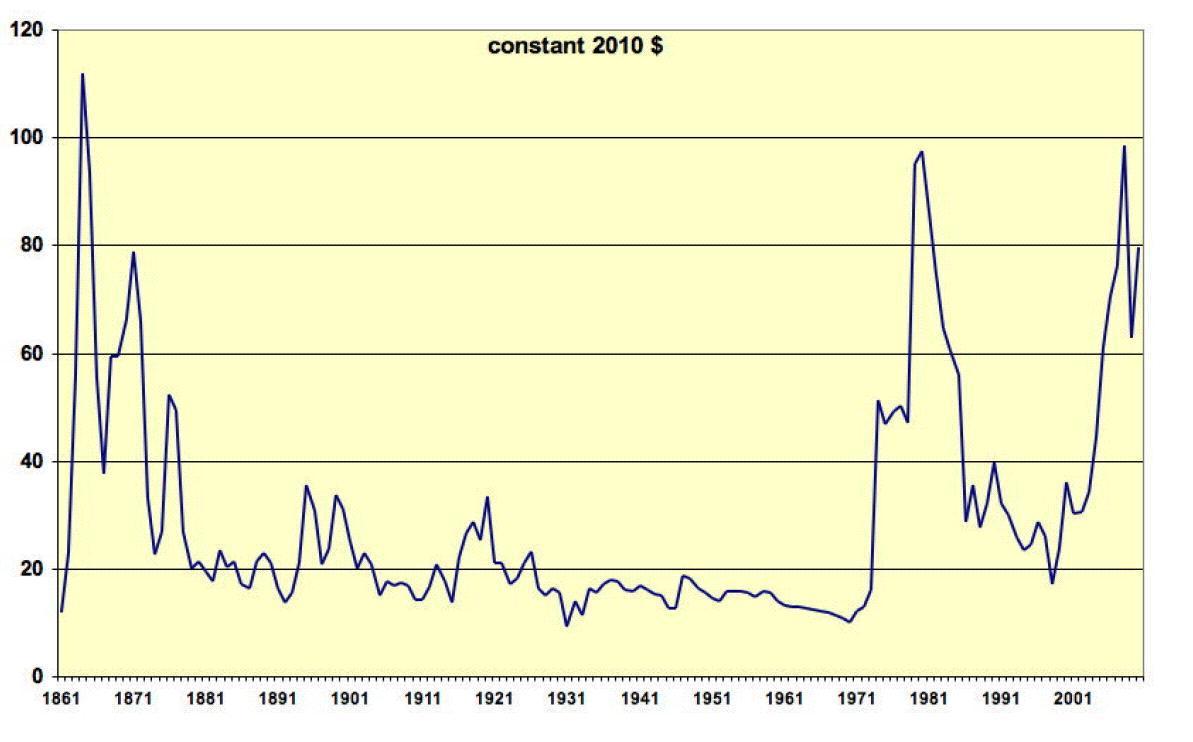
If we follow the curve of oil prices in current dollars and constant dollars (i.e. adjusted for changes due to inflation), we see that the average price of crude oil from 1900 to 1970 remained stable. After 1973, the amplitude of fluctuations increases and the price seems more difficult to control: we have two spikes in 1973-1974 and 1979-1980, a collapse in 1986, a stagnation in 1975-1978, an erosion between 1982 and 1985, volatility from 1987 onwards, but a regular increase after 1999 with the exception of the dizzying but ephemeral peak in 2008.
However, the annual average for the period never fallen below the current $14/15 per barrel ($18/20 in 2010). The fluctuation always remains above a minimum price. For good reason: considering that in 1978, the cost of a barrel of oil extracted in the US was 69 times higher than that extracted in Saudi Arabia ($8.06/barrel vs. $0.13), and knowing that cheap oil would be bound to drive higher-cost oil out of the market, it is understandable that a minimum price is necessary to avert the shutdown in US production. Obviously, the USA does not exclude the use of military force to protect the security of its ‘reasonably priced’ oil supplies. In 1986, the price war broke through the minimum price, forcing the then US vice-president Bush Sr. to rush to Saudi Arabia to set things right.
While OPEC countries with fewer reserves or high financial needs (such as Iran and Iraq after the 1980 war) aim to maximise prices, Saudi Arabia, with its 40% proven reserves, has always played an important stabilising role for the benefit of the United States, in exchange for protection and military aid.
Petroleum is an oil, originating from biological or abiotic processes, trapped in underground deposits (United States, Canada, Russia, Middle East, Venezuela, etc.) or on the seabed (Caspian, Gulf of Mexico, North Sea, Gulf of Guinea, coasts of Brazil). Despite energy-saving measures and the increasing use of natural gas and nuclear power, but above all despite the chronic general crisis of overproduction, the world consumes around three billion tonnes of petroleum products annually.
According to data provided by the International Energy Agency, in 2007 global energy consumption was 8.2 billion toe, up from 4.7 in 1973. The toe, tonne of oil equivalent, is the unit of measurement of calorific power and is equivalent to 1.43 tonnes of high-grade coal. Primary energy production was 12 billion toe, 80.4% of it coming from the combustion of fossil fuels (oil, coal, gas) and the rest from nuclear power.
Most oil is supplied by only eight Companies. That of oil (fuels, plastics, synthetic textiles, etc.) is the world’s largest industry. Among the top ten industrial companies, no fewer than eight are oil companies, and four of these are American. In 2011, at the end of a relentless process of restructuring and concentration, five large multinationals, with activities in all sectors (banking, services, transport, etc.), remained at the top of the oil world: in first place, based in Dallas, we find ExxonMobil Corporation, direct descendant of Rockefeller’s Standard Oil, with its 45 refineries in 25 different countries and 42,000 service stations; in California there is Chevron, which in 2005 merged with Texaco and Unocal; then there is the French Total (formed by the merger of Total, Fina, and Elf), which in 2011 acquired the gas giant GDF Suez with holdings in the North Sea fields; then there are the Anglo-Dutch Shell and BP (the former Anglo-Persian Oil Company), which in 2004 acquired 50% of the Russian oil company TNK, now TNK-BP, holder of concessions in the Arctic.
According to Wikipedia’s Fortune Global 500, these multinationals are among the richest industrial companies in the world in terms of turnover: Shell is in second place behind Wal-Mart, an American leader in mass retail; right after comes Exxon in third place and BP in fourth; in fifth and sixth place are the Chinese Companies Sinopec and China National Petroleum; in tenth place we find Chevron and in eleventh Total. If, however, we look at realised profits, the order changes: 1st Exxon, 2nd Shell, 3rd Chevron, 4th Wal-Mart, 5th China Petroleum Corporation, 6th Total.
In the period 2003-2007, the main oil-importing countries were the USA with 23.5% of the world share, Western Europe with 26.8%, and Japan with 9.6%. Most trade originates from the Middle East with destinations in Europe, North America, and Japan. Africa exports mainly to the USA and Western Europe, whereas Russia mainly to Eastern Europe. North Sea production is destined for Europe. Oil consumption almost sextupled between 1950 to 1973, whereas between 1973 and 2002 it only increased by 1.25 times.
There has also been a radical change in the hierarchies among the different energy sources: if in 1950, oil accounted for 27% of total energy consumption, compared to 62% for coal and 10% for natural gas, by 1970 it already covered 48% of global energy demand, compared to 31% for coal and 18% for gas. World commercialised energy production in 2008 was derived 34% from oil, 24% from natural gas, 29% from coal, 6% from hydropower, 5% from nuclear, 1% from wind and 0.04% from photovoltaics (BP Statistical Review of World Energy, 2009). It is expected that in 2020, oil will remain the leading source of energy (40%), compared to 24% for coal, which is increasingly being replaced by natural gas (24%).
According to a January 2011 study published by Documentation Française and referring to the year 2010, the main oil-producing countries, among the more than 90 that exist, are: Russia (12.9% of world production), Saudi Arabia (12%), the USA (8.5%), Iran (5.3%), and Venezuela, China, Mexico, Norway, Iraq, Nigeria, Brazil, and the UK (3% to 5% each). Supply has been virtually stable for several years and hovers around 85-87 million barrels/day.
In 2009, the main consumers in descending order were: USA (21.7%), China (10.4%), Japan (5.1%), India (3.8%), Russia (3.2%), Saudi Arabia (3.1%), Germany (2.9%), Brazil (2.7%). China’s share could reach 20% of the global total by 2030 (up from 5% in 2002). Within the G20, which accounts for 85% of world trade and 2/3 of the population, these are the shares of energy consumption: China 25%, USA 22%, European Union 16%, Russia 7%, India 7%, Japan 5%, Brazil 3%. In some countries such as France and Japan, gas and nuclear energy have replaced oil, especially for the electricity production. In industrialised countries, 54% of oil is consumed in transport.
In 2010, global oil consumption reached a record 87.4 million barrels/day (52.7% in OECD countries, 47.4% in non-OECD countries). Compared to previous years, the largest increase occurred in the USA, Brazil, Russia, the Middle East, and China.
In 2010, global (non-oil) energy consumption increased by 5.5%, following a 1% decline in the previous year. Emerging countries contributed 2/3 of this increase (China alone accounted for a quarter of the total energy growth).
The extraction of oil through hydraulic fracturing has developed mainly in North America, where it has caused groundwater pollution.
As for energy produced by wind and sun, we may have to wait for communism, which will be heedless of high production costs, for it to develop.
According to data from the IEA, in 2006, 28% of energy was used by industry, 27% by transport, 24% by households, and only 2% by agriculture.
In 2009, the world’s proven reserves, i.e. the quantities extractable at a given moment, exceeding one trillion barrels, are concentrated in limited geographical areas: the Middle East has 60% (Saudi Arabia 19.8%, Iraq 8.6%, the United Arab Emirates 7.3%, Kuwait 7.6%, Iran 10.3%), Venezuela 12.9%, Russia 5.6%, Libya 3.3%, Kazakhstan 3%, Nigeria 2.8%, Canada 2.5%, the US 2.1%, and less than 2% all others.
Knowing the real state of the reserves is a very complicated matter, not only because the information comes essentially from those interested in not revealing their hand, i.e. the Companies and producing countries, who inflate the size of their reserves. The geological conditions of the subsoil, the geographical location, the type of crude oil, the development of techniques, and price trends are all elements that contribute to making a deposit relevant or not in economic-industrial terms. Despite the fact that no large deposits have been discovered since the 1960s, the size of reserves has increased thanks to new extraction techniques that have made previously uneconomic fields attractive.
The forecasts of the Cassandras, who see the ‘end of oil’ just around the corner, must be considered in these dynamics. Thus, according to some American geologists, who have revised downwards the figures provided by OPEC, the remaining reserves of Saudi Arabia, the world’s largest oil exporter, would only amount to 50-60 billion barrels, an amount equivalent to only two years of world consumption!
The real problem is, if anything, that 80% of the 85 million barrels consumed daily come from a small core of countries. The International Energy Agency, which groups together the main consumer countries but is under American influence, is decidedly catastrophist in this regard: in a 2009 report it claimed that Saudi Arabia’s reserves would need to be multiplied by four in order to meet global demand.
Indeed, global demand for energy tends to rise due to the entry of new large consumers such as China and India onto the market. Moreover, oil remains the fundamental raw material for the manufacture of an endless number of products, from synthetic fabrics to plastics. Furthermore, the use of sophisticated soil drilling techniques (even up to 12 kilometres deep) increases production costs enormously, making investment increasingly unprofitable.
OPEC is now a cartel torn between countries chained to the interests of American imperialism, such as Saudi Arabia, Kuwait, and the United Arab Emirates (who, in order to keep prices low, especially in an anti-Russian function, increased production during the Libyan conflict of 2011 and during the Ukrainian crisis of 2014), and the ‘hawks’, such as Iran and Venezuela, rather tied to the Russian and Chinese empires. The fear of a global recession, and thus of a drastic decrease in oil consumption, thickens clouds on the horizon.
The only sensible solution, that is, to stop the race for profit, and thus to reduce both energy production and consumption, implies the destruction of the political power of the world bourgeoisies.
Henry Kissinger said in June 2005: ‘[D]emand, and competition for access to energy can become the life and death for many societies’. Russia and the United States, which possess considerable energy reserves on their own territory, militarily control both production areas and supply routes to the West. The Russians garrison the Caspian area, but with their enormous resource potential they openly target the European market: Gazprom is now a fully fledged multinational, which has entered the court of the Great Powers.
We note that the American shield built in 1955 to contain the expansionism of the USSR in the Gulf region, the Baghdad Pact that united Turkey, Iraq, Iran, and Pakistan in a mutual anti-Soviet defence treaty, is now a distant memory. The Syrian question makes the area even more explosive: a Western international intervention in Syria would have to reckon with opposition from Russia, which has signed an agreement with Assad to build a nuclear submarine base on the Mediterranean, and also from China, Brazil, and India.
The USA, taking advantage of the recurring conflicts that traverse the Middle East, has established an impressive number of military bases, on land and at sea, in the area where over 60% of the world’s crude oil reserves are located. After having provided support to the worst regimes in the region and contributed to the rise of Islamic terrorism, today the United States wants to give the impression that it wants to change its strategy and that it wants to open the Middle East and Maghreb region to democracy, torn apart by profound social and political transformations. In reality, this is yet another volte-face that behind the democratic pretense hides the cynical objective of achieving, through wars, a large supermarket for American strategic and energy needs.
Meanwhile, the increasingly energy-hungry Chinese dragon forges alliances with all the resource-rich countries (Russia, Venezuela, African countries), its oil Companies seek to secure the best terms, through its powerful banks that provide financing to half the world, and through direct and indirect participation in local conflicts. The clash with other imperialisms is in the long run inevitable, since China’s is a capitalism in full expansion and extends its tentacles to the four corners of the world, from Indonesia to the Middle East to Black Africa.
In Niger, for example, which is already one of its oil strongholds, China is aiming to get its hands on the uranium in which the country is rich, but which is also indispensable for French nuclear industry. Perhaps one can understand the French fervour in wanting to free Libya from the ‘dictator’ Gaddafi at all costs, given the strategic importance of the North African country for the control of Central Africa.
Behind the economic monopolies, there are therefore the old and new great powers aiming to divide up the planet among themselves. Lenin wrote in Imperialism:
‘The more capitalism is developed, the more strongly the shortage of raw materials is felt, the more intense the competition and the hunt for sources of raw materials throughout the whole world, the more desperate the struggle for the acquisition of colonies’.
If one replaces the term colonies with semi-colonies – leaving the uninitiated with the illusion that ‘independent’ countries exist – Lenin’s passage also illuminates the situation today.
‘Unable to stop the infernal pace of accumulation, this humanity, a parasite on itself, burns and destroys surplus profits and surplus values in a circle of madness, and makes its conditions of existence increasingly uncomfortable and senseless. The accumulation that made it wise and powerful now renders it torn apart and stupefied, until the relation, the historical function that it has had, is dialectically reversed’ (‘Volcano of Production or Swamp of the Market?’).
From this infernal struggle, from this all-out consumption of energy that destroys the world of the living, from this uncontrollable spiral of despair into which the capitalist system with all its mercenaries has plunged, the proletariat has nothing to hope for except fratricidal massacres, destruction, misery, suffering, and endless inter-imperialist wars.
Capitalism has now completed its tour of the world: the East-West opposition, the colonial question, and the national question are no longer a driving force for revolutions and a reason for workers and the dispossessed masses to mobilise. Only the radical struggle of the international proletariat against the international bourgeoisie is on the agenda. May the class organisations, closely tied to their sole communist party, arise again to confront and finally overthrow the capitalist vampire and all its mercantile dealings.
It is necessary to kill capitalism so that humanity may live.