|
|||
|
The Organic and Central Foundations of Tomorrow’s Revolution – From the Inevitable Organic Crisis of Capitalism to the Disintegration of Complicit and Renegade Opportunism Reports relating to the General Meeting held in Milan on 20 and 30 March 1964 – Continued: 2nd Session Marxist Economics (Il Programma Comunista, No.16, 1964) |
At previous meetings, and in particular those held in Milan in June 1962 and in Genoa in November 1962, the written reports of which appeared in issue no. 20 of 2 November 1962, issue no. 8 of 15 April 1963, no. 9 of 30 April 1963, and no. 10 of 14 May 1963, respectively, as part of the first summary report of the Milan meeting of 4–5 May 1963, the theory of crises and waste was addressed. The topics, however, as is our method, have not yet had a definitive, nor even satisfactory, formulation; they are, that is, works in progress, to which the party periodically devotes its efforts by incorporating the work of new comrades and adding the corresponding results.
In Milan in 1962, the well-known ‘Marx’s Table for the Simple Reproduction of Fixed and Circulating Capital’ was presented and explained; published in issue no. 20 of Il Programma Comunista on 2-11-63. The aim was to characterise the phenomenon of the annual rate of surplus value which, in relation to the numerical example contained in the table itself, is 1000% compared to the absolute rate, which is 100%. The issue is resolved by taking into account the capital advances required for the first turnover, in the first department, namely the production of means of production. Once this advance of circulating capital, consisting of circulating constant capital and variable capital, has been made, the absolute rate of surplus value is calculated, assuming the surplus value produced in the turnover is quantitatively equal to the variable capital advanced, and this yields a rate of 100%.
This phenomenon does not, however, occur in the second department, namely that of consumer goods production, at least as regards foodstuffs. Here, the turnover of advanced capital is reduced to a single cycle, since agricultural production is closely linked to seasonal cycles and natural factors. The rate of surplus value is always 100%. Furthermore, as a result of these cycles, fixed capital is depreciated at less frequent intervals in the second department than in the first, with significant implications for money-capital in terms of liquidity availability, particularly at the firm level.
The disparity in turnovers between the two departments explains the varying and disproportionate amount of capital employed, and the resulting trends in production. It would seem logical that the second department, that of consumer goods production, would be the object of more massive investment, as required by the low frequency of capital turnover, in contrast to industry.
Instead, an opposite process occurs: a disproportionately larger amount of capital is directed towards the first department than the second. The reason lies in the driving force that moves and directs capital, profit, surplus value. Capital is invested where the return is greater.
This ‘Marx’s Table’ served and serves as the basis for the two major issues of ‘waste’ and ‘crises’, which we aim to explore in detail. In Genoa, therefore, in November ‘62, we addressed the question of the destruction of labour in the two moments: that of production and that of the circulation of capital. We took our cue from the fiery Section 4 of the 17th Chapter of Part V of Volume I of Capital, on which the framework of ‘Variations in the distribution of net social product between labour and capital’ was constructed and explained to our comrades; this is published in its definitive edition in this issue of the newspaper, following some modifications to the presentation of mathematical symbols.
We refer to Marx’s Table on ‘Variations’ as the ‘second’ table, the ‘first’ being the one on the turnover of capital. In the table, the three cases considered by Marx are presented in three forms: one algebraic, one fractional arithmetic and one in terms of number of daily hours, arranged in the box and separated by a bold continuous horizontal line, and marked at the far right by the capital letters A, B, C.
In the table, constant capital is not taken into account, because it does not generate value. At the top of the vertical columns are the symbols for the categories; which, given the familiarity now had with them, we refrain from explaining, with the exception, if any, of l, which is the product of a full day’s labour, that is, of t, the number of working hours in a day, multiplied by u (the product of one hour’s labour). The last two columns on the right, entitled ‘General Relations’, consist, in the first case, of the basic relation of the rate of surplus value following the variations resulting from changes in the duration, intensity, and productivity of labour; a relation in which s’ is necessarily greater than s, just as the ratio p’/v’ is greater than p/v. The second relation consists of three equations: the first v + p = l, that is, the product of a day’s labour is given by the wages paid during the day (necessary labour) plus the surplus value (surplus labour or unpaid labour); the second v = l – p, that is, the wages paid are given by the difference between the day’s product and the surplus value; the third z = u’/u, that is, z, the productivity of labour in one hour, is equal to the product of one hour, increased as a result of the variations in the duration and intensity of labour, divided by the product of one hour prior to the aforementioned variations.
Marx’s three cases are arranged in a different order, and specifically Marx’s third comes first in the table; the second remains as it is, and the first comes third. This different arrangement is suggested by the fact that the third and second cases in Marx may also concern the individual firm, and thus be the object of analysis of the first moment; but when the measures are generalised, that is, when one is compelled to consider the variation in labour productivity, then, in Marx’s first case, our third, we move fully into the second moment, from which it is easy to glimpse the third moment, the communist moment of the historical dissolution of the destruction of labour.
| Variable Capital or Wages | Surplus Value | Daily Working Hours | Product of an Hour’s Labour | Product of a Day’s Labour | Rate of Surplus Value | GENERAL RELATIONS | ||
|---|---|---|---|---|---|---|---|---|
| v | p | t | u | l=tu | s=p/v | s’=p’/v’ | v+p=l; v=l-p; z=u’/u | |
| I (III in Marx) | ||||||||
| v v |
p p’=l’-v= =p+(t’-t)u= =p+(l’-l) |
t t’ |
u u |
l l’ = t’u |
s | s’=p’/v= = (p+l’-l)/v |
The length of the working day varies | A |
| 2/3 | 1/3 | 10 | 1/10 | 1 | 1/2 | B | ||
| 2/3 | 8/15 | 12 | 1/10 | 1.2 | 4/5 | |||
| 16 | 8 | 8 | 3 | 24 | 1/2 | C | ||
| 16 | 20 | 12 | 3 | 36 | 5/4 | |||
| II | ||||||||
| v v |
p p’=l’-v= =p+t(u’-u)= =p+(l’-l) |
t t |
u u’ |
l l’=tu’ |
s | s’=p’/v= =(p+l’-l)/v |
The intensity of labour at the company varies | A |
| 2/3 | 1/3 | 12 | 1/12 | 1 | 1/2 | B | ||
| 2/3 | 8/15 | 12 | 1/10 | 1.2 | 4/5 | |||
| 16 | 8 | 8 | 3 | 24 | 1/2 | C | ||
| 16 | 16 | 8 | 4 | 32 | 1 | |||
| III (I in Marx) | ||||||||
| v v’=v/z |
p p’=l-v’= =p+v-v’= =p+v((z-1)/z |
t t |
u [u’] |
l l |
s | s’=p’/v= =[p+v(z-1)/z](z/v)= =zs+(z-1) |
z=[u’]/u Social labour productivity varies |
A |
| 2/3 | 1/3 | 12 | 1/12 | 1 | 1/2 | z = 6/5 | B | |
| 5/9 | 4/9 | 12 | [1/10] | 1 | 4/5 | |||
| 16 | 8 | 8 | 3 | 24 | 1/2 | z = 4/3 | C | |
| 12 | 12 | 8 | [4] | 24 | 1 | |||
| The constant capital c is always taken to be zero. The superscript, i.e. the ’, indicates the same quantities after the change has taken place. [u’]; [4] ≡ quantity of product changed in physical terms, unchanged in monetary terms. A – Algebraic deductions as in Table 1, pages 15, 16, 17, with the exception of a few immediate steps; B – Numerical example, setting the product l for the day prior to the change equal to 1 (see Il Programma Comunista, no. 9, 1963 – concluding section of the Genoa meeting of 3-4 November 1962). C – Numerical example, setting the product (l) of the day preceding the change equal to 24 currency units (see Il Programma Comunista, no. 10, 1963 – presentation of an initial report on the Milan meeting of 4–5 May 1963), subject to purely formal variations. |
||||||||
Let us examine the overall table. First case: variation in the working day. The daily working hours increase from t to t’, that is, the working day increases from 10 hours to 12 hours, whilst variable capital, or wages, and the product of one hour’s labour remain unchanged. Consequently, the product of a working day increases because the number of hours worked increases, and correspondingly, for the same reason, the rate of surplus value, or the exploitation of wage labour, increases, with an implicit increase in the mass of surplus value. Surplus value, p, changes to p’, which is equal to l’ minus v, that is to say, the product of the 12-hour working day minus the wage paid; or it is equal to the initial surplus value increased by the difference between the duration of the working day extended to 12 hours and the original 10-hour day, that is to say, the difference of 2 hours multiplied by the product of one hour’s labour; in other words, the modified surplus value is equal to the initial surplus value plus the difference between the product of the 12-hour working day and that of the 10-hour working day. Thus the product of the working day, l, varies to l’, that is, is equal to the number of daily hours increased from 10 to 12 multiplied by the product of one hour’s labour. Then the index of exploitation of the labour power rises from s to s’, where the greater quantity of unpaid labour extracted is given by the difference s’ – s, that is, between the mass of surplus value extracted during the 12-hour day and that of the 10-hour day. The algebraic development of s’ in the general relations highlights precisely the origin of the increased rate of surplus value, due precisely to the increased product of the 12-hour working day, which is added to the initial surplus value.
Under B). It is assumed that variable capital is equal to 2/3, surplus value to 1/3, the working day to 10 hours, the product of one hour to 1/10, the product of the working day equal to 1, and the rate of surplus value, i.e. 1/3 divided by 2/3, equal to 1/2. The variations resulting from the extension of the working day from 10 to 12 hours affect, as in the algebraic example, the surplus value produced, which passes from 1/3 to 8/15; with the variation in the working day, the product of the day itself varies from 1 to 1.2, that is, by 1/10. The rate of exploitation will increase from 1/2 to 4/5; indeed, p’/v is equal to 8/15 divided by 2/3, that is, 4/5, which is much greater than 1/2 when the working day was 10 hours.
Under C). Now suppose that in an eight-hour day, assuming that the product of one hour is 3, a quantity of product expressed as 24 is obtained; let us further imagine that the capitalist, whilst paying the same wages, manages to obtain 12 daily hours and thus a product of 36. Variable capital remains the same, equal to 16, the hourly product remains 3, the daily hours vary from 8 to 12 and the daily product is 36, that is, 12 hours multiplied by 3 for the hourly product; the surplus value extracted varies from 8, that is, 24 of total product minus 16 in wages, to 20, that is, 36 of product minus 16 in wages. The rate of surplus value passes from 1/2, i.e. 8 divided by 16, to 5/4, i.e. 20/16. In this form, the rate is higher than in form B), as we have assumed that the hours vary from 8 to 12 rather than from 10 to 12 in the working day. In this case, we are in the midst of the phase of the first moment, that is, in the midst of the enterprise phase: the greater volume of surplus value is extracted by the capitalist through the simple and brutal extension of the working day, as occurred in the transition to the manufacturing period of capitalism, for example in 18th-century England, and in the Russia of the five-year plans, where, with good reason, Stalin proclaimed that man is the most precious capital.
The intensity of labour in the enterprise varies. There are variations in u and l, that is, in the product of one hour’s labour and in the total daily product; consequently, variations in the mass of profit and in the rate. Variable capital, wages, and the hours of the working day, however, remain unchanged. An increased surplus value is obtained as a result, not, as in the first case, through the extension of the working day, but by intensifying the workers’ labour effort within the same period of time. A recent example can be found in the textile production sector, where workers are made to tend to ten looms instead of eight.
Unlike form A) in the first case, p varies into p’ with the addition of the extra product of each hour of labour across all the hours of the day. Thus, the total product of the working day, i.e. l’, is given by the usual number of working hours multiplied by the increased output of one hour of labour. In the case of textiles, ten looms instead of eight, set in operation by a single worker, will produce a greater product in the same hour than before, and the daily product will increase by as many units as there are working hours multiplied by the additional product of one hour. In form B), the output per hour rises from 1/12 to 1/10, the hours of labour remain 12, the variable capital (wages) remains 2/3, and the surplus value varies from 1/3 to 8/15, the daily output from 1 to 1.2, and finally the rate from 1/2 to 4/5. The reason for the increase in the daily product from 1 to 1.2 is clearly shown in the table. In the first case, the same result was achieved by increasing the daily hours whilst keeping the product per hour unchanged, i.e. 12 hours multiplied by 1/10 of the hourly product; in this case, the hours remain unchanged at 12, but the product per hour varies, so that the total product of 1.2 is given by 12 hours multiplied by 1/10 of the hourly product. The rate of surplus value varies to 4/5, this being the ratio between surplus value, increased to 8/15, and 2/3 of variable capital.
In form C), the number of hours in the working day remains unchanged, i.e. 8, wages paid, i.e. 16, remain the same; however, the hourly product changes from 3 to 4, consequently the total daily product changes from 24 (i.e. 8 × 3) to 32 (i.e. 8 × 4); the surplus value, or net product, changes from 8 (24 minus 16) to 16 (32 minus 16). The rate of surplus value rises from 1/2, i.e. 8 divided by 16, to 1, i.e. 16 divided by 16. Here too, the projected increase in hourly product is greater in C) than in B) (4/3 instead of 12/10). The intensity of labour increases the total product through the increased intensity of labour, which presupposes a higher organisational level of the productive forces, due to the wise consideration of the capitalist bourgeoisie not to squander the worker’s strength by pushing them beyond biological limits, and to the harsh and often bloody social struggles of the proletariat.
This is achieved through the leap from the power of labour to its social productivity, inherent in intensity. The distinction is in Marx, and the first, the power of labour, concerns the value produced; the second, the productivity of labour, concerns the physical quantity of the product. And so we move on to the third case, the first in Marx, because productivity varies; that is, the productive capacity of labour on a social scale increases, as more perfected tools and machines have made it possible to obtain the same quantity of product with fewer workers and fewer working hours. For this reason, a new symbol is introduced into the table, namely z, which indicates the general increase in productivity.
In the algebraic form A), wages v vary into v’, according to the ratio v/z, in the sense that the quantity of products available to the worker increases, but the nominal value of wages does not. Indeed, the greater productivity of labour leads to an increase in the quantity of products, not the total value, which is thus distributed across a larger range of commodities. The same applies to u, the product of one hour’s labour, which varies not in value but in quantity of products. The hours of labour and the product of the working day remain unchanged.
Surplus value, on the contrary, increases from p to p’, that is, by the difference between the previous higher wage, v, and the new wage, v’, which is lower by the ratio of v/z (that is, wages prior to the change divided by the general increase in productivity).
The rate of surplus value also increases, as we shall see from the numerical and quantitative examples, in the ratio p’/v’, since p’ is greater than p and v’ is less than v.
In form B), wages v fall from 2/3 according to the ratio of the general increase in productivity from 1/12 to 1/10. Surplus value rises from 1/3 to 4/9, again as a result of the fall in wages. The number of hours worked remains the same as before at 12, and likewise the total daily product remains 1.
The rate of surplus value varies from 1/2 to 4/5. It should be noted that the rate of surplus value in this third case does not change relative to the second, because, since we are expressing it in terms of value, this does not vary. Indeed, as we have already said, all other things being equal, i.e. given the same working hours, the value produced does not increase, but the quantity of commodities over which the same amount of value is distributed does.
Consequently, the prices of commodities must fall in the ratio 1/z, including labour power, itself a precious commodity. In form C), wages fall from 16 monetary units to 12, in the ratio of 16 divided by 4/3, which indicates the social index of productivity; surplus value rises from 8 units to 12, that is, the total daily product of 24 units minus the wages paid, 12, the hours remain 8, the daily product remains 24, and the hourly product varies from 3 units to 4. Surplus value rises from 1/2 to 1 unit; in fact, in our example, p/v is equal to 12/12, that is, 1.
There occurs, therefore, for surplus value the same leap that occurred in the second case, when a single firm had managed to get its workers to produce 4 physical units in an hour instead of 3, without raising wages (for Marx, an increase in the intensity of labour). When this has occurred across the whole of society, as a collection of capitalist firms, the measure of value, which in present-day society is money, changes in proportion to the average social product of an hour’s labour, that is, it rises from 3 to 4. Consequently, the workers’ standard of living (purchasing power for subsistence) remains the same in real terms, even though it is expressed in money as a figure reduced to 3/4.
Marx’s analysis shows that all technical improvements applied to a firm and extended to the whole corporate society are used by capital and worsen the workers’ lot when the total product is distributed among the classes. This is the meaning of the doctrine of growing misery and of the conclusion that, as long as the wage system (time-based monetary compensation) is in place, the sacrifice of the workers persists in the distribution of the total product (a critique of Russia and of all false capitalist economies).
From this brief examination of the table, we can see that, despite the increase in production due to the diabolical intensification of the torment of labour, whether by prolonging the duration of the working day (Case I) or by increasing the power or productivity of labour (Cases II and III), the tragic condition of the subjugation of labour to capital remains not in the slightest undermined. On the contrary, if the productivity of labour increases while the duration of the working day decreases (this is the historical course demonstrated and described by Marx himself), the index of labour exploitation does not decrease at all, but rather increases disproportionately, to a far greater extent than the table itself might suggest.
The share belonging to labour is always relatively smaller than that belonging to surplus labour. It follows that wage-earners have no interest whatsoever in increased production, a myth which, on the contrary, underpins the opportunist betrayal of the workers’ parties. It also follows that whilst under the capitalist regime increased labour production is a tool for the oppression of workers, under the socialist regime it will first and foremost be the primary reason for the radical reduction in the duration of the working day for the production of ‘material’ goods, with ‘the avoidance of all useless labour’ and the elimination of ‘the most outrageous squandering of labour-power and of the social means of production, not to mention the creation of a vast number of employments, at present indispensable, but in themselves superfluous’.
Therefore it means that labour must be distributed among all those capable of working, and that no social stratum should be able to shirk ‘the natural burden of labour’ by shifting it onto others. Humanity thus regains a great deal of time for ‘the free development, intellectual and social, of the individual’.
This matter was briefly discussed at the previous meetings mentioned above. In particular, it was pointed out that if the entire turnover time were reduced to the labour period, productive capital would ‘turn over’ as many times as there are labour periods, and here waste in circulation would be eliminated. Marx sets the time of circulation precisely equal to zero in order to demonstrate that, since the transformation of productive capital into commercial and ultimately money-capital is a necessity under the capitalist mode of production, under the capitalist system, waste in circulation is inseparable from production itself; and to avoid it, there is no other solution than to prevent products from becoming commodities, which amounts to the abolition of the capitalist form of production. But Chapter XV of Capital dwells in detail on the turnover of capital, with particular regard to the influence exerted on turnover by the differing relationship between working time and circulation time.
Recall Marx’s first schema on the simple reproduction of fixed and circulating capital, in which, abstracting from circulation time, the annual rate of surplus value was shown to be equal to the number of turnovers of the advanced circulating capital, and thus a rate considerably higher than the absolute rate.
This phenomenon was explained precisely by the characteristic of industrial circulating capital to be reinvested with regular frequency. Now this periodic reinvestment of capital, of the same mass of capital, is no longer considered in isolation from the other phase of turnover, namely circulation, in reality inseparable from the labour phase. Therefore it is possible, drawing on Marx’s own examples, to establish a quantitative index of the waste in the circulation of capital.
Marx gives three typical and general cases: first, working time greater than circulation time; second, working time equal to circulation time; third, circulation time greater than working time. Setting the turnover time at 8 weeks, in the first case we have a division into 5 weeks of working time and 3 weeks of circulation time: in this case, according to the general formula Tc/T = waste index, we have that i = 3/8 = 33% of time wasted. In the second case, we find that i = 4/8 = 1/2 = 50%. In the third case, we find that i = 5/8 = 66%. As circulation time increases relative to working time, the waste index also increases.
Let us now examine the actual turnover, the mechanism of turnover of circulating capital, that is, of variable capital and circulating constant capital, of constant capital, that is, excluding depreciation shares on fixed capital, machinery, plants, and equipment.
In tracing the interplay between the working time and circulation time of a capital, or of total social capital, which is the same thing, an anomaly is observed in the turnover of capital, which Marx terms ‘freed capital’. We faithfully reproduce Marx’s own examples, aided by the diagrams printed here which illustrate the numerical examples and, more effectively, the alternation of the two phases of turnover. In the first case – working time equal to circulation time – there is no interruption in the turnover of capital, insofar as the two forms of capital alternate regularly: when the first capital is in the labour phase, the second capital is in the circulation phase, and both alternately cover their respective periods of turnover. The division into first, second, and third capital, K₁, K₂ and K₃, is made for explanatory purposes, as capital is always one, even if divided into ideal portions.
The necessity of dividing social capital in this way stems from the law ‘which determines the quantity of the constantly functioning productive capital by the ratio of the time of circulation to the time of turnover’. In this case, the ratio is 1:2; that is to say, in order to have a mass of capital of 450 constantly in production, a total mass of capital of 900 is required. This is derived from a circulation time of 4½ weeks and a working time of 4½ weeks. If the capital required for production is 100 per week, a production capital of 100 × 4.5 = 450 will be required. The need for a further ‘additional’ capital of 450 stems from the obligation to continue production even during the period when the productive capital, having been transformed into commodities, leaves the labour phase to enter the market and circulate until it realises its monetary value. In this phase, production would have to stop and the firm would have to close, awaiting the return of the monetary value of 450 with which to resume production. To avoid production coming to a standstill for exactly 4.5 weeks, the second capital comes into operation. Here no special turnover problems arise, as is easy to see: the first capital of 450 enters a 4.5-week working period, which at the end of the 4.5 weeks enters the circulation period; K₂ then takes over in its working period, covering the circulation period of K₁, for the next 4.5 weeks. At the end of the 9th week, K₁ of 450 returns from the circulation period and re-enters the working period, whilst K₂ exits the working period and enters the circulation period, and so on, ad infinitum. No problems arise: everything runs smoothly.
SECOND CASE: the working period greater than the circulation period.
The case under examination assumes that to produce a given commodity, for example a dam, takes longer than it does to recover its monetary value, that is, to collect its price. This case, when the capitalist mode of production is highly developed, rarely occurs in reality. In the diagram the following elements are given: at the top, the series of weeks from 1 to 51, assuming for the sake of demonstration that a year is equal to 51 weeks; on the second horizontal axis from the left, the notation K₁ = 600, the mass of the first portion of capital, then a series of brackets, distinguished by the symbols Tp (working time) and Tc (circulation time); at the bottom, another series of notches marked RI, RII, etc., indicating the sequential number of turnovers. On the second level, we see the notation K₂ = 300, flanked by the upper and lower series of brackets with the same meaning as the previous ones.
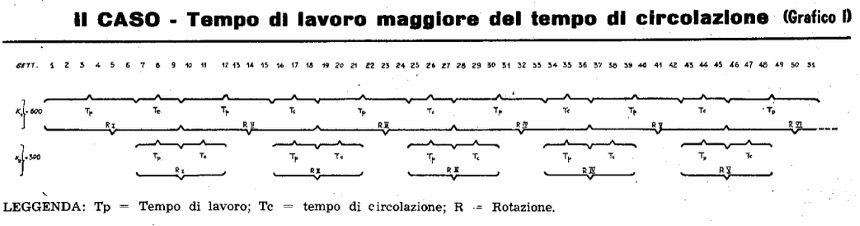
This is the diagram showing the turnover of circulating capital in the second case. Here is how it is read: first of all, the capital available for the entire turnover is 900, divided into 600 for the first and 300 for the second, corresponding to 6 weeks of production and 3 weeks of circulation. With the 1st, K₁ enters the working phase and completes its 6-week working period, and at the end of the 6th week enters the circulation phase (Tc), thus completing the first full 9-week turnover (R₁). However, to ensure that production is not interrupted during K₁’s 3-week circulation period, weeks 7 to 10, K₂’s 300 comes into operation; which, being half of K₁, completes only 3 weeks of the working period. At the end of K₂’s 3-week working period, at the end of the 9th week, the K₁’s 600 returns from the circulation period to complete another 6-week working period from weeks 10 to 16. Meanwhile, K₂ has already completed its 3-week working period, and as K₁’s 600 has returned in full from its circulation period, it remains unused until the 16th week. In the diagram, this period of inactivity is highlighted by the empty space between the 13th and 16th weeks of K₂. This period of inactivity is repeated in the 22nd, 31st and 40th weeks. For three weeks, 300 units of capital thus remain ‘freed’ by the simple mechanism of capital turnover; that is to say, 1/3 of the entire capital remains idle for 15 weeks in a 51-week year.
THIRD CASE: Marx distinguishes here between two possibilities: one in which the circulation time is a simple multiple of the working time, and in this specific case there is no release of capital. Example: 3 weeks of labour and 6 weeks of circulation. The sequence of the first case – working time equal to circulation time – is repeated, with the sole difference that the portions of capital, instead of being two, are three of 300 each, alternating in equal intervals and giving rise to no release of capital. In a second scenario, where the circulation time is longer but not a simple multiple of the working time, the phenomenon of ‘freed’ capital reappears. The second diagram reproduces it using the same mechanism as the first, with the difference that the total capital of 900 is divided into three portions: one of 400, the second of 400, and the third of 100.
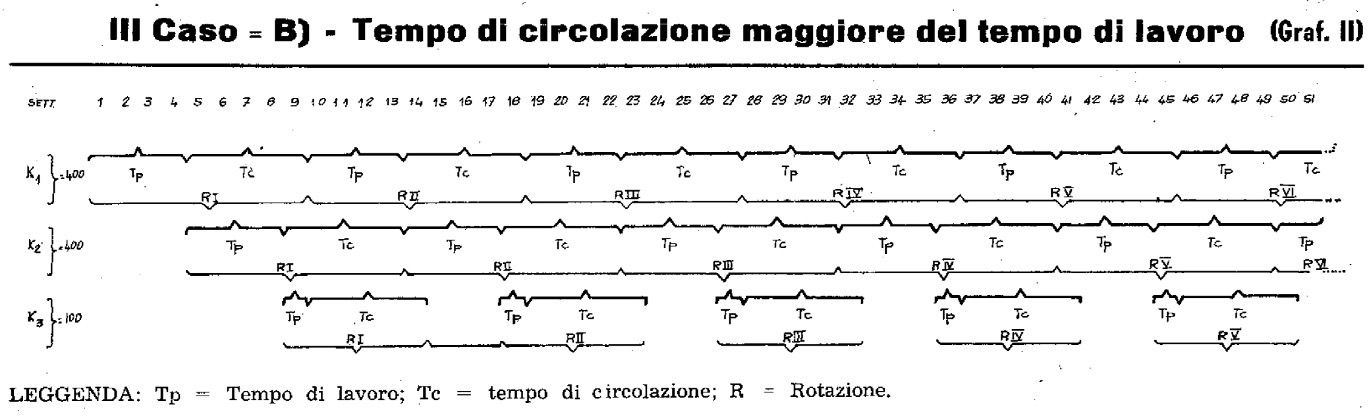
The working period is 4 weeks and the circulation period is 5; as can be seen, this is not a simple multiple of 4. K₁’s 400 comes into operation in the 1st week and covers the 4-week working period, entering the circulation phase at the start of the 5th week. To cover the 4-week circulation period of K₁, K₂’s 400 enters the working period, covering the following 4 weeks. To complete the entire turnover, which consists of 9 weeks, one week is missing, which is covered by K₃’s 100, covering the 9th week, at the end of which K₁ returns from circulation. This covers the period from the 10th week to the 14th week in the working phase; at the end of the 13th, K₂ returns from circulation. At the same time, and precisely from the 10th to the 14th week, K₁’s 400 and K₃’s 100 are in the working period. But since the working period is 4 weeks, the 100 portion of capital is superfluous and is temporarily expelled from production until the beginning of the 18th week, when it is called upon to supplement the 9th week of turnover. Ideally, K₃’s 100 would complete one week of production and five of circulation, and should therefore return from the circulation period at the end of the 14th week. The gap in the graph from the 14th to the 18th week marks the 3-week period during which the 100-unit portion of total capital remains idle. In this third case, the ‘freed’ capital amounts to 1/9 of the total capital, and remains unproductive for 13 weeks out of 51.
Capital is ‘freed’, that is, not only in the 15th week, but also in the 24th, 33rd, and 42nd.
It follows from the above that in all cases where the working time is greater than the circulation time (Tp Tc), and in those where the circulation time exceeds working time but is not a simple multiple of it, there is a ‘release’ of a portion of advanced capital exactly equal, in the first case, to the additional capital employed, that is, 300 (K₂), and in the second case to the third portion of advanced capital, that is, 100 (K₃).
The expulsion of a portion of advanced capital during turnover occurs independently of other circumstances, but by the simple mechanism of capital turnover itself: it is a mechanical ‘release’ that is entirely independent of the will of the individual capitalist or the capitalist class as a whole. Similarly, the employment of a certain mass of additional capital is inevitable, operating intermittently throughout the annual turnovers, during which it becomes superfluous. To eliminate the idleness of a part of the advanced social capital, one would have to eliminate the circulation of capital and reduce turnover to the period of production alone; which renders the very capitalist form of production impossible. It follows that, by eliminating the dual metamorphosis C-M-C, of commodities into money and of money into commodities, which implies the other basic transformation of products into commodities, one achieves the complete transition from a mode of production in which capital dominates to one in which production does without commodities and money, capitalist forms of products. Socialist society, therefore, will not only know neither commodities, nor money, nor capital, but not even circulation properly so called: there will be no market on which to carry out exchanges, not even of products.
Stalin attempted to theorise, as ‘Marxist’, the compatibility of the commodity-form of products and the capitalist category of exchange and the market with socialism. As we have seen, the situation is entirely different in Marx.
In it are read the revolutionary programme and the laws governing the socialist economy. Under socialism, circulation will not exist because in communist society ‘there will be no money-capital at all in the first place, not the disguises cloaking the transactions arising on account of it’ (p. 332). There will be no exchange of equivalents, because there will be no value. Products will move from one part of the globe to another, according to essentially physical criteria. Production sites will not have monetary accounting, and the accounting of physical quantities (input and output of materials and products) will be kept only with the social centre, where alone it will be decided which and how many products and materials there will be. There will be no ‘customers’, no ‘debtors’, and no ‘creditors’. Products from A to B will not have compensation in an inverse economic flow from B to A, but A will receive raw materials from B, which will in turn receive products from the social centre. That is, the production-consumption balance, centralised, will operate at the social scale rather than at the corporate, sectoral, regional, or national level.
The form taken by ‘liberated capital’ is monetary, at least in the part constituting variable capital (wages), which cannot be stockpiled like raw materials. This undoubtedly monetary part of ‘freed’ capital periodically generates a plethora of money which, in the capitalist mode of production, given the generalisation of the phenomenon, cannot remain unused and therefore ‘must play an important role as soon as the credit system develops and must at the same time form one of the latter’s foundations’. ‘Freed’ capital, then, will either be reinvested proportionally in the same firm, or lent to other firms for the period of its availability (the function of banks); in any case, it will serve to expand production.
At this point in Marx’s exposition (pp. 298–300, ibid.), Engels intervenes, arguing that the question of ‘freed’ capital did not warrant such an in-depth and detailed study. It is not within the scope of our current presentation of the turnover of capital to address the objection raised, especially in consideration of the fact that Marx’s printed and published literary output has been subject to such vicissitudes, through concealments, arbitrary manipulations, subjective judgements, etc., such that one must assume the key to re-establishing the importance of this part of the economic treatise, as well as of others, is yet to be found in his voluminous unpublished writings and notes.
Indeed, thanks to our French comrades, a text has been discovered bearing the title ‘Chapter Six of Capital’, which, although it does not appear in Capital by the explicit decision of Marx himself, is nevertheless so enlightening for revolutionary Marxists, and so disheartening for the opportunists, that it deserves not only to be studied but, following careful editing of the text, which is not easy to translate, it must also be disseminated to the greater glory of our doctrine and our party, and to the greater shame of our enemies. The discovery by our comrades took place so close to the meeting that it was not possible to report on it in a complete and methodical manner. The definitive presentation will follow in the forthcoming general meetings and will form part of the written report in this journal.
Marx did not intend to publish Chapter VI, fearing that it would be difficult to understand, particularly for proletarian readers, having given the analysis of surplus value a mathematical form. In reality, the explanation that Marx provides in the opening pages of the chapter, ‘Capitalist Production as the Production of Surplus Value’, is rigorous and flawless, and it is easy to arrive at the subsequent social and political conclusions which he draws in such an admirable manner.
‘Originally capital stepped forth as money, which needed to be converted into capital, or was only capital dunamei [potentially]’ Marx begins by pointing out the error committed by economists in treating money as capital, whilst attributing to money the characteristic typical of capital: the ability to increase in value. Now, if this mass of money is to increase, this means that the initial value must possess the property of yielding an increase, a differential, a surplus value, ‘with the result that the given value – the given sum of money – represents a fluens and the increment a fluxion’.
Setting the initial capital equal to x, this becomes capital by the fact that it transforms into x plus a differential of x, ‘i.e. into a sum of money or a quantity of value = the original quantity of value + an excess amount over and above the original quantity of value, into the given magnitude of money + additional money, into the given value + surplus value’. The production of surplus value is therefore the aim, the end, ‘the driving concern, and the final result’ of the capitalist production process. It is easy to deduce that this differential, surplus value, can only originate from a ‘variable’ magnitude. This ‘variable’ cannot be provided by the constant capital which is re-incorporated – entirely into the circulating part and pro rata into the fixed part – into the produced capital. By process of elimination, it is wage labour, variable capital. It is labour that produces the differential of x, the surplus value, the aim of the capitalist economy. It follows that ‘the doctrine that the net product is the final and highest goal of production is only a brutal, but correct expression of the fact that the valorisation of capital, and therefore the creation of surplus value, without any concern for the worker, is the driving force and the essence of capitalist production’. Therefore, ‘[t]he highest ideal of capitalist production – corresponding to the relative growth of the net product – is the greatest possible reduction in the number of people living on wages, and the greatest possible increase in the number of people living off the net product’.
These passages put an end once and for all, if ever it had been necessary, to the foolish opportunist demands for increased production and a fairer distribution of the net social product, to the reactionary policy of protecting the interests of the petty and middle bourgeoisie pursued by parties that call themselves workers’ parties, and to the alliance of the proletariat with the political parties expressing those classes. The ‘highest ideal’ of capitalism is the ‘greatest possible increase in the number of people living’ off unpaid labour, off surplus value, on the backs of the working class, and the parties that defend this ‘claim’ of the petty bourgeoisie can only be counter-revolutionary, enemies of the proletariat and of the communist revolution.
More than a century on, the Master’s invective against the mouthpieces of these middle classes, parasitic strata of net-product leeches, resounds as a terrible condemnation of the parties that have made the defence of these middle classes the purpose of their lives, the aim of their political activity, and likewise confirms the correctness of the Communist Left’s struggle against bourgeois society, against treacherous opportunism, against the renegades.